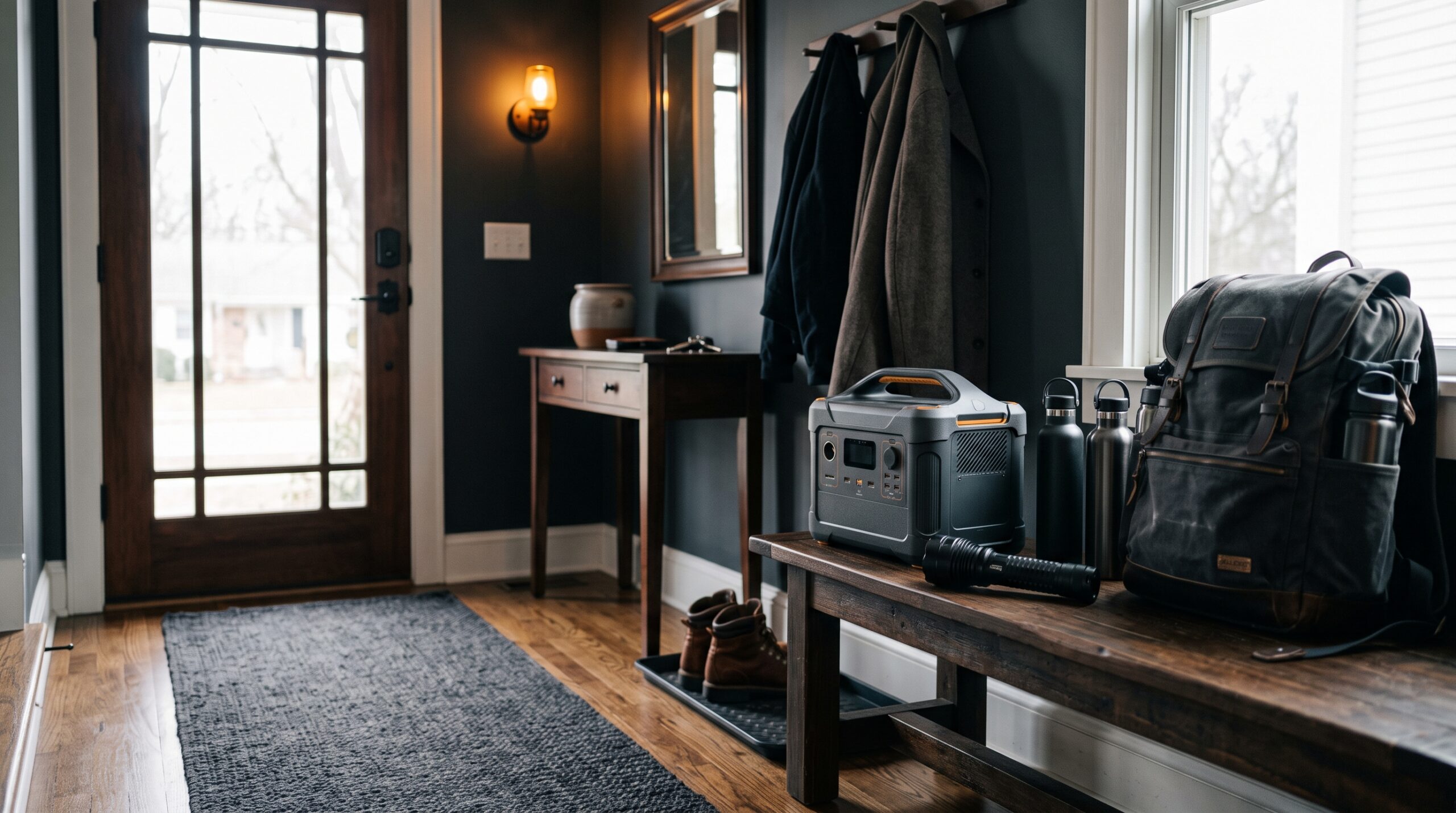
The best time to prepare your home for a power outage is before one happens. Build a kit, decide how you will keep a few essentials running, and make sure everyone in the house knows the plan. Ready.gov recommends keeping at least a three-day supply of water, food, and other essentials on hand, and building toward two weeks if you can.
This guide walks through whole-home readiness one system at a time: your kit, backup power, food, water and well pump, the sump pump, surge protection, heating and cooling, lighting, communication, and a family plan. Work through them now so you can stay safe and protect what matters until the lights come back.
⚠️ Run generators outdoors only
Portable generators give off carbon monoxide, an odorless gas that can be deadly in minutes. Run them outdoors only, at least 20 feet from windows, doors, and vents, with the exhaust pointed away from the house. Never run one in a home, garage, basement, or on a porch. Keep a battery-powered CO alarm, and never use a grill, camp stove, or fuel-burning heater indoors to cook or heat.
Build a kit
Everything else is easier when the basics are already in a bin you can find in the dark. Start with the supplies below, then see the full emergency kit list if you want to go deeper.
- Water: at least one gallon per person, per day, for three days or more.
- Non-perishable food that needs no cooking, plus a manual can opener.
- Flashlights and lanterns for every person, with spare batteries. Skip candles to avoid fire risk.
- A battery-powered or hand-crank radio, ideally one that picks up NOAA weather alerts.
- A first-aid kit, a several-day supply of any daily medications, and copies of key documents.
- Battery-powered CO alarms on every level of the home, in case you ever run a generator or alternate heat source.
- Charged power banks, plus a little cash for when card readers are down.
Size backup power for essentials
You rarely need to power the whole house. The practical goal is to keep a short list of essentials running: the fridge, a few lights, your phones and internet, and any medical or safety equipment. A battery power station is the simplest indoor-safe option for that list; a generator can do more but must stay outdoors. If you are weighing the two, see our guide to choosing backup power.
| Essential | Why it matters in an outage | Typical running watts* |
|---|---|---|
| Refrigerator / freezer | Protects food; cycles on and off | ~100 to 200 W (higher on startup) |
| Phone and small-device charging | Calls, alerts, flashlight | ~5 to 30 W |
| WiFi modem and router | Staying online for information | ~10 to 30 W |
| A few LED lights | Safe movement at night | ~10 to 60 W total |
| CPAP or other medical device | Health-critical | Check the device label |
| Sump pump (½ HP) | Keeps the basement dry | ~800 to 1,050 W (much higher startup) |
*Approximate figures to help you plan. Verify against your appliance labels and the calculators below before you buy.
Protect your food
The single best move is to keep the doors shut. According to the CDC and FoodSafety.gov, food stays safe about 4 hours in a closed refrigerator, 48 hours in a full freezer, and 24 hours in a half-full freezer.
- Keep an appliance thermometer in the fridge and freezer so you can check the real temperature, not just guess.
- Freeze jugs of water ahead of a storm to help the freezer hold its cold and to use as drinking water later.
- Once power has been out about 4 hours, move perishables to a cooler with ice or frozen gel packs to hold them at 40°F or below.
- Throw out perishable food kept above 40°F for more than two hours. You can refreeze or cook thawed food only if it still has ice crystals or is at 40°F or below.
- Never taste food to judge it. When in doubt, throw it out.
Water and well pump
Store at least one gallon of water per person per day, with three days as the minimum and two weeks as the goal. If your home runs on a private well, remember that the well pump is electric: when the power is out, so is your running water. Fill clean containers, and even bathtubs for flushing and washing, before a storm arrives, and keep enough drinking water set aside that a multi-day outage does not leave you stuck. If you rely on a well year-round, a generator or power station sized for the pump’s high startup surge is worth planning for in advance.
Sump pump and basement
The storms that knock out power are often the same ones pushing water toward your basement, and a standard sump pump stops the moment the electricity does. A battery backup sump pump is built for exactly that gap: sensors detect rising water and power loss, and the backup pump takes over automatically. Depending on the battery and how fast water is coming in, these typically run for several hours to about half a day. Test the backup and replace its battery on the schedule the manufacturer recommends, well before storm season, so it is ready when you need it.
Surge protection
Damage does not only happen when the power goes out — it can happen when it comes back. A surge as the grid re-energizes can harm sensitive electronics. During an outage, unplug computers, TVs, and other delicate gear, and leave one light switched on so you know the moment power returns. Point-of-use surge protectors and a whole-home surge protector installed by a licensed electrician add a longer-term layer of defense. When power is restored, plug things back in a few at a time rather than all at once.
Heating and cooling plan
In winter, pick one room to keep warm. Close it off, layer up with wool or fleece and blankets, and have everyone gather there. Shared body heat in a small space goes a long way. In summer, block out the sun, drink plenty of water, and move to the coolest part of the house. If your home becomes dangerously hot or cold, go to a friend’s place or a local shelter or cooling center.
The hard rule in either season: never heat or cook with anything that burns fuel indoors. A gas stove or oven, charcoal grill, camp stove, or portable fuel heater used inside can fill your home with carbon monoxide. Keep CO alarms working, and keep generators outside.
Lighting and comms
Light the house with flashlights, headlamps, and battery lanterns rather than candles, which start fires every year during outages. Keep a battery or hand-crank radio for local emergency information, and conserve your phone by switching to low-power mode and dimming the screen. Power banks keep phones alive for calls and alerts; a small power station can also keep a modem and router online so you can check outage maps and reach family.
Make a family plan
Decide ahead of time how your household will handle an outage, and write it down with the rest of your power outage checklist.
- Agree on how you will reach each other and where you will meet if you are apart.
- If anyone depends on powered medical equipment, talk to their provider about an outage plan and ask your utility about its medical-priority or notification program.
- Sign up for your utility’s outage alerts so you know when restoration is expected.
- Know how to release and open an electric garage door by hand.
- Check on older neighbors, young children, and pets, who are most at risk in extreme heat or cold.
Size the backup-power part of your plan
Once you know which essentials you want to keep running, the next question is how much battery or generator you actually need. Run your own numbers with the Power-Station Sizing calculator, or see how long a given battery would last with the Appliance Runtime calculator.
Frequently asked questions
How do I prepare my home for a power outage?
Build a kit with water, food, flashlights, and a radio; decide how you will power a few essentials like the fridge and phones; protect your basement and electronics; and make a family plan. Ready.gov suggests keeping at least a three-day supply of water and food on hand.
What should I power first in an outage?
Focus on essentials, not the whole house: the refrigerator, a few lights, phone and internet, and any medical or safety equipment such as a CPAP or sump pump. A battery power station handles that short list indoors; a generator can do more but must run outside.
Do I need a generator to be ready for an outage?
No. Many households stay comfortable with a charged power bank and a battery power station, which are safe to run indoors. A generator adds capacity for bigger loads but produces carbon monoxide, so it must run outdoors only, at least 20 feet from windows, doors, and vents.
How do I keep my basement from flooding during an outage?
A battery backup sump pump turns on automatically when the power fails or the primary pump cannot keep up. Most run for several hours to about half a day on a charge. Test it and replace the battery on schedule before storm season.
What happens to my well water during a power outage?
A private well uses an electric pump, so when the power is out you have no running water. Store drinking water ahead of time, fill containers and a bathtub before a storm, and consider a generator or power station sized for the pump’s startup surge if you rely on a well.