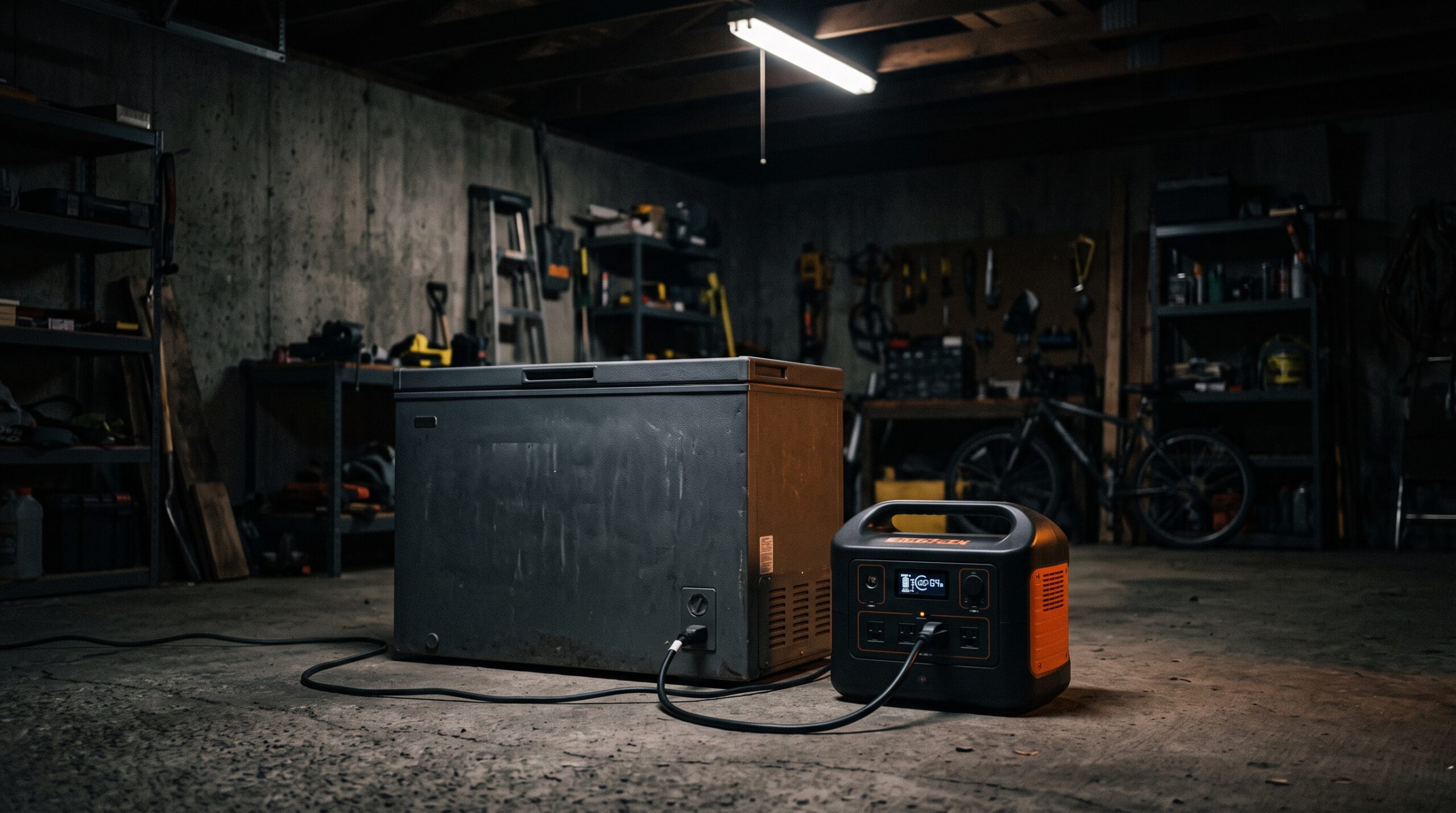
Yes, and it is one of the easier appliances to keep running. A chest freezer sips power most of the time, drawing roughly 40 to 100 watts while the compressor runs, but it demands a brief startup surge of about 600 to 1,200 watts the moment the compressor kicks on, so your inverter has to be able to absorb that spike. Because the compressor only cycles on about 30 to 50 percent of the day, the energy a freezer actually pulls is low, often 500 to 1,500 watt-hours over 24 hours, which means a modest LiFePO4 power station can keep one frozen for a day or more on a single charge.
Why a chest freezer is an easy load
Two things make chest freezers friendly to battery power. First, they are well insulated and the lid sits on top, so cold air stays put instead of spilling out the way it does with a front-opening fridge. Second, the compressor does not run constantly. Once the interior hits temperature, the compressor shuts off and the freezer coasts, sometimes for an hour or more, before the next short cooling cycle.
That cycling is what keeps the daily energy bill small. An ENERGY STAR certified chest freezer is rated at around 215 kWh per year, which works out to roughly 590 watt-hours a day on average. Running wattage depends on size: compact 5 to 7 cubic foot units typically draw 40 to 100 watts, while larger 15 to 25 cubic foot models pull closer to 100 to 350 watts when the compressor is on. For a full breakdown, see how many watts a freezer uses.
The startup surge your inverter has to handle
The catch with any compressor appliance is the inrush current at startup. For a fraction of a second, the motor draws far more than its running wattage to overcome inertia and get spinning. On a chest freezer that surge commonly lands in the 600 to 1,200 watt range, even though steady running draw is a tenth of that.
A power station’s continuous output rating is not the number that matters here. What matters is its surge or peak rating, which is the short burst it can deliver. Most stations advertise a surge figure roughly double their continuous rating, so a unit rated 1,000 watts continuous with a 2,000 watt surge will start a chest freezer without complaint. If the surge rating is too low, the inverter trips and shuts off the instant the compressor tries to start. This is the single most common reason a freezer will not run on an undersized station. The difference is explained in detail in running watts vs. starting watts.
How long a power station keeps your freezer cold
Because the compressor cycles, you size runtime against daily watt-hours, not against the running wattage. The table below estimates daily energy for common freezer sizes and how long a typical station holds out. Battery figures assume about 85 percent of the rated capacity is usable after inverter losses, which is realistic for a quality LiFePO4 unit.
| Freezer size | Avg. running watts | Daily energy (≈30-50% duty) | Days on a 1,000Wh station | Days on a 2,000Wh station |
|---|---|---|---|---|
| 5 cu ft (compact) | 40-60 W | ~450 Wh | ~1.9 days | ~3.8 days |
| 7 cu ft (ENERGY STAR) | 55-90 W | ~600 Wh | ~1.4 days | ~2.9 days |
| 10 cu ft | 90-140 W | ~850 Wh | ~1.0 day | ~2.0 days |
| 15 cu ft | 120-200 W | ~1,150 Wh | ~0.8 day | ~1.5 days |
| 20+ cu ft (deep) | 200-350 W | ~1,500 Wh | ~0.6 day | ~1.2 days |
A few practical notes pull from this table. A 1,000Wh station carries a small or mid-size freezer through a typical overnight outage with margin to spare. A 2,000Wh station covers most freezers for a full day or longer, which is often enough to bridge the gap until grid power returns or the sun comes up. Older units and big deep freezers eat into runtime fastest, so measure your own freezer’s draw with a plug meter if you can. To match a battery to your exact model, work through what size power station to run a freezer.
Pairing it with solar for multi-day outages
Battery alone gets you a day or two. Add solar and the math changes completely, because a freezer’s modest daily appetite is easy for panels to cover. A freezer needing 600 to 1,200 watt-hours a day can be fully replenished by a couple of hundred watts of solar in a few hours of decent sun, with the battery carrying the load overnight.
For a setup that runs indefinitely, the rough target is daily solar harvest that meets or beats the freezer’s daily draw, plus enough battery to ride through the night and through cloudy stretches. Even a cloudy day that only delivers half the usual harvest still buys you significant extra runtime instead of draining the battery flat.
Keep the lid shut, and watch the clock
The cheapest power you have during an outage is the cold already inside the freezer. A full freezer holds a safe temperature for about 48 hours with the lid kept closed, or roughly 24 hours if it is only half full, according to USDA and FoodSafety.gov guidance. That buffer means you do not have to power the freezer every minute. Many people run their station in short stints, or simply wait, and only commit battery power once they are approaching that window.
- Open the lid as little as possible. Every opening dumps cold and forces a longer compressor cycle.
- Keep the freezer full. Frozen mass acts as a thermal battery; jugs of water fill empty space and hold cold longer.
- Judge safety by temperature, not appearance. Food is safe to refreeze if it still has ice crystals or is at 40°F (4°C) or below. Never taste food to check it.
- A freezer thermometer or the station’s app lets you track the interior without opening the lid.
For the full timeline on how long your food stays safe with no power at all, see how long a freezer lasts without power.
Matching the station to your freezer
To keep a chest freezer running you want two boxes checked: a surge rating that clears the compressor’s startup spike, comfortably above 1,200 watts, and enough battery capacity to cover the daily watt-hours for as long as you expect to be off grid. A LiFePO4 station in the 1,000 to 2,000Wh range with a 1,000 to 1,500 watt continuous output and roughly double that on surge covers the vast majority of household chest freezers. If you want the numbers tailored to your gear, run them through the sizing calculator.
The 1,000Wh and 2,000Wh classes, live prices



As an Amazon Associate we earn from qualifying purchases. Prices are pulled automatically from Amazon and may have changed.
Frequently asked questions
What size power station do I need for a chest freezer?
For most chest freezers, a LiFePO4 station with at least 1,000Wh of capacity, about 1,000 watts of continuous output, and a surge rating above 1,200 watts will start and run the unit. A 1,000Wh station typically lasts a day for small to mid-size freezers; step up to 2,000Wh or add solar for multi-day outages.
Will the startup surge trip my power station?
Only if the station’s surge rating is too low. A chest freezer compressor briefly pulls 600 to 1,200 watts at startup. Check the station’s peak or surge figure, not just its continuous rating. A unit rated around 1,000 watts continuous usually has a 2,000 watt surge, which clears the spike easily.
How long will a chest freezer run on a 1,000Wh power station?
Roughly one to two days, depending on size and age. A compact or ENERGY STAR freezer using 450 to 600 watt-hours a day can stretch a 1,000Wh station to around 1.5 to 1.9 days. A large deep freezer using 1,500 watt-hours a day gets closer to half a day before the battery is empty.
Do I need a pure sine wave power station for a freezer?
Yes, use a pure sine wave inverter. Compressor motors run hotter and less efficiently on modified sine wave power, and some refuse to start at all. Nearly all modern LiFePO4 power stations output pure sine wave, so this is rarely a problem with current models.
Should I run the freezer continuously or in short bursts?
You do not need to run it continuously. A full freezer stays safe for about 48 hours with the lid closed, so you can conserve battery and only power the freezer as you approach that window, or run it periodically to keep the interior topped up. Keeping the lid shut does more for food safety than constant power.