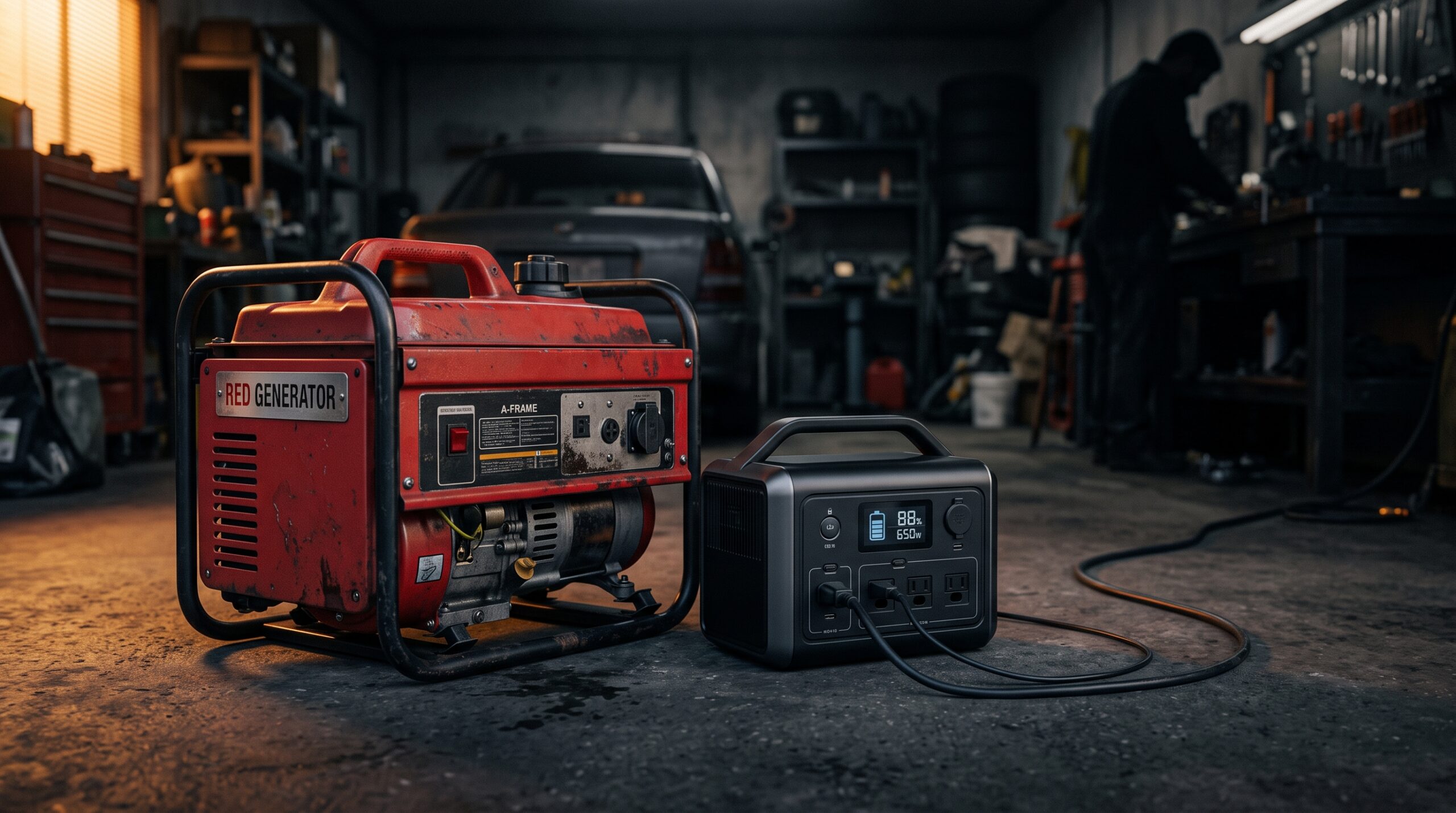
The honest answer: a gas generator wins on sustained high power and long runtime, while a battery power station wins on safety, quiet, and indoor use. Most homes are choosing between those two trade-offs, not looking for one machine that does everything. If you want to run a fridge, a sump pump, and a space heater through a multi-day winter storm, a generator is hard to beat on raw capacity. If you mostly need to keep phones, a router, a CPAP, and a few lights alive during shorter outages, and you live somewhere a generator simply cannot run safely, a power station is the saner pick. Below is a plain comparison across the things that actually decide it.
⚠️ Only a battery station is safe to run indoors
Gas generators emit carbon monoxide and must run outdoors only, at least 20 feet from windows, doors, and vents, with the exhaust pointed away from the house. Never run one in a garage, basement, crawlspace, shed, on a porch, or on a balcony, even with the door open. CO is colorless and odorless and can kill within minutes. A battery power station produces no exhaust and is the only option safe to use inside.
Power output: what each can actually run
This is the gas generator’s home turf. A mid-size portable generator in the 3,500 to 7,500-watt range can start and run heavy loads that battery units struggle with, like a well pump, a sump pump, a window AC, or a furnace blower. The starting (surge) wattage matters as much as the running wattage, because motors draw two to three times their running load for a split second when they kick on, and gas generators usually have plenty of surge headroom.
Battery power stations have closed much of the gap. Many home-backup models now deliver 1,800 to 3,600 watts continuous, which covers a fridge, lights, a microwave, and electronics, and some can briefly surge higher to start a motor. The catch is capacity, not just output: a power station holds a fixed amount of stored energy, while a generator keeps producing power for as long as you feed it fuel. For sustained high-wattage loads, the generator pulls ahead.
Runtime and refueling
A generator’s runtime is set by its tank and its load. A typical mid-size unit runs roughly 8 to 12 hours on a tank at about half load, then you refuel and keep going. As long as you have gasoline (or propane for a dual-fuel model), it can run for days. The trade-off is the refuel itself: you have to shut the engine off and let it cool before adding fuel, so you lose power during that window, and you need a safe stock of fresh fuel on hand.
A power station’s runtime is its capacity, usually measured in watt-hours. Consumer units run from a few hundred watt-hours up to several thousand. A 1,000 watt-hour station can deliver about 1,000 watts for an hour, or 100 watts for roughly ten hours, minus some conversion loss. When it’s empty, it’s empty until you recharge it, which is why the recharge method below matters so much. For short outages it’s effortless; for a multi-day grid-down event, you need either a large battery, solar to refill it, or a generator alongside it.
Indoor safety and carbon monoxide
This is the single biggest difference, and it isn’t close. Portable generators kill an average of about 100 people a year in the United States through carbon monoxide poisoning, according to the U.S. Consumer Product Safety Commission. The gas is invisible and has no smell, and people die from it indoors, in attached garages, and on porches every storm season, often while asleep. CPSC guidance is to run a generator outdoors only, at least 20 feet from the house, with the exhaust directed away from windows, doors, and vents, and to have working CO alarms inside.
A battery power station has no engine and no exhaust, so it produces zero carbon monoxide. You can sit it on the kitchen counter or next to the bed and run it all night. If you live in an apartment, a condo, or anywhere you cannot safely place an engine 20 feet outside with airflow, this is effectively the deciding factor: a generator is not a safe option, and a power station is.
Noise
Conventional open-frame generators are loud, commonly in the 70 to 90 decibel range, about like a busy street or a loud vacuum running outside your window all night. Quieter inverter generators are much better, often in the high 40s to low 60s of decibels at lighter loads. A battery power station is close to silent; the only sound is a small cooling fan that runs under heavy load. If you have close neighbors or you’re trying to sleep, that difference is real, and it’s another reason many people keep a battery unit for nights even if they own a generator.
Upfront and running cost
Generators are cheaper to buy per watt. You can get a capable mid-size portable for a few hundred dollars, and an inverter model for somewhat more. Power stations cost more upfront for the same output, because you’re paying for the battery, and a large home-backup unit with extra battery modules can run well into four figures.
The lines cross over time. A generator has ongoing running costs: gasoline at every refill, oil, filters, and fuel stabilizer. A power station’s running cost is roughly zero if you recharge from the grid between outages, and genuinely zero per kilowatt-hour if you recharge from solar. Over many years and many outages, the fuel and upkeep on a gas unit can add up to a meaningful share of, or more than, its purchase price. Which one is cheaper for you depends on how often your power actually goes out.
Maintenance
A gas generator is a small engine, and it needs the care of one. That means oil changes, air and fuel filters, fresh fuel or stabilizer so it doesn’t gum up, and the habit of starting it every month or two so it actually runs when you need it. Stale fuel and a generator that won’t start are one of the most common reasons people get caught without power despite owning one.
A battery power station needs almost nothing. There’s no oil, no fuel, and no engine to seize. The main job is keeping it charged and stored at a moderate temperature, and topping it up every few months so the battery stays healthy. Lithium iron phosphate (LiFePO4) cells, now standard in better units, are typically rated for several thousand charge cycles, which translates to roughly ten years or more of regular use.
Solar recharge
Only the battery side does this, and it’s a genuine advantage in a long outage. Plug solar panels into a power station and it refills itself with no fuel and no noise, which means a battery unit can outlast its own capacity during a multi-day event as long as the sun cooperates. Recharge time varies a lot: a small unit can fill in a few hours of strong sun, while a big one can take all day or more, and a cloudy winter day can stretch a job that takes three hours in summer into two or three days.
Wall charging is the fast fallback when there’s no sun and you still have grid power before or after the outage, usually a couple of hours to a handful, depending on the model. A gas generator has no equivalent: it converts fuel to power, full stop, and when the fuel runs out, so does the power.
Head-to-head comparison
| Gas generator | Battery power station | |
|---|---|---|
| Power output | High; strong surge for motors, runs heavy loads | Moderate to high; capacity is the limit, not output |
| Runtime | Hours per tank, then refuel; days on stored fuel | Fixed watt-hours; refill by recharging |
| Safe indoors | No, ever; CO poisoning risk | Yes; no exhaust |
| Noise | Loud (70 to 90 dB); inverter models quieter | Near silent (fan only) |
| Fuel | Gasoline or propane; must be stocked | Battery; recharge from grid or solar |
| Cost | Lower upfront, ongoing fuel and upkeep | Higher upfront, near-zero running cost |
| Maintenance | Oil, filters, fuel, monthly test runs | Minimal; keep charged and stored cool |
Which should you choose
Apartment, condo, or no safe outdoor spot: a battery power station, full stop. You cannot place a running engine 20 feet from the building with airflow, so a generator is not a safe option no matter how much power it makes. A mid-size station keeps your essentials going safely indoors.
Short, occasional outages (a few hours): a power station is the easy, quiet pick for most people. It powers the router, phones, a few lights, and the fridge in bursts, with nothing to refuel and no noise, and it lives in a closet until you need it.
Multi-day outages and heavy loads: a gas generator, or a generator paired with a battery. When you need to run a well pump, a sump pump, or heat for days, the generator’s ability to make power as long as you have fuel is decisive. Many households run both: the generator for heavy daytime loads, the battery for quiet, exhaust-free power at night.
Medical equipment (CPAP, oxygen concentrator, fridge for medication): a battery power station for the device itself, because it can run safely indoors, overnight, beside the bed, with no fumes. If the equipment is high-draw or the outage may last days, back it with solar or a generator to refill the battery, and never run that generator anywhere near where the patient is breathing.
Not sure how big a unit you need, or how long it would actually last on your gear? Size it before you buy. Our Power-Station Sizing calculator turns your appliance list into the watt-hours and surge watts to look for, and the Appliance Runtime calculator shows how many hours a given battery or generator will hold those loads.
Both routes, live prices


Champion 4500W Dual Fuel Inverter
Gas or propane, electric start, RV ready
$988.62Check price on Amazon →


As an Amazon Associate we earn from qualifying purchases. Prices are pulled automatically from Amazon and may have changed.
Frequently asked questions
Can a battery power station replace a generator entirely?
For short outages and indoor essentials, yes. For multi-day outages with heavy loads like a well pump or electric heat, a single battery usually can’t store enough energy on its own, so you either add solar to refill it, buy a very large battery system, or keep a generator alongside it. The two tools solve slightly different problems.
Is it ever safe to run a gas generator in the garage with the door open?
No. The CPSC is explicit that an open door or window does not provide enough ventilation, and carbon monoxide builds to deadly levels in garages, basements, and crawlspaces even with openings. Run a generator outdoors only, at least 20 feet from the house, with the exhaust pointed away from windows, doors, and vents.
How long can a power station run a refrigerator?
It depends on capacity and the fridge. A modern fridge averages a fairly low draw because the compressor cycles on and off, so a roughly 1,000 watt-hour station can often keep one cold for a number of hours, and a larger 2,000 to 3,000 watt-hour unit can stretch into a day or more. Use the runtime calculator with your fridge’s listed wattage for a real estimate.
Do power stations work in winter?
Yes, but cold reduces battery performance and solar recharging slows down with shorter, weaker daylight. A station that refills in a few hours of summer sun can take much longer on a cloudy winter day, so in cold climates plan to wall-charge it fully before a storm and don’t count on solar alone for fast recovery.
Which is cheaper over the long run?
A generator is cheaper to buy; a power station is cheaper to own. Generators carry ongoing costs for fuel, oil, and upkeep, while a battery recharged from the grid or solar costs little to nothing per use. If your power rarely goes out, the generator’s lower upfront price usually wins. If you lose power often, the battery’s near-zero running cost catches up.
Sources
- U.S. Consumer Product Safety Commission, Carbon Monoxide Information Center
- CPSC, Generator, Carbon Monoxide and Fire Hazards Ahead of Hurricane Season
- EcoFlow, Portable Power: Gas or Battery?
- Harbor Freight, Portable Power Stations vs Generators Buying Guide
- EcoFlow, How Long Does a Solar Generator Take To Charge?
- Ufine Battery, LiFePO4 Cycle Life and Depth of Discharge
- Bob Vila, The Best Quiet Generators, Tested