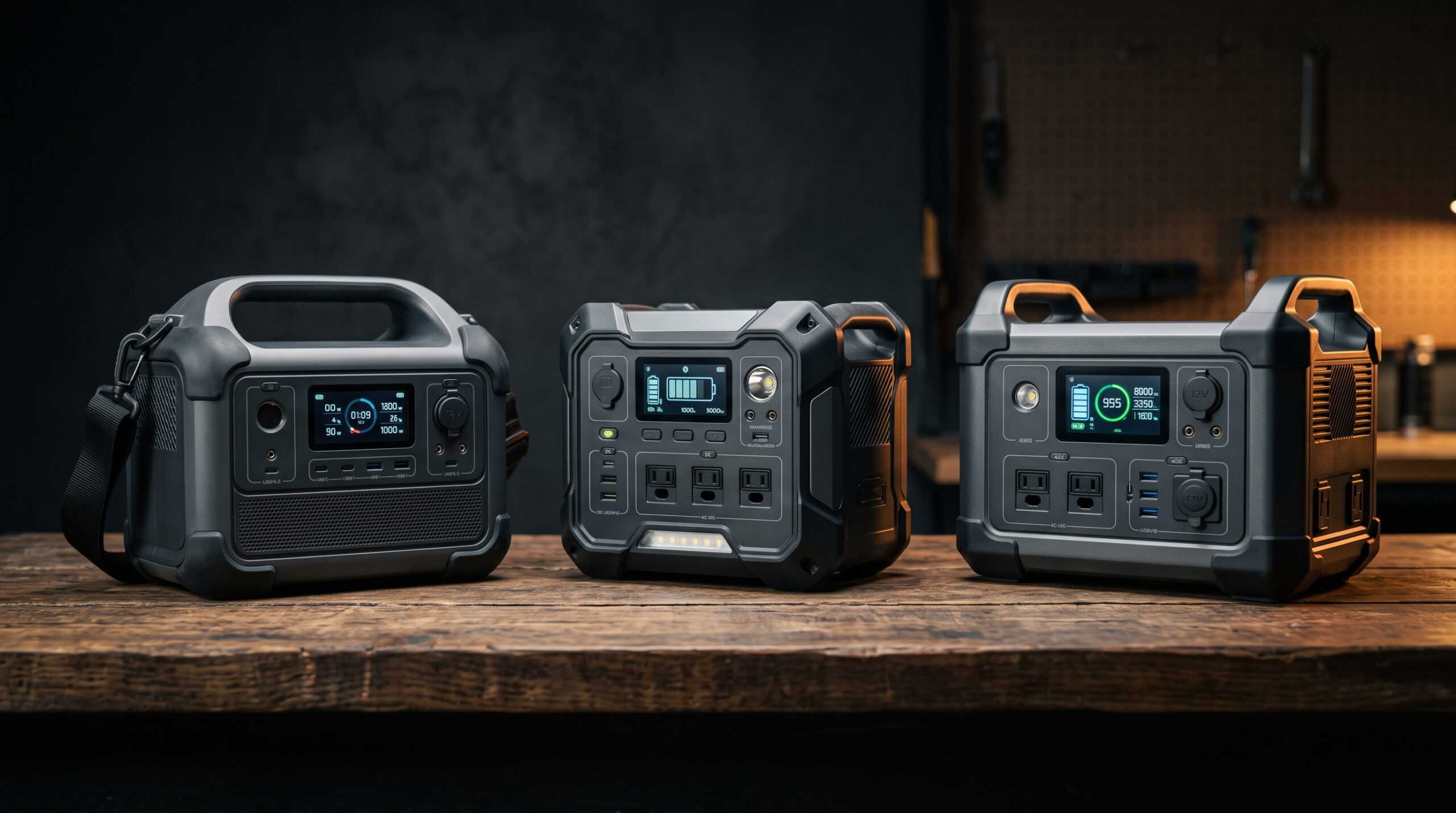
In short: EcoFlow charges fastest and has the most capable app, Jackery is the lightest and simplest to live with, and Bluetti gives you the most watt-hours per dollar and the most room to expand. All three now run LiFePO4 batteries on their main lines, so the differences are about how you charge, carry, grow, and control the unit, not whether the cells will last.
This is a brand comparison, not a single-winner contest. The right pick depends on your outage profile, where you live, and how much you care about app control versus grab-and-go simplicity. Below is how the three differ on the things that actually change day to day, followed by which brand tends to fit which household.
Charging speed: EcoFlow sets the pace
If you only get a short window to refill before the next outage, charging speed matters. EcoFlow’s X-Stream charging is the fastest of the three: most DELTA-class units hit 80% from a wall outlet in under an hour, and the larger DELTA Pro 3 reaches 0 to 80% in roughly 50 minutes. Bluetti is close behind on its current units, with the AC200L reaching about 80% in around 45 minutes. Jackery’s newer LiFePO4 models charge quickly too, the Explorer 2000 v2 fills in a little over an hour, but as a brand Jackery generally prioritizes simplicity and quiet operation over chasing the fastest possible number.
For most home backup, “fast enough” is any unit that can top off between rolling outages or overnight. EcoFlow’s edge only becomes decisive if you face frequent, back-to-back outages and need to refill on a tight schedule.
App and smart features
EcoFlow’s app is widely considered the most complete in the category. It offers real-time monitoring, remote control, scheduled charging, charge-rate limiting, and firmware updates in one interface, working over Bluetooth when you are nearby and Wi-Fi when you are away. Bluetti’s app is capable and covers the essentials, monitoring, output control, and updates, but generally feels a step behind EcoFlow’s depth. Jackery deliberately keeps things simpler: its app handles monitoring and basic control, and some of its most popular units lean on physical buttons and a clear display rather than deep app menus.
If you want to schedule charging around time-of-use rates, watch draw remotely, or fine-tune settings, EcoFlow rewards that. If you would rather press one button and not think about an app, Jackery’s approach is a feature, not a limitation.
Weight and portability
Jackery’s brand identity is lightweight, rugged, and easy to move. The Explorer 2000 v2, at roughly 40 lb for a 2kWh LiFePO4 unit, is among the lightest and most compact in its class, and the line is built for hauling between the house, the garage, and the campsite. EcoFlow and Bluetti units in the same capacity range tend to be heavier, partly because they pack in more output hardware, faster charging, and expansion ports. None of these are truly “carry with one hand” once you pass 2kWh, but if you plan to move the unit often, Jackery has the clearest advantage.
Price per watt-hour
On raw capacity for the money, Bluetti is usually the value leader. Its mainstream units, like the AC200L, tend to land at the lowest cost per watt-hour of the three, especially when you add expansion batteries that spread the price of the inverter and electronics across more storage. Jackery typically sits in the middle. EcoFlow is generally the premium of the three on a per-watt-hour basis, and you are paying for the faster charging and the more advanced app rather than for the cells themselves. Treat exact prices as moving targets, all three discount heavily and often, so compare cost per watt-hour at the moment you buy rather than sticker to sticker.
Expandability
If you might want more capacity later, expandability decides whether you upgrade or replace. Bluetti and EcoFlow are both strong here. Bluetti’s expandable units, such as the AC200L, accept add-on battery packs that push total capacity well into the multi-kilowatt-hour range. EcoFlow’s flagship DELTA Pro 3 scales even further with extra batteries and smart generators for whole-home-style setups. Jackery offers expansion on its Plus and current v2 kits, but its ecosystem is generally narrower and more modest in ceiling. If “buy once, grow into it” is your plan, Bluetti and EcoFlow give you the most headroom.
Warranty
Coverage is close across the board on current models. EcoFlow offers a 5-year warranty on its DELTA-class units. Bluetti provides a 5-year warranty on its current Elite and AC-series stations. Jackery’s newer LiFePO4 units typically come with a 3-year base warranty plus a 2-year extension that you activate by registering, which also reaches five years total. Read each brand’s terms, registration windows and what counts as a covered fault vary, but on headline length the three are effectively even.
Battery chemistry: LiFePO4 across the board
This is the part that has converged. All three brands now use LiFePO4 (also written LFP) on their main backup lines, replacing the older NMC lithium chemistry found in some legacy units. LiFePO4 matters for backup because it is rated for far more charge cycles and runs cooler and safer. Expect cycle ratings in the range of roughly 3,000 to 6,000+ cycles to 80% capacity depending on the model: EcoFlow rates the DELTA Pro 3 at about 4,000 cycles, Bluetti’s AC200L at 3,500+, and some premium Bluetti Elite units at 6,000+. In plain terms, even daily use puts these batteries on a 10-to-15-year-plus runway before they fade to 80%. For occasional outage duty, the cells will almost certainly outlast your interest in the unit.
Because chemistry is no longer a differentiator, do not pay a premium for “LiFePO4” as if it were rare. It is the baseline now. Spend your decision energy on charging, app, weight, value, and expansion instead.
Which brand to pick by use case
Apartment or small-space backup
In a small home you want something compact, quiet, and easy to stash. Jackery fits this well thanks to its lighter, smaller units and simple operation. EcoFlow works too if you value app control and faster top-offs. A smaller Bluetti unit is fine if value is your priority and you do not need to move it much.
Fridge and essentials backup
For keeping a refrigerator, Wi-Fi, and a few lights alive through an outage, all three brands have a 1kWh-to-2kWh unit that does the job. Bluetti tends to give you the most stored capacity for the price, which is exactly what fridge runtime is about. EcoFlow is worth it if you want to recharge fast between outages. Jackery is the easy pick if you also want to carry the unit elsewhere when the power is on.
CPAP and medical devices
For overnight medical loads like a CPAP, what you care about is quiet operation, a clean pure-sine output, and enough capacity to cover one or more nights. Any of the three covers a single CPAP comfortably. Jackery’s simplicity and quiet running suit a bedside unit. EcoFlow’s app lets you watch the battery level and set limits. For multiple nights without recharging, lean toward the brand that offers the most capacity in your budget, often Bluetti, or add an expansion battery. If the device is life-critical, confirm the specific power station against your equipment’s requirements and keep a tested backup plan.
RV and camping
Off the grid, weight, ruggedness, and recharge flexibility all matter. Jackery’s lighter, tougher units are a natural fit for moving in and out of a vehicle. EcoFlow’s fast solar and AC charging help when sun or shore power is limited. Bluetti’s expandable units and 30A RV-style outputs on some models appeal if you want to power more of the rig. All three accept solar input, so match panel and input specs to how you actually camp.
Whole-home-ish backup
For backing up a large share of a home, you are in expansion territory, and this is where EcoFlow and Bluetti pull ahead. EcoFlow’s DELTA Pro 3 scales with extra batteries and generators toward serious capacity and can interface with a transfer switch for selected circuits. Bluetti’s larger expandable systems reach high totals at a friendlier cost per watt-hour. Jackery can stack capacity with its kits but is generally aimed below true whole-home ambitions. Whichever you choose, sizing the load and the transfer setup correctly matters more than the badge on the case.
| Capability | Jackery | EcoFlow | Bluetti |
|---|---|---|---|
| AC charging speed | Fast on newer LFP units | Fastest in class (X-Stream) | Fast (about 80% in ~45 min on AC200L) |
| App and smart features | Simple, essentials only | Most complete (remote, scheduling) | Capable, covers the basics |
| Weight and portability | Lightest in its class | Heavier, feature-dense | Heavier, capacity-focused |
| Price per watt-hour | Mid-tier | Premium | Best value, especially expanded |
| Expandable capacity | Limited (Plus / v2 kits) | High (DELTA Pro 3 scales far) | High (stackable add-on packs) |
| Warranty (current lines) | 3 yr + 2 yr extension | 5 years | 5 years (Elite / AC series) |
Before you commit to any brand, size the job first. Use the Power-Station Sizing calculator to find the capacity and continuous-watt rating your outage actually needs, then the Appliance Runtime calculator to see how long a given watt-hour rating runs your fridge, CPAP, or essentials. Once you know the numbers, pick the brand whose strength, fast charging, light weight, or value, fits how you live with it. Size first, then pick a brand.
All three brands, live prices

Jackery Explorer 1000 v2
1,070Wh, 1,500W — light and simple for outages
$499.00Check price on Amazon →

EcoFlow DELTA 2 Max
2,048Wh, 2,400W — fast solar, runs most of a kitchen
$1,049.00Check price on Amazon →

As an Amazon Associate we earn from qualifying purchases. Prices are pulled automatically from Amazon and may have changed.
Frequently asked questions
Is one of these brands clearly the best for home backup?
No single brand wins outright. EcoFlow leads on charging speed and app control, Jackery on light weight and simplicity, and Bluetti on capacity per dollar and expansion. The best choice depends on your outage pattern and what you value most, which is why sizing your load first makes the brand decision easier.
Do all three use LiFePO4 batteries now?
Yes. Jackery, EcoFlow, and Bluetti all use LiFePO4 (LFP) chemistry on their current main backup lines. LFP is rated for thousands of charge cycles and runs cooler and safer than older NMC lithium. Because all three share it, battery chemistry is no longer a meaningful tiebreaker between them.
Which brand is cheapest per watt-hour?
Bluetti is usually the value leader on cost per watt-hour, especially once you add expansion batteries that spread the price of the inverter across more storage. Jackery typically sits mid-tier, and EcoFlow is generally the premium option because you are paying for faster charging and the more advanced app. Prices move often, so compare cost per watt-hour at the moment you buy.
Which is best if I want to expand later?
Bluetti and EcoFlow both offer strong expansion. Bluetti’s units accept stackable add-on packs that push capacity well up, and EcoFlow’s DELTA Pro 3 scales the furthest toward whole-home-style setups. Jackery offers some expansion on its kits but has a lower ceiling, so if growing your system is the plan, lean toward Bluetti or EcoFlow.
Can any of them back up my whole house?
A single portable unit will not run an entire house, but EcoFlow’s and Bluetti’s expandable systems can back up a meaningful share of circuits when paired with extra batteries and, in some cases, a transfer switch. The right size depends entirely on your loads, so calculate the capacity and continuous watts you need before assuming any one model is enough.
Sources
- EcoFlow DELTA Pro 3 product page (specs, 50-minute 0 to 80% charge, 4,000-cycle LFP, 5-year warranty)
- EcoFlow DELTA 3 product page (X-Stream charging, LFP)
- EcoFlow app review (real-time monitoring, remote control, scheduled charging)
- Jackery Explorer 2000 v2 product page (2,042Wh LiFePO4, ~40 lb, fast charge, warranty)
- Bluetti AC200L product page (2,048Wh LiFePO4, expandable, ~45-minute fast charge)
- Bluetti product warranty period (5-year coverage on current Elite / AC series)