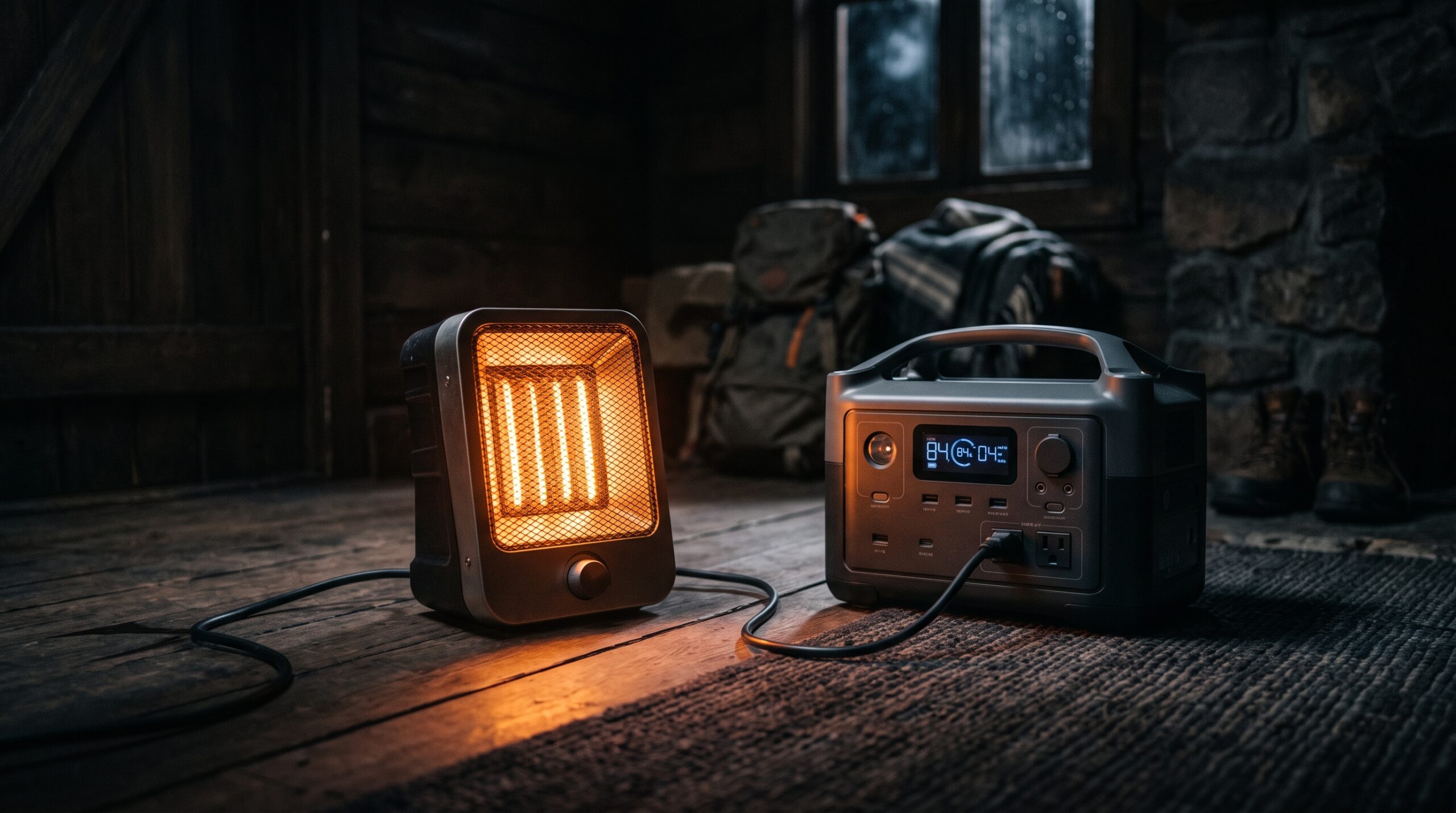
Yes, but not for long. A standard space heater pulls about 1,500 watts, which drains even a large power station fast: a 2,000Wh battery runs a 1,500W heater for only about an hour. For staying warm through an outage, a heated blanket is the far smarter use of the same battery.
Here is why electric heat is the hardest thing to run on backup power, how long a station really lasts, and what to do instead.
⚠️ Only electric or battery heat is safe indoors
Never use a propane or kerosene heater, a gas stove, a grill, or a generator inside to stay warm. They release carbon monoxide, which is odorless and deadly. Run generators outdoors only, and keep a CO alarm.
Why a space heater is such a demanding load
Most appliances cycle on and off, so they draw their full watts only part of the time. Electric resistance heat does not. A space heater on high pulls a steady 1,500 watts the entire time it runs, with no breaks. That is roughly the same as running ten refrigerators at once, and it is why heating is the toughest job to ask of any battery.
How long a power station actually lasts
Take the battery’s watt-hours, subtract about 10 to 15 percent for inverter losses, then divide by the heater’s watts. A 2,000Wh station has roughly 1,700 to 1,800 usable watt-hours, so at 1,500 watts it lasts about an hour to an hour and a quarter. Drop the heater to a 750-watt eco setting and you roughly double that. Compare that to a heated blanket, which sips power and runs all night.
| Heat source | Watts | Approx. hours on a 2,000Wh station |
|---|---|---|
| Space heater (high) | 1,500 W | About 1 hour |
| Space heater (eco/low) | 750 W | About 2 to 2.5 hours |
| Heated mattress pad | 80 to 180 W | About 10 to 20 hours |
| Heated blanket or throw | 50 to 100 W | About 17 to 30 hours |
The smarter option: heat the person, not the room
During an outage, the goal is to keep people warm, not to heat the whole house. A heated blanket, a heated mattress pad, or even a USB-heated vest does that on a tiny fraction of the power. Pair it with the basics: gather everyone into one small room, close the door, layer clothing, and use blankets and sleeping bags. That keeps a power station useful for many hours instead of one.
What size station if you insist on a heater
To run a 1,500-watt heater for a meaningful stretch, you would need a large, expandable station with 4,000 watt-hours or more, plus a strong solar or AC recharge to keep up. That is a lot of battery for a little heat, and for most people the money is better spent on a heated blanket and a station sized to keep the fridge and devices going.
Want to check the numbers for your own gear? Use the Appliance Runtime calculator to see how long a station would power a given heater, or the Power-Station Sizing calculator to size a battery for the loads that actually matter.
What electric heat actually takes, live prices


As an Amazon Associate we earn from qualifying purchases. Prices are pulled automatically from Amazon and may have changed.
Frequently asked questions
Can a power station run a 1500W space heater?
Yes, if the station’s output is at least 1,500 watts, but a 2,000Wh battery lasts only about an hour at that draw. A lower heat setting or a heated blanket stretches it much further.
Why does a heater drain a power station so fast?
Electric resistance heat runs at full watts continuously, with no on-off cycling. At 1,500 watts it uses energy about ten times faster than a refrigerator.
What can I use to stay warm instead?
A heated blanket or mattress pad uses 50 to 200 watts and can run all night on a mid-size station. Heating one small room with body heat, layers, and blankets works without any power at all.
What size power station do I need to run a space heater for hours?
Plan on 4,000 watt-hours or more, plus fast recharging, to run a 1,500-watt heater for several hours. For most people that is not worth it compared to a heated blanket.
Can I run a propane heater indoors during an outage?
No. Propane, kerosene, and other fuel-burning heaters release carbon monoxide and are not safe to run indoors. Stick to electric or battery heat inside, and keep a CO alarm.