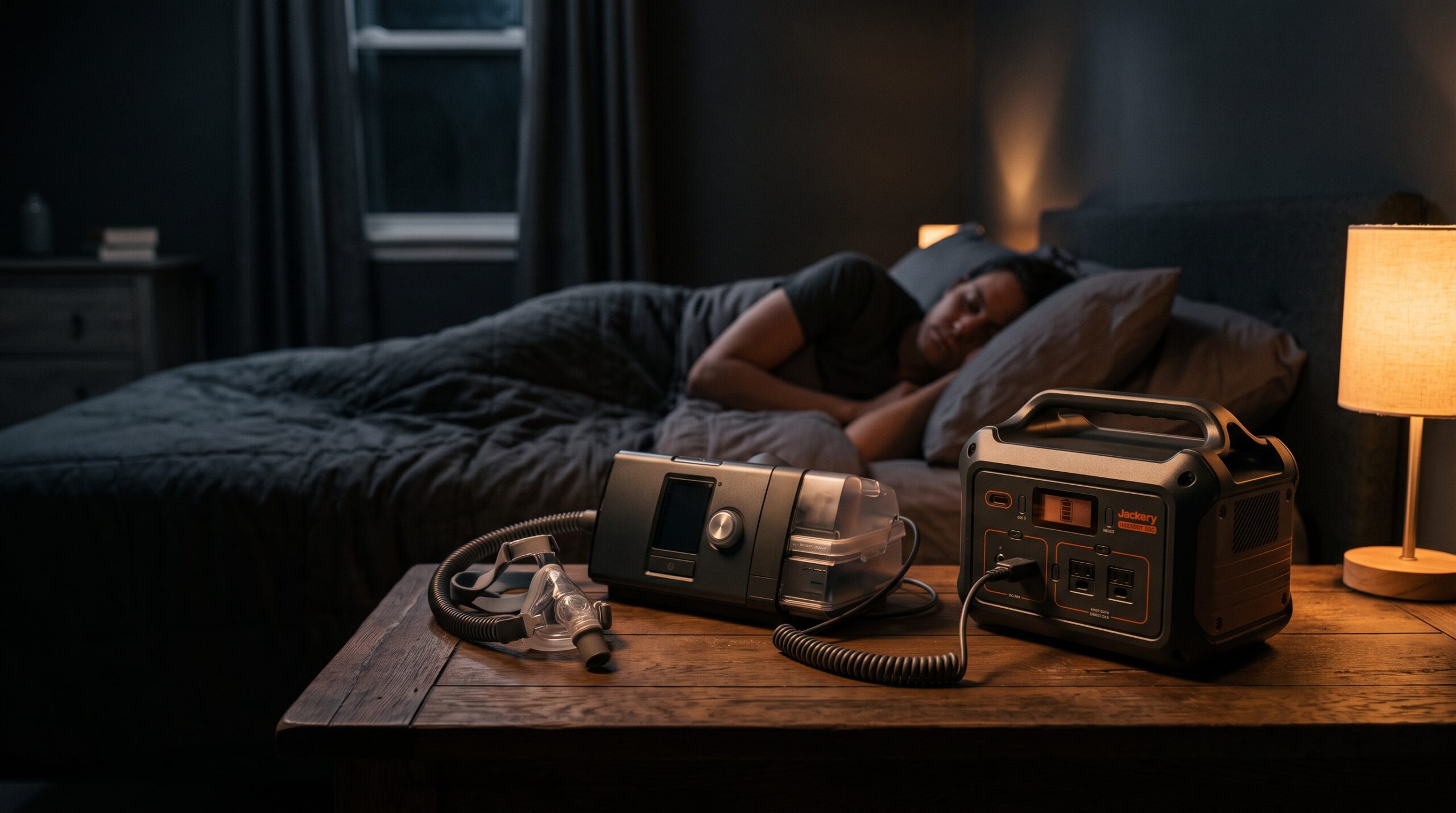
If someone in your home relies on powered medical equipment, the safest plan has three layers: register with your utility’s medical-priority program, confirm your exact backup needs with your equipment supplier and clinician, and keep a battery power station sized to your devices. No single layer is enough on its own, and for oxygen you also want a non-electric tank fallback that keeps working when every battery is dead.
This guide explains the watts-per-device approach, the watt-hour math that turns a battery’s rating into real runtime, and how to build a layered plan that holds up through a long outage. It is planning information only. The specifics for any life-sustaining device belong to you, your durable medical equipment (DME) supplier, and your clinician.
⚠️ This is planning guidance, not medical advice
For any life-sustaining device, confirm exact backup-power requirements with your equipment supplier (DME) and clinician, register with your utility’s medical-priority or medical-baseline program, and follow your device manual. For oxygen, keep a non-electric tank fallback. Do not change prescribed settings, flow rates, or feeding schedules to save power.
Make a plan before the lights go out
Backup power for medical equipment is not a single purchase. It is a plan you build before you need it, and the two phone calls below come first because they cost nothing and they change what hardware you actually need.
Register with your utility’s medical-priority program. Most U.S. electric utilities run a “medical baseline” or “life support” registry for households that depend on powered equipment. Enrolling does two things: it flags your address for priority notification before a planned shutoff and, in many areas, faster restoration after one, and it often lowers your rate on the extra electricity those devices use. PG&E’s Medical Baseline Program, for example, covers equipment that sustains a vital function or that you rely on for mobility, including motorized wheelchairs, CPAP machines, respirators, and dialysis machines, and it sends enrolled customers advance notice before a Public Safety Power Shutoff. Registration usually needs a form your clinician signs, so start early. Call your utility or search its name plus “medical baseline” to find the application. Registering does not guarantee your power stays on, so you still need the layers below.
Confirm backup needs with your provider and DME. Ask your equipment supplier and clinician three questions for each device: how long can I safely be without it, what backup power does the manufacturer approve, and what is the manual fallback if every power source fails. The American Lung Association advises medical-device users to sort this out with their provider before an emergency, and Ready.gov puts the same instruction first: talk to your provider about a power-outage plan for any electricity-dependent device and any refrigerated medicine. Their answers, not the averages in this article, are what you plan around.
How much power each device uses
Every backup plan starts with watts. Watts are the rate a device pulls power right now; watt-hours (Wh) are how much energy it uses over time. The trick is that medical devices fall into two very different groups. Some, like a CPAP or a nebulizer, run intermittently or sip power. Others, like a home oxygen concentrator, run continuously at a few hundred watts and will drain almost any battery fast. Knowing which group each of your devices is in is the whole planning exercise.
The table below gives rough planning ranges so you can see the shape of the problem. Find your exact figure on the device’s rating label or power supply, or ask your DME, before you size anything.
| Device | Typical watts | Notes |
|---|---|---|
| CPAP (humidifier off) | 30 to 60 W | The heated humidifier and heated tube push it to 60 to 100 W. Turning the heat off is the single biggest way to stretch a battery. |
| Home oxygen concentrator (5 LPM) | 300 to 600 W | Runs continuously, so it dominates any battery plan. Most standard 5-liter units land near 300 to 350 W. Keep a non-electric tank fallback. |
| Nebulizer (compressor) | 50 to 140 W | Only runs during a treatment, often just a few minutes. Portable mesh nebulizers sip 1 to 2 W and can run off a power bank. |
| Powered wheelchair charger | 100 to 400 W | Only while charging, not while you sit in the chair. Draw is highest in the first hour, then tapers as the battery fills. |
| Enteral feeding pump | 5 to 25 W from the wall | Most pumps carry a long internal battery (often 15 to 26 hours), so the wall draw is small. Keep it charged and keep a spare set. |
| Medication / insulin mini-fridge | 50 to 100 W | Cycles on and off rather than running flat out. Insulin can also sit at room temperature for a stretch (see the FAQ). |
Sizing a power station
Power stations are rated in watt-hours, which is energy stored. To size one, you work out how many watt-hours your devices use over the window you want to cover, then pick a station with enough usable capacity. The basic relationship is simple:
Watt-hours a device needs ≈ its watts × hours it runs. A station then delivers roughly its rating minus inverter losses, usually around 10 to 15 percent, so a 1,000 Wh station gives you about 850 usable watt-hours through its AC outlets.
Run the math per device and the difference between the two groups jumps out. A CPAP at 40 watts with the humidifier off over an eight-hour night is about 320 Wh, so a 1,000 Wh station covers two nights or more. A nebulizer at 60 watts for four short treatments a day is only about 60 Wh, almost a rounding error. A feeding pump on its internal battery barely touches the station. But a home oxygen concentrator at 350 watts running around the clock needs roughly 8,400 Wh a day, so that same 1,000 Wh station holds it for only about two to three hours. That is not a flaw in the battery; it is why continuous oxygen needs its own layer, covered below.
One spec is non-negotiable for medical electronics: pure sine wave AC output. Medical devices are designed for the clean power of a wall outlet. A cheaper modified sine wave inverter can run hot, behave unpredictably, or be refused by the device. Mainstream lithium power stations from brands like Jackery and EcoFlow state pure sine wave output; if a unit does not clearly say it, do not assume it. After that, favor LiFePO4 battery chemistry for cycle life and heat tolerance, check that the station runs quietly enough near a bedside, and confirm you can recharge it during a long outage by solar panel or car. Whatever you choose, ask your DME whether they approve that station for your specific device before you depend on it.
Build backup in layers
No single power source should be your whole plan. The idea is to stack layers so that when one runs out, the next one is already in place. For most households that means three:
- Layer one: the device’s own battery. Many devices, including feeding pumps, portable oxygen concentrators, and powered wheelchairs, carry an internal battery that covers the first stretch of an outage on its own. Keep it fully charged, keep manufacturer-approved spares where the device supports them, and know exactly how many hours it gives you. This layer buys you time to bring the next one online.
- Layer two: a power station sized to your devices. A pure sine wave battery station, sized with the math above, carries the load once internal batteries run low and recharges from solar or a car during a long event. Size it to the devices that matter most and the number of hours or nights you want to cover, and recharge it after every use so it is full when you need it.
- Layer three: a non-electric fallback for life-sustaining devices. For supplemental oxygen, this is the most important layer of all. The American Lung Association advises oxygen users to work with their provider to keep stand-by oxygen tanks that do not rely on electricity, plus extra batteries and a vehicle charger for any portable concentrator. A compressed or liquid oxygen tank keeps delivering when every battery is flat, which is exactly the situation a long outage can create. For refrigerated medication, the equivalent fallback is knowing how long it stays safe at room temperature so you are not dependent on a running fridge.
What to do when an outage hits
- Switch life-sustaining devices to backup first. Move oxygen, ventilators, or other critical equipment to their internal battery or your power station right away, and bring out the non-electric oxygen fallback if the outage looks long. Do not change a prescribed flow rate or setting to save power; if you are worried about runtime, that is a call to your provider, not a setting to lower yourself.
- Cut the optional load. Turn off anything that drains the station without sustaining therapy, such as a CPAP’s heated humidifier and heated tube. That alone can multiply your runtime, leaving more energy for the devices that matter.
- Protect refrigerated medicine. Keep the fridge door shut. The FDA notes that insulin in vials or cartridges can generally be kept between 59 and 86°F for up to 28 days and still work, so it usually does not need a powered fridge for a typical outage, but it must not freeze. Confirm the specifics for your own medications with your pharmacist, and follow your provider’s guidance on what to discard.
- Report the outage and check your timeline. Call your utility to report the outage and confirm your medical registration is on file, and ask for an estimated restoration time. Compare it against how long your layers last. If the gap is too wide, move to your backup location or contact your provider before you run out, not after.
- Have a relocation trigger. Decide in advance the point at which you leave for a hospital, a relative’s home, or a community charging or cooling center. For anyone on continuous oxygen or a ventilator, that trigger should be conservative. Knowing it ahead of time removes the worst decision from the worst moment.
Size it to your own devices
Once you know the wattage of each device and how many hours you want to cover, you can size a station to your real setup instead of an average. Use our Power-Station Sizing calculator to work backward from the hours or nights you need to a capacity target, and the Appliance Runtime calculator to check how long a given battery will hold a specific device. Enter your own watts, not the planning ranges in the table above, for an answer you can actually rely on, then confirm it with your DME.
Frequently asked questions
How do I find out how many watts my medical device uses?
Check the rating label on the device or its power supply, where the wattage or the volts and amps are usually printed; volts multiplied by amps gives you watts. The device manual lists it too. If you cannot find it or want the real draw at your settings, ask your equipment supplier (DME), since the same model can pull very different power depending on flow rate, pressure, or mode. Plan around your own measured figure, not a generic average.
Can a power station run a home oxygen concentrator through an outage?
For a short window, yes, but not for long, because a stationary concentrator runs continuously at roughly 300 to 600 watts. At 350 watts it uses about 8,400 watt-hours a day, so even a large 1,000 Wh station holds it only a couple of hours. That is why oxygen needs a layered plan: internal or portable-concentrator batteries, a power station for short coverage, and above all the non-electric stand-by tanks the American Lung Association recommends you arrange with your provider. Confirm your exact backup with your DME and clinician.
Do I need a pure sine wave power station for medical equipment?
Plan on pure sine wave output. Medical electronics are built for the clean power of a wall outlet, and a modified sine wave inverter can cause heat, erratic behavior, or a refusal to run. Mainstream lithium power stations from brands like Jackery and EcoFlow specify pure sine wave output; if a unit does not clearly state it, do not assume it has it. Then confirm the specific station with your equipment supplier before you rely on it for any essential device.
How do I register with my utility’s medical program?
Search your electric utility’s name plus “medical baseline” or “life support,” or call its customer line, and ask for the medical-priority or medical-baseline application. You typically fill out your part and have your clinician sign or confirm the medical need, after which you are enrolled. Benefits vary by utility but commonly include advance notice before planned shutoffs, priority for restoration, and a lower rate on the extra electricity your equipment uses. Registering does not guarantee uninterrupted power, so keep your battery and tank layers ready regardless.
How long can insulin go without refrigeration during an outage?
The FDA states that insulin in vials or cartridges, opened or unopened, can generally be kept between 59 and 86°F for up to 28 days and still work, so a typical outage usually does not spoil it. Keep it out of direct heat and sunlight, and never let it freeze; do not use insulin that has frozen. Insulin already loaded in a pump’s infusion set should be discarded after 48 hours. These are general figures, so confirm the specifics for your product with your pharmacist or clinician, and follow their guidance on what to discard after a long outage.
Sources
- American Lung Association, preparing for a power outage as a medical device user: https://www.lung.org/blog/power-outage-preparation
- Ready.gov, power outages: https://www.ready.gov/power-outages
- U.S. Food and Drug Administration, insulin storage and switching products in an emergency: https://www.fda.gov/drugs/emergency-preparedness-drugs/information-regarding-insulin-storage-and-switching-between-products-emergency
- PG&E, Medical Baseline Program (example utility medical-priority program): https://www.pge.com/en/account/billing-and-assistance/financial-assistance/medical-baseline-program.html
- Oxygen Concentrator Store, stationary oxygen concentrator electricity usage and costs: https://www.oxygenconcentratorstore.com/blog/stationary-oxygen-concentrator-electricity-usage-and-costs/
- ResMed, CPAP batteries and power converters: https://www.resmed.com/en-us/products/cpap/battery-and-power-converters/