The safest way to stay cool during a summer power outage is to block the heat and slow your body down: cover sunny windows, move to the lowest and coolest part of your home, sip water, and avoid hard activity during the hottest hours. When the AC quits in a heat wave, the real danger isn’t the dark or the warm fridge. It’s heat illness, and it can come on faster than people expect.
⚠️ Know the signs of heat illness
Heat exhaustion (heavy sweating; cold, pale, clammy skin; weakness; nausea; dizziness; headache) can progress to heat stroke (hot, red skin; confusion; fainting; a body temperature of 103°F or higher), which is a medical emergency. Call 911. Move the person to the coolest place you can reach, loosen clothing, and apply cool, wet cloths. Check on older adults, young children, and anyone with a health condition, because they overheat first. (Sources: CDC, American Red Cross)
Block the heat before it builds up
A house with no power heats up from the sun coming through the windows. Your first job is to shut that out before the rooms get hot, not after.
- Close blinds, curtains, or shades on any window the sun hits, especially east-facing rooms in the morning and west-facing rooms in the afternoon. Light-colored shades or window reflectors that bounce heat back outside work best.
- Close off the rooms that bake in the sun and keep their doors shut, so that heat doesn’t spread into the spaces you’re actually using.
- Don’t add heat indoors. Skip the oven and stovetop, and never use a gas range or oven to cool or warm a room, because it can release carbon monoxide. Unplug or switch off electronics you don’t need, since they give off heat too.
Use the coolest air you have
Heat rises, so the lowest floor of your home is usually the most comfortable. If you have a basement or a ground floor, spend the hottest part of the day there.
Use the cooler night air when you can. Once the outdoor temperature drops below the temperature inside, open windows on opposite sides of the house to pull a cross-breeze through, then close everything up again in the morning before the day heats up. During the daytime in a real heat wave, when it’s hotter outside than in, do the opposite and keep windows closed and shaded so you trap whatever cool you have left.
Cool your body, not just the room
This is the part that actually prevents heat illness. You don’t have to cool the whole house. You just have to keep your own body temperature down.
- Drink water steadily through the day, before you feel thirsty. If you’re sweating heavily, a sports drink or a salty snack helps replace the salt and minerals you lose. If you’re on a fluid-restricted diet or take medication that affects fluids, ask your doctor how much to drink.
- Take a cool shower or bath. If the water is off, lay a wet cloth or bandana on your neck, wrists, and forehead, or mist yourself with a spray bottle and sit near a fan.
- Wear light, loose, light-colored clothing, and skip anything heavy or tight.
- Rest during the hottest hours and save any hard work or exercise for early morning or after dark. Go easy on alcohol and big hot meals.
Running a fan on backup power (not an AC)
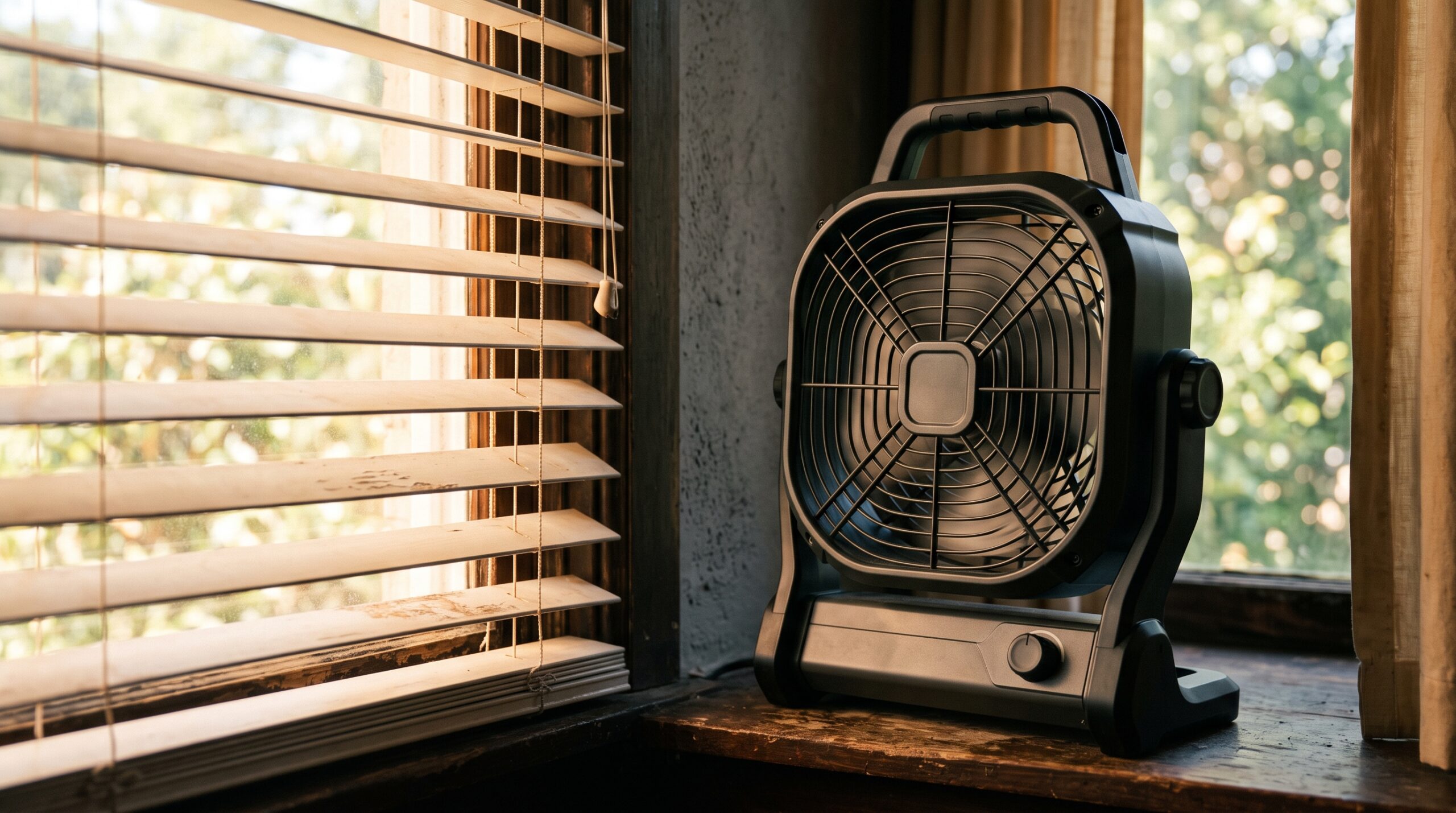
A fan is the realistic thing to run on a battery during an outage. It moves air, helps your sweat evaporate, and barely sips power. An air conditioner cools the air, but it pulls far more electricity than most portable batteries can give, which is why running one on backup power usually isn’t practical.
One important limit: a fan helps you feel cooler, but it does not lower your core temperature. The CDC notes that when temperatures are really high, a fan won’t prevent heat-related illness on its own. Use it alongside water and cool water on your skin, and point it out a window to push hot air out during the day, or in at night to pull cooler air in. Don’t blow a fan straight at someone in a closed, very hot room, since that can speed up dehydration.
| Device | Running watts | Start-up surge | Backup-power feasibility |
|---|---|---|---|
| Box or pedestal fan | ~30–100 W | Minimal | Easy. A small ~300 Wh power station runs one for many hours. |
| Portable AC (8,000 BTU) | ~700–900 W | ~1,400–1,800 W | Hard. Needs a large, high-output station (1,000 Wh and up), and runtime is short. |
Want to know exactly what your battery can handle? Find the wattage on your fan or AC label, then run the numbers in our Power-Station Sizing calculator and Appliance Runtime calculator to see what it takes to run a fan or portable AC, and for how long.
Where to go if it gets dangerous
If your home stays dangerously hot, or if anyone starts showing signs of heat illness that don’t ease up, the safest move is to get to air conditioning. Even a few hours in a cool place can help your body recover.
- Head for a public library, a shopping mall, a community center, or an official cooling center. To find one near you, call your local health department, dial 211, or check your city or county emergency page.
- Keep an ice-filled cooler stocked with water and any medicine that needs to stay cold.
- Never leave children, older adults, or pets in a parked car, even for a few minutes. The temperature inside climbs fast.
Frequently asked questions
Does a fan keep me safe in a power outage?
A fan helps you feel cooler by moving air, but the CDC warns that when it’s really hot, a fan won’t prevent heat-related illness on its own. Treat it as one tool among several. Keep drinking water, put cool water on your skin, and when the temperature climbs into the high 90s, plan to reach an air-conditioned place rather than relying on the fan.
How do I sleep when it’s too hot and the power is out?
Sleep on the lowest floor of your home, where the air is coolest. Use light bedding, lay a damp cloth on your skin, and if the outside air has cooled down, open windows on opposite sides to draw a cross-breeze through. Keep water by the bed and drink a little before you turn in.
Can I run a portable AC off a battery or power station?
You can, but it’s rarely practical. A portable AC draws roughly 700 to 900 running watts and a much higher surge to start, so you’d need a large, high-output power station, and even then the runtime is short. A fan uses a fraction of that power and is the far more realistic choice on backup. Check the wattage on your own unit and use our calculators to see what your battery could actually support.
When should I leave for a cooling center?
Leave when your home stays dangerously hot or when anyone shows signs of heat exhaustion, such as heavy sweating, weakness, nausea, or dizziness, that don’t improve after cooling down and drinking water. Go to a library, mall, or public cooling center. If someone has hot, red skin, confusion, or faints, that’s heat stroke. Call 911 first, then start cooling them.
Who is most at risk during a heat-related outage?
Older adults, young children, pregnant people, and anyone with a chronic illness or who takes certain medications overheat faster and are most at risk. If you know someone in that group, check on them often during the outage, and help them get to a cooler place if their home is too hot.