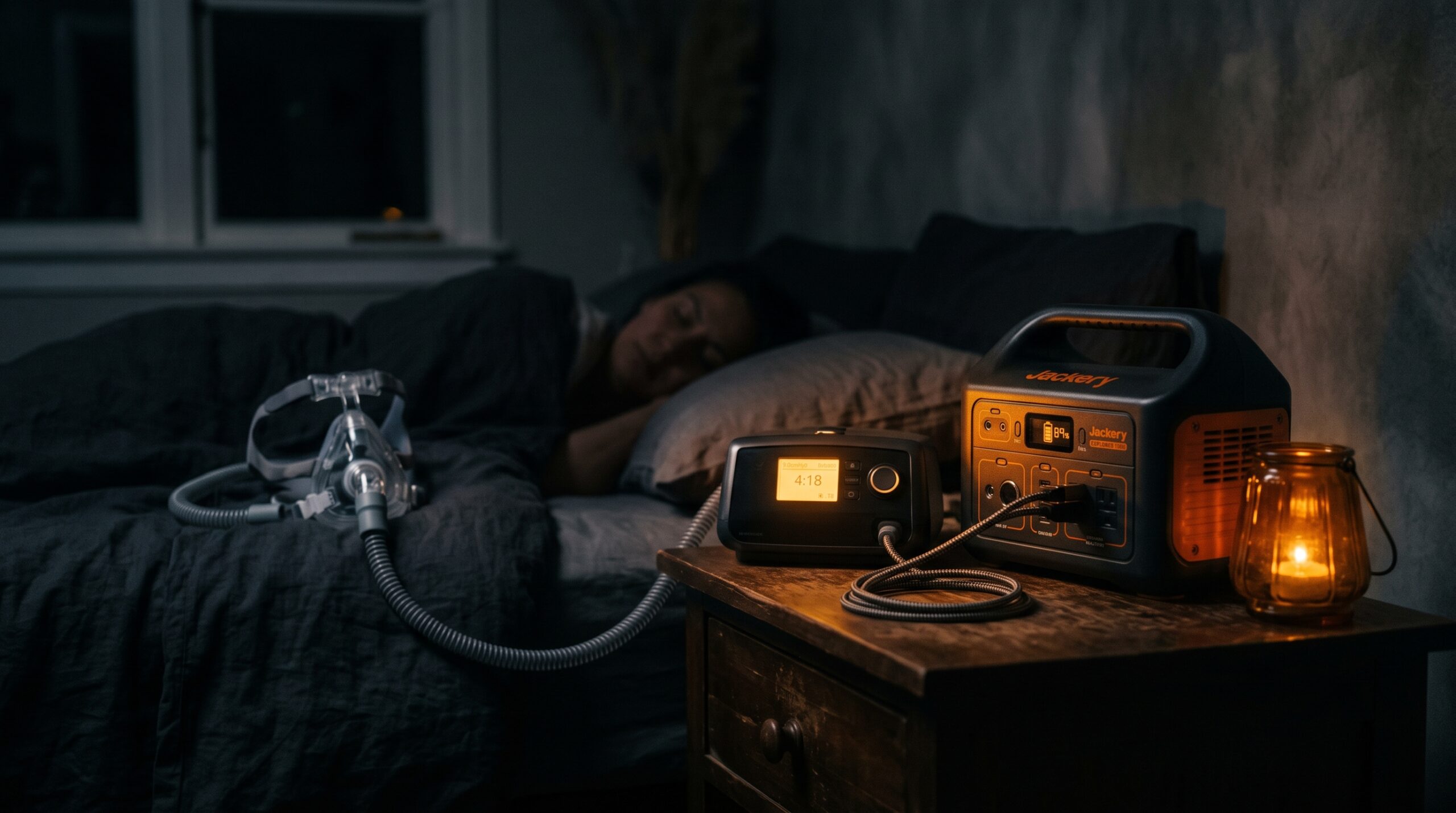
A battery power station can keep most CPAP machines running for one or more nights during a power outage, especially with the heated humidifier turned off, which is the single biggest drain on the battery. The base machine sips power, but the humidifier and heated tube are heavy drinkers, so switching them off is the fastest way to stretch a charge across a blackout.
This guide walks through how much power a CPAP actually draws, how to do the watt-hour math for your own setup, and how to pick and run a power station so therapy keeps going when the grid does not. It is planning information only. Your therapy is between you, your equipment supplier, and your clinician.
⚠️ This is planning guidance, not medical advice
If your CPAP therapy is medically essential, confirm backup-power requirements with your equipment supplier (DME) and clinician before you rely on any battery. Register with your utility’s medical-priority or medical-baseline program, keep distilled water on hand if you use a humidifier, and read your device manual for its exact power input, voltage, and approved battery or DC-converter options. Do not change your prescribed pressure or other therapy settings to save power.
How much power a CPAP uses
A CPAP has two very different power profiles. The blower motor that delivers your pressure is efficient. The heated humidifier and the heated tube are not, because heating water and air takes far more energy than moving air does. That split is the whole game when you are running on a battery.
As a rough planning range, a standard CPAP draws about 30 to 60 watts without humidification. Add a heated humidifier and you are often in the 60 to 90 watt range, and a heated tube on top of that can push draw toward 100 watts, according to equipment supplier Hart Medical. Newer machines can be more efficient at low pressures. ResMed’s AirSense 11, for example, ships with a 65-watt power supply and can sit in the single-digit watts during gentle use, while peaking around 72 watts with the humidifier and ClimateLine tube running hard. The older AirSense 10 shipped with a 90-watt supply and peaks higher, near 104 watts.
Translated to a full night, RespBuy’s measured figures for those ResMed machines show roughly 0.07 to 0.12 kWh (about 70 to 120 watt-hours) over eight hours with no humidification, rising to about 0.24 to 0.50 kWh (240 to 500 watt-hours) with both the humidifier and heated hose on low to medium heat. Your machine, your pressure, your leaks, and your room temperature all move that number. The only figure you should plan around is your own, so check your device manual or ask your DME for the wattage and nightly draw of your exact model.
How long a power station lasts (the watt-hour math)
Power stations are rated in watt-hours (Wh), which is energy stored. The simple version is:
Nights of runtime ≈ usable watt-hours ÷ watt-hours your CPAP uses per night.
Say your machine draws about 40 watts with the humidifier off and you sleep eight hours. That is roughly 320 watt-hours a night. A 500 Wh station would not deliver all 500 Wh to the machine, because an AC inverter loses energy as heat, usually somewhere around 10 to 15 percent. Call it about 425 usable watt-hours. Divide 425 by 320 and you get a little over one night. Turn the humidifier back on at, say, 90 watts (about 720 Wh a night) and the same station covers well under a single night.
That is why the humidifier is the headline. EcoFlow notes that turning off the heated humidifier and heated tube can easily triple a battery’s runtime. The table below is a planning starting point, not a guarantee. Build your own estimate from your machine’s real numbers, and leave yourself margin.
Power station capacity and approximate nights
| Station capacity | Approx. nights, humidifier OFF | Approx. nights, humidifier ON |
|---|---|---|
| ~300 Wh | About 1 short night | Often less than 1 full night |
| ~500 Wh | 1 to 2 nights | About 1 night |
| ~750 to 800 Wh | About 2 nights | About 1 night |
| ~1,000 Wh | 2 to 3 nights | 1 to 2 nights |
| ~1,500 Wh | 3 to 4 nights | About 2 nights |
| ~2,000 Wh or more | 4 to 6 nights | 2 to 3 nights |
How to maximize runtime
- Turn off the heated humidifier. This is the single biggest lever and can multiply your runtime. Many people accept a drier night during an outage to keep therapy going. If dryness is a problem for you, ask your provider what they recommend.
- Turn off the heated tube. The heated hose is a second meaningful draw. Switching it off, on its own or alongside the humidifier, frees up more watt-hours.
- Use a DC cord instead of the AC inverter when your machine supports one. Running the machine on DC avoids inverter conversion losses. EcoFlow estimates a direct DC cord can extend battery life by 20 to 30 percent. The cord and converter must match your exact model and voltage, so use the manufacturer’s part. ResMed, for example, sells an Air11 DC converter for the AirSense 11.
- Do not change your prescribed pressure to save power. Pressure is a medical setting your clinician controls. Some machines adjust automatically for altitude, which is fine, but runtime planning should never involve lowering your therapy. If you think your settings affect your backup needs, raise it with your provider.
- Keep the station fully charged and cool. Recharge it after every use, store it at room temperature, and replace aging batteries on the manufacturer’s schedule. A cold or worn battery delivers less than its rating.
Choosing a power station for CPAP backup
Two specs matter most for CPAP use:
- Capacity in watt-hours. Match it to how many nights you want to cover, using the math above. For one no-humidifier night, many people plan around 500 Wh or more. For humidifier use or multi-night reserve, 1,000 Wh and up gives breathing room.
- Pure sine wave AC output. This is the non-negotiable one. CPAP electronics expect clean, grid-like power. A modified sine wave inverter can run hot, behave unpredictably, or be refused by the machine. Confirm the station says “pure sine wave,” as mainstream units from brands like Jackery and EcoFlow do.
After those two, look at battery chemistry (LiFePO4 lasts more charge cycles and tolerates heat better), weight, how quietly it runs near your bed, whether it offers a DC output that fits your CPAP cord, and how you can recharge it during a long outage, for example by solar panel or car. Whatever you choose, ask your DME whether they approve that station or battery for your specific device before you depend on it.
Other backup power options for CPAP
A power station is not the only path. Dedicated CPAP battery packs are built specifically for travel and outages, are lighter than a power station, and often connect over DC for efficiency, though many cannot drive a heated humidifier and have smaller capacity. A 12V DC car adapter or converter lets you run the machine from a vehicle in an extended outage. A small uninterruptible power supply (UPS) can bridge brief flickers but rarely holds a full night. The American Lung Association suggests medical-device users keep a battery backup or car adapter ready, keep devices charged, and talk to their supplier and clinician about options before an emergency. As always, confirm any option against your machine’s manual and your DME’s guidance.
Plan your own runtime
Once you know your CPAP’s wattage, you can estimate exactly how long a given battery will hold it. Use our Appliance Runtime calculator to turn your machine’s watts and a station’s watt-hours into hours and nights of runtime. If you are still deciding which station to buy, the Power-Station Sizing calculator works backward from the nights you want to cover to a capacity target. Plug in your own numbers, not the averages here, for the most useful answer.
Frequently asked questions
Can a power station run my CPAP all night during an outage?
Usually yes for one night, and often several nights, if you turn the humidifier off. A 500 Wh station covers roughly one no-humidifier night for many machines, and a 1,000 Wh unit can cover two or more. With the humidifier and heated tube running, expect closer to a single night per 700 to 1,000 Wh. Your exact result depends on your machine’s draw, so run the numbers for your own setup and confirm with your supplier.
Does turning off the humidifier affect my therapy?
Turning off the heated humidifier does not change the air pressure your machine delivers, which is the core of the therapy. It mainly affects comfort, since the air will feel drier. Many people accept that trade for a night or two during an outage to keep the machine running. If dryness, nosebleeds, or congestion are a concern for you, ask your clinician or DME what they recommend. This is planning guidance, not medical advice.
Do I need a pure sine wave power station for a CPAP?
Yes, plan on pure sine wave output. CPAP electronics are designed for the clean power of a wall outlet, and a modified sine wave inverter can cause heat, erratic behavior, or refusal to run. Mainstream lithium power stations from brands like Jackery and EcoFlow specify pure sine wave output. If a unit does not clearly state it, do not assume it.
Is a DC cord better than the AC adapter when running on a battery?
Often, yes. Running your CPAP from a matched DC cord skips the inverter, which avoids conversion losses and can extend runtime by roughly 20 to 30 percent. The catch is that the cord and any converter must be the correct part for your exact model and voltage. ResMed, for instance, sells a dedicated DC converter for the AirSense 11. Use the manufacturer’s approved accessory and check it with your DME.
What size power station do I need for several nights of backup?
Estimate your nightly watt-hours (machine watts multiplied by hours of sleep), then multiply by the number of nights you want to cover, and add 15 to 20 percent for losses and a safety margin. As a rough guide, with the humidifier off, a 1,000 Wh station tends to cover two to three nights and a 2,000 Wh unit four to six. With the humidifier on, plan for far fewer. Use the runtime and sizing calculators above to size it to your own machine.
Sources
- ResMed, CPAP batteries and power converters: https://www.resmed.com/en-us/products/cpap/battery-and-power-converters/
- The CPAP Shop, ResMed AirSense 11 power guide: https://www.thecpapshop.com/blog/the-airsense-11-power-guide/
- RespBuy, how much electricity an AirSense 11 uses vs older models: https://respbuy.com/how-much-electricity-an-airsense-11-uses-vs-older-models/
- Hart Medical Equipment, how much power does a CPAP machine use: https://hartmedical.org/blog/post/how-much-power-does-a-cpap-machine-use-hart-medical-equipment
- EcoFlow, how to power a CPAP during an outage: https://www.ecoflow.com/us/blog/how-to-power-cpap-during-outage
- American Lung Association, preparing for a power outage as a medical device user: https://www.lung.org/blog/power-outage-preparation