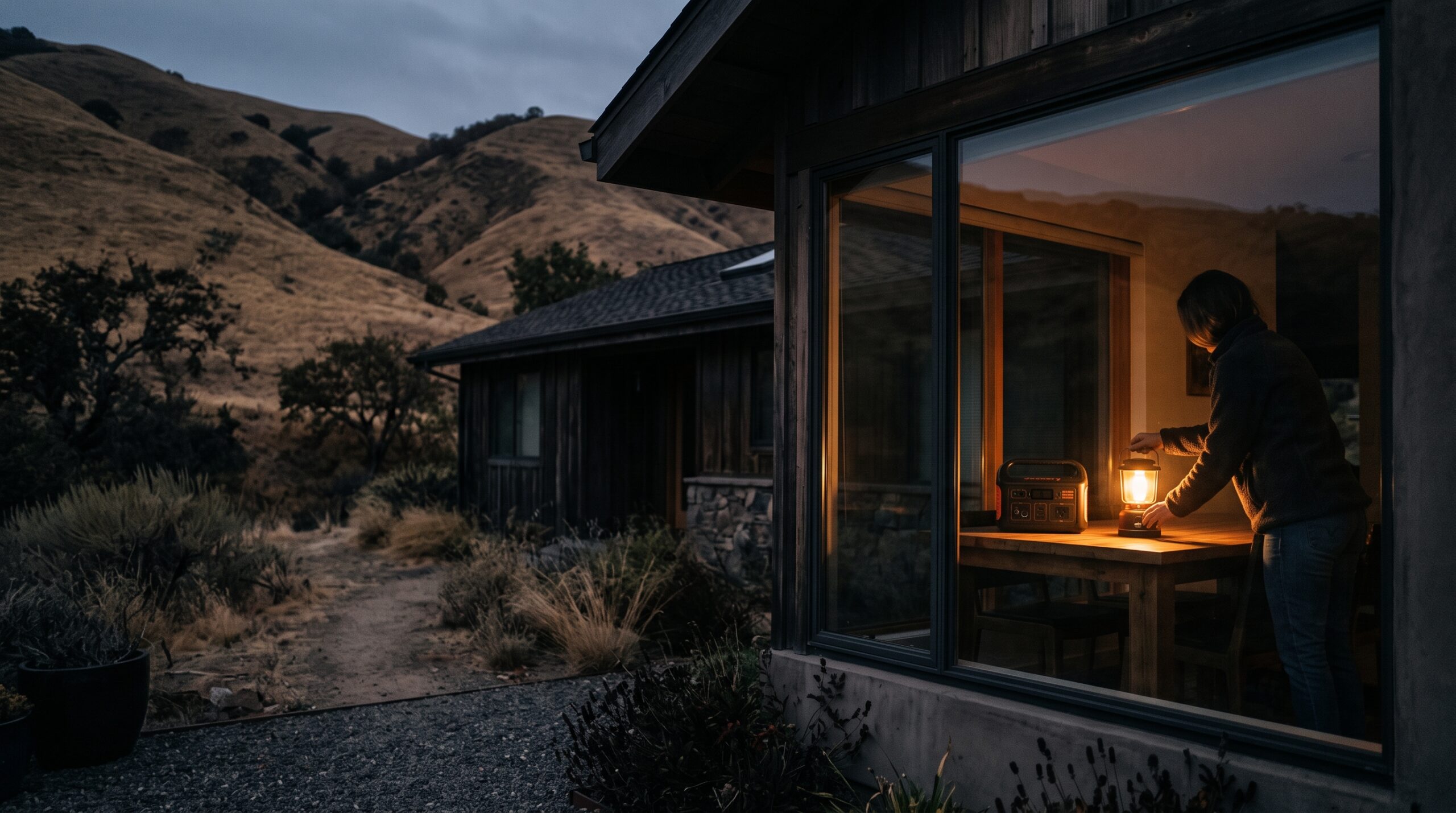
A Public Safety Power Shutoff (PSPS) is a planned outage your utility turns off on purpose during dangerous fire weather, so it is the one outage you can almost always prepare for in advance. Because you usually get hours to a couple of days of warning, a PSPS is the ideal case for battery backup: you can charge everything before the lights go out. The California Public Utilities Commission describes a PSPS as a measure of last resort that utilities use to keep wind-damaged power lines from sparking a wildfire. The CPUC oversees how the big California utilities run these shutoffs and notify the people in their path.
This guide explains what a PSPS is and how you find out one is coming, how to prepare in the days and hours beforehand, how to register powered medical equipment with your utility, and how to cover backup power, food, and water. The most important step, registering medical equipment and running any generator safely, comes first.
⚠️ Register medical equipment, and run generators outdoors only
If anyone in your home relies on powered medical equipment, sign up for your utility’s Medical Baseline program and confirm your exact backup needs with your equipment supplier and clinician. Enrollment can take a billing cycle or two, so start now. Run any generator outdoors only, at least 20 feet from windows, doors, and vents, because the carbon monoxide it gives off is odorless, colorless, and can be deadly indoors.
What a PSPS is and why a utility calls one
A Public Safety Power Shutoff is a deliberate, temporary de-energization. When fire weather turns severe, a utility cuts power to specific high-risk circuits so that a wind-toppled line or flying debris cannot start a fire. The trigger is usually a combination of strong, gusty winds, very low humidity, and dry vegetation, often during a National Weather Service Red Flag Warning. The CPUC stresses that a PSPS is meant to be a last resort, used only when the fire risk of keeping the lines energized outweighs the serious hardship of turning the power off.
That is exactly what makes a PSPS different from a storm outage: it is planned, and your utility tells you it is coming. The flip side is that it can last a while. Depending on the weather and the terrain, a shutoff can run anywhere from a few hours to several days. San Diego Gas & Electric, for example, warns customers that a PSPS could last several hours or multiple days. Power does not come back the moment the wind dies down, either, because crews have to inspect every de-energized line for damage, often in daylight, before they can safely re-energize it. Southern California Edison says it aims to restore most customers within 24 to 48 hours after the severe weather passes. Treat any duration you hear as a planning estimate, not a promise.
How you get notice before a PSPS
Advance warning is the whole advantage of a PSPS, but only if your utility can reach you. The big California utilities send PSPS alerts by automated phone call, text message, and email, and they send them at any hour as the forecast firms up. The single best thing you can do today is log into your utility account and make sure your phone number and email are current, then turn on outage and PSPS alerts. If you are not the account holder, or you want alerts for a second address such as a relative’s home, the utilities offer address-lookup alert tools that do not require an account.
Notice usually arrives in stages over the days before a shutoff, with the warnings growing more specific as the event gets closer. Here is roughly when customers first hear from the three large California utilities, though every utility cautions that shifting forecasts can move these windows, sometimes to the same day:
| Utility | When customers are typically notified first | How you’ll hear |
|---|---|---|
| PG&E | When possible, alerts start about 2 days (48 hours) ahead, with updates as the event nears; if the forecast shifts, the first alert can come the same day | Automated call, text, and email (Warning, Power Off, Restoration, and All Clear) |
| Southern California Edison | Around 2 days ahead to customers, an update about 1 day ahead, and an imminent alert roughly 1 to 4 hours before power is cut | Automated call, text, and email |
| San Diego Gas & Electric | An outage warning about 24 to 48 hours before a possible shutoff | Automated call, text, and email, plus the Alerts by SDG&E app |
Because the final timing can move, do not wait for the last alert to start getting ready. Keep a battery-powered or hand-crank radio as a backup way to hear official updates if your phone runs low, and treat the first warning as your cue to begin charging and prepping rather than the moment to wait and see.
How to prepare before the shutoff
The hours of warning before a PSPS are the difference between a manageable couple of days and a scramble in the dark. Ready.gov recommends taking stock of everything you rely on electricity for, then planning batteries and backup power to cover it. When a PSPS warning arrives, work through the basics while the grid is still up:
- Charge everything. Top off your phones, laptops, battery banks, and any portable power station the moment a warning lands. A full battery is worth far more once the power is out, and you may not be able to recharge from the wall for days.
- Build or check your outage kit. Gather flashlights for everyone, spare batteries, a battery or hand-crank radio, a manual can opener, and any medications in one place. Use flashlights rather than candles, which are a fire risk.
- Fuel up. Fill your car’s tank and keep cash on hand, since gas pumps and card readers go down with the power. If you keep a generator, store fuel safely and well before the event.
- Pre-cool and protect food. Turn your refrigerator and freezer to their coldest settings before the shutoff, freeze extra water or gel packs, and group food together so it holds temperature longer once the power is off.
- Make a medical plan. If anyone depends on electric medical equipment or refrigerated medicine, register with your utility’s medical program (next section) and talk to your provider about a power-outage plan now, not during the event.
- Plan for it to last longer than predicted. Prep as if the shutoff could run a day or two past the estimate, because restoration depends on weather and inspections you cannot control.
Register for your utility’s medical baseline program
If someone in your household relies on powered medical equipment, registering with your utility is one of the highest-value things you can do before fire season, and it costs nothing. PG&E, Southern California Edison, and San Diego Gas & Electric all run a Medical Baseline program for customers who depend on electricity for a medical need. PG&E’s program, for example, covers equipment such as motorized wheelchairs, respirators, CPAP machines, and dialysis machines, and it sends enrolled customers advance notice before a Public Safety Power Shutoff. Enrolling also adds an allowance of electricity at the lowest rate to help cover what those devices use.
Enrollment usually requires a short application that your clinician signs to confirm the medical need, and it can take a billing cycle or two to take effect, so apply early rather than during a heat wave or fire warning. Search your utility’s name plus “medical baseline,” or call its customer line, to find the form. Two cautions matter, though. First, registering does not guarantee your power stays on or comes back faster, so you still need your own backup. Second, confirm your exact backup-power requirements with your durable medical equipment (DME) supplier and clinician, follow your device manual, and for oxygen keep a non-electric tank fallback. Do not change a prescribed setting or flow rate to save power.
Backup power is the ideal PSPS use case
A PSPS is close to the perfect job for a battery power station, precisely because you get notice. When the warning comes, you charge the station to full from the wall, and when the power cuts you have a quiet, fume-free battery that is safe to run indoors. That lets you keep lights, a Wi-Fi router, phone chargers, a fan, a CPAP, or a refrigerator going without stepping outside to a generator. The one wrinkle for a multi-day PSPS is recharging: you cannot plug back into a dead grid, so plan to top the station up from solar panels during the day or from your car, and budget your battery for the hours of darkness in between.
Size the station for two numbers: the running watts of what you want to keep on, and the higher surge watts some appliances need to start. A refrigerator might draw only 100 to 400 watts while running but spike to several times that at startup, so the station’s surge rating has to clear that spike or it will trip. Capacity, measured in watt-hours, decides how long the battery lasts. A mid-size station in the 500 to 2,000 watt-hour range covers lights, electronics, Wi-Fi, and short fridge cycles, while a 1,500-watt space heater or window air conditioner will drain most portable batteries fast. A gas generator makes more power for a longer haul, but it has to run outdoors only, at least 20 feet from the house, and it needs fuel you have to store and refresh.
Whatever you choose, do the math before fire season, not during a warning. Our Power-Station Sizing calculator helps you match a station to the loads you actually need to keep running, and the Appliance Runtime calculator shows how long a fridge, fan, or CPAP will last on a given battery before it runs flat.
Food and water
Because a PSPS can stretch across days, food and water deserve their own plan. The simplest rule is to keep the refrigerator and freezer doors shut. A closed refrigerator keeps food cold for about 4 hours, a full freezer for roughly 48 hours, and a half-full freezer for about 24 hours. Coolers with ice extend a refrigerator well past that 4-hour window, so move the milk, leftovers, and medications that need cold into a cooler if the shutoff looks long. When in doubt, throw it out: perishable food that has sat above 40°F for more than 2 hours is no longer safe to eat.
For water, Ready.gov recommends storing at least one gallon per person per day, and because a PSPS can run several days, plan for that full stretch rather than a single day. Keep a few days of no-cook food that does not need refrigeration, plus a manual can opener. If your water comes from a well with an electric pump, store extra water ahead of time, since the pump will not run during the shutoff.
Staying safe during the shutoff
The hazards of a PSPS come less from the dark than from how people cope with it. The deadliest mistake is carbon monoxide: portable generators, gas and charcoal grills, and camp stoves all give off CO and must never run indoors, in a garage, or near a window. Ready.gov and the CDC say to run a generator outdoors only, at least 20 feet from any window, door, or vent, and to keep a battery-powered CO alarm in the home. Unplug sensitive electronics so a surge does not damage them when power returns, and leave one light switched on so you can tell at a glance when it comes back.
PSPS events strike during hot, dry, windy weather, so heat is the other big risk. The CDC’s guidance is to stay cool, stay hydrated, and stay informed: drink water before you feel thirsty, wear loose, light clothing, and keep blinds closed against the sun. If your home gets dangerously hot, do not tough it out. Utilities open Community Resource Centers during many PSPS events where you can cool off, charge devices, and get water and information, and local officials may open cooling centers as well. Older adults, young children, and anyone with a chronic condition are the most at risk, so check on neighbors who live alone. Remember that traffic signals go dark too: treat an intersection with dead signals as an all-way stop.
Frequently asked questions
What is a Public Safety Power Shutoff (PSPS)?
A PSPS is a planned, temporary power shutoff that a utility turns off on purpose during severe fire weather, such as strong winds, very low humidity, and dry vegetation, so that a wind-damaged power line cannot spark a wildfire. The CPUC describes it as a measure of last resort. Unlike a storm outage, it is deliberate and pre-warned, which is why it is the one kind of outage you can almost always prepare for in advance.
How much notice do you get before a PSPS?
Usually hours to a couple of days. When possible, PG&E begins alerts about two days ahead, SCE notifies customers roughly two days out with an imminent alert one to four hours before the cut, and SDG&E sends an outage warning around 24 to 48 hours ahead. But forecasts change, so the first alert can sometimes arrive the same day power is shut off. Sign up for your utility’s alerts and update your contact info now so you actually receive them.
How long does a PSPS last?
Anywhere from a few hours to several days, depending on the weather and the terrain. Power does not return the instant the wind drops, because crews must inspect every de-energized line for damage, often in daylight, before re-energizing it. SCE aims to restore most customers within 24 to 48 hours after the severe weather passes. Treat any figure you hear as a planning estimate, and prep as if the shutoff could run longer than predicted.
Is a battery power station good for a PSPS?
Yes, a PSPS is one of the best uses for one, because you get notice. When the warning comes, you charge the station to full, and once the power is out it runs quiet, gives off no fumes, and is safe indoors, so it can keep lights, Wi-Fi, phone chargers, a CPAP, or a fridge going. For a multi-day shutoff, plan to recharge it from solar panels or your car, since you cannot plug into a dead grid. Size it for both the running watts and the startup surge of what you want to power.
How do I sign up for PSPS alerts and the medical baseline program?
For alerts, log into your electric utility account, confirm your phone number and email, and turn on outage and PSPS notifications; utilities also offer address-lookup alert tools that do not require an account. For the Medical Baseline program, search your utility’s name plus “medical baseline” or call its customer line to get the application, which a clinician typically signs. Enrolling adds advance PSPS notice and a lower-cost electricity allowance, but it can take a billing cycle or two, so apply early. Registering does not guarantee your power, so keep your own backup ready.
Sources
- California Public Utilities Commission — Public Safety Power Shutoffs (PSPS)
- PG&E — Public Safety Power Shutoffs
- PG&E — Medical Baseline Program
- Southern California Edison — Public Safety Power Shutoff (PSPS)
- San Diego Gas & Electric — Public Safety Power Shutoff (PSPS)
- Ready.gov — Power Outages
- CDC — Protect Yourself From the Dangers of Extreme Heat