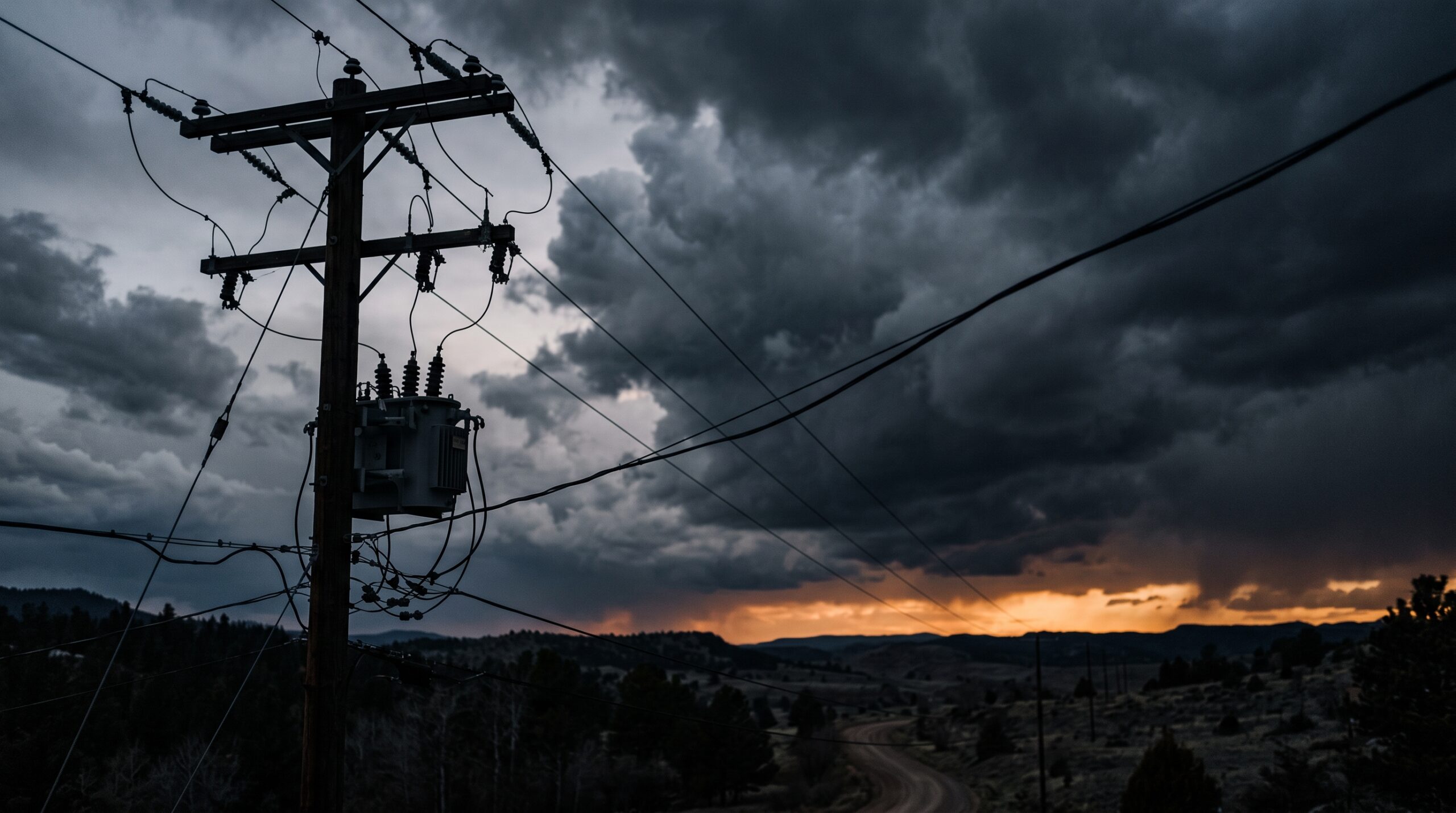
The power goes out for a handful of common reasons, but most outages trace back to one thing: the weather. About 80% of major U.S. power outages from 2000 to 2023 were weather-related, according to a Climate Central analysis of federal data, with severe storms, winter weather, and hurricanes leading the list. The rest come from equipment failures, grid strain in extreme heat or cold, animals, accidents, and planned shutoffs the utility orders on purpose.
This guide walks through each of those causes, sorts out what you can and can’t control, and shows how to be ready when the lights go out anyway. Most causes are out of your hands. Your response to them is not.
Severe weather and storms
Weather is the single biggest reason the power goes out, and it isn’t close. High winds snap branches and whole trees onto overhead lines, lightning strikes transformers and substations, ice and heavy snow drag lines down under their own weight, and floodwater shorts out ground-level equipment. Of the weather-related major outages from 2000 to 2023, Climate Central found that severe weather such as thunderstorms and high wind drove most of them, followed by winter storms and tropical cyclones including hurricanes.
The damage shows up in the national numbers. The U.S. Energy Information Administration reported that customers averaged about 11 hours without power in 2024, nearly twice the typical year in the decade before, and that major hurricanes Beryl, Helene, and Milton accounted for roughly 80% of those lost hours. In a calmer year like 2022, the average was closer to five and a half hours, and only about two hours once you set aside major weather events. In other words, normal grid operation keeps most people on most of the time. Big storms are what turn a short blip into days in the dark.
Downed lines and equipment failure
Sometimes the grid simply wears out. The U.S. electric system runs on transformers, breakers, switches, and miles of line, much of it decades old, and any one part can fail on its own. A transformer overheats, an underground cable degrades, an aging substation component gives out, and the circuit it feeds goes dark. These failures can happen on a clear, calm day with no storm in sight, which is why the power sometimes goes out for what looks like no reason at all.
Weather and equipment also overlap. A storm rarely takes out the grid by magic; it does it by physically damaging hardware, snapping a line off a pole or dropping a tree across a feeder. When a line comes down, treat it as live and dangerous, stay far away, and call 911 and your utility. You can’t fix the pole down the street, but you can report it fast, which is often what gets a crew dispatched.
Grid strain in extreme heat and cold
The grid has to match supply to demand second by second, and extreme temperatures push both sides to the edge. In a summer heat wave, millions of air conditioners switch on at once just as the late-afternoon sun fades solar output, and demand can climb faster than available supply. In a hard winter freeze, heating load spikes while cold weather can knock power plants and natural gas supply offline at the same time. When demand threatens to outrun supply, a grid operator may order rolling blackouts, short rotating cuts that shed just enough load to keep the whole system from collapsing into a much larger, uncontrolled outage.
These events are usually forecast hours or even days ahead through conservation appeals and grid alerts, so they come with more warning than a sudden storm. The flip side is that the final order to cut power can arrive with only minutes of notice, which is why signing up for alerts ahead of a heat wave or cold snap pays off.
Animals and accidents
One of the most common non-weather causes of outages is wildlife. Squirrels, birds, snakes, and raccoons climb on equipment and bridge the gap between energized parts, which trips the circuit and can damage the gear in the process. Squirrels are the usual culprits at substations and on distribution lines, and utilities report thousands of animal-caused outages every year. Nesting birds and rodents chewing on insulation add to the count.
Human accidents do the same thing in a hurry. A car crashes into a utility pole, a backhoe or excavator hits an underground line during digging, a crane contacts an overhead wire, or a mylar balloon drifts into a substation and shorts it out. None of these are predictable, and from your side of the meter there is little you can do to prevent them. They are a good reminder that outages are not only a stormy-day problem.
Planned shutoffs and maintenance
Not every outage is a failure. Utilities sometimes cut power on purpose to do the work that keeps the grid safe. Routine planned outages let crews replace a transformer, upgrade a line, or connect new equipment without working on live wires, and your utility normally gives advance notice of these so you can plan around them.
The other planned outage is a Public Safety Power Shutoff, or PSPS. During dangerous fire weather, when strong winds, dry vegetation, and low humidity raise the risk that power lines could spark a wildfire, utilities in high-risk areas proactively de-energize circuits as a last resort. The California Public Utilities Commission describes PSPS as a safety measure that prevents utility equipment from igniting a fire, with the trade-off that it leaves communities without power, sometimes for an extended stretch. If you live in a wildfire-prone area, a PSPS is one of the outages most worth preparing for, because it can last far longer than a storm blip.
| Cause | How common | Can you prepare? |
|---|---|---|
| Severe weather and storms | The top cause; about 80% of major U.S. outages 2000-2023 | Can’t prevent it, but you can stock a kit and backup power and track the forecast |
| Equipment failure and downed lines | Common, and can strike on a clear day | No, but report downed lines fast and keep a battery ready |
| Grid strain in extreme heat or cold | Seasonal, during heat waves and deep freezes | Yes, sign up for grid alerts, pre-cool or pre-heat, and charge up early |
| Animals and accidents | A leading non-weather cause, year-round | Not really, beyond having backup power on hand |
| Planned shutoffs and PSPS | Occasional; more frequent in fire-risk areas | Yes, you usually get advance notice, so charge devices and plan ahead |
How to be ready for any outage
You can’t control the weather, a failing transformer, or a squirrel on a substation. What you can control is whether an outage is a minor inconvenience or a real problem. The prep is the same no matter what causes the lights to go out, so set it up once and you’re covered for all of the above:
- Turn on alerts. Enable text or email outage alerts in your utility account and sign up for your local emergency alert system. For heat, cold, and fire events you’ll often get hours of warning.
- Keep an outage kit. Flashlights for everyone, spare batteries, a battery or hand-crank radio, drinking water, some no-cook food, and a manual can opener, all in one place. Plan on at least one gallon of water per person per day.
- Protect your food. Keep the refrigerator and freezer closed. A closed fridge holds food safely for about 4 hours, a full freezer for roughly 48 hours, and a half-full freezer for about 24 hours.
- Plan for medical needs. If anyone relies on electric medical equipment or refrigerated medicine, talk to your provider about a power-outage plan and ask your utility about a medical priority registry.
- Have backup power. A charged battery power station or a generator keeps the essentials running. If you use a generator, run it outdoors only, at least 20 feet from any window, door, or vent.
⚠️ Never run a generator indoors
Portable generators give off carbon monoxide, an odorless, colorless gas that can kill within minutes. Ready.gov and the CDC say to run a generator outdoors only, at least 20 feet from any window, door, or vent, and never in a garage even with the door open. Keep a battery-powered or battery-backup CO alarm in your home. A battery power station gives off no fumes and is the safe choice for running essentials indoors.
Backup power for the outages you can’t avoid
Since you can’t stop most outages, the practical move is to make sure the essentials keep running when one hits. A battery power station is quiet, gives off no fumes, and is safe indoors, so it can keep a fridge, a few lights, the Wi-Fi router, phone chargers, or a CPAP machine going through a short outage. A gas generator makes more power for a longer haul but has to run outside. Either way, size it for two numbers: the running watts of what you want to keep on, and the higher surge watts some appliances, like a refrigerator, need to start.
Do the math before the next storm or heat wave, not during it. Our Power-Station Sizing calculator helps you match a station to the loads you actually need to keep running, and the Appliance Runtime calculator shows how long a fridge, fan, or CPAP will last on a given battery before it runs flat.
Frequently asked questions
What is the most common cause of power outages?
Weather is the most common cause by a wide margin. A Climate Central analysis of federal data found that about 80% of major U.S. power outages from 2000 to 2023 were weather-related, led by severe storms and high wind, then winter storms, then tropical cyclones including hurricanes. Equipment failure, grid strain, animals, accidents, and planned shutoffs make up the rest.
Why does the power go out during a storm?
Storms knock out power by physically damaging the grid. High winds blow branches and trees onto overhead lines, lightning strikes transformers and substations, and ice or heavy snow drags lines down under the added weight. Once a line comes down or a piece of equipment is damaged, the circuit it feeds loses power until a crew can repair it, which is why storm outages can last from hours to days.
Why does the power go out when there’s no storm?
Plenty of outages have nothing to do with weather. Aging equipment can fail on a clear day, a car can hit a utility pole, a squirrel or bird can short out a substation, or a digging crew can cut an underground line. Utilities also cut power on purpose for maintenance or, in fire-risk areas, for a Public Safety Power Shutoff. So an outage on a calm, sunny day usually means equipment, an animal, an accident, or planned work, not the weather.
What is a Public Safety Power Shutoff (PSPS)?
A Public Safety Power Shutoff is a planned outage a utility orders during dangerous fire weather. When strong winds, dry vegetation, and low humidity raise the risk that power lines could spark a wildfire, utilities in high-risk areas proactively cut power to certain circuits as a last resort. The California Public Utilities Commission supports it as a safety measure, with the trade-off that it can leave communities without power, sometimes for an extended period.
How can I keep the power on during an outage?
You can’t keep the grid up, but you can keep your essentials running with backup power. A charged battery power station is safe to use indoors and can run a fridge, lights, Wi-Fi, phone chargers, or a CPAP through a short outage; a gas generator makes more power but must run outdoors only. Size either one for both the running watts and the startup surge of what you want to power, and set it up before the next outage rather than during it.
Sources
- Climate Central — Weather-related Power Outages Rising
- U.S. Energy Information Administration — Hurricanes in 2024 led to the most hours without power in 10 years
- U.S. Energy Information Administration — U.S. electricity customers averaged five and one-half hours of interruptions in 2022
- Ready.gov — Power Outages
- California Public Utilities Commission — Public Safety Power Shutoffs (PSPS)
- Unitil — How Animals Impact Our Electrical Infrastructure