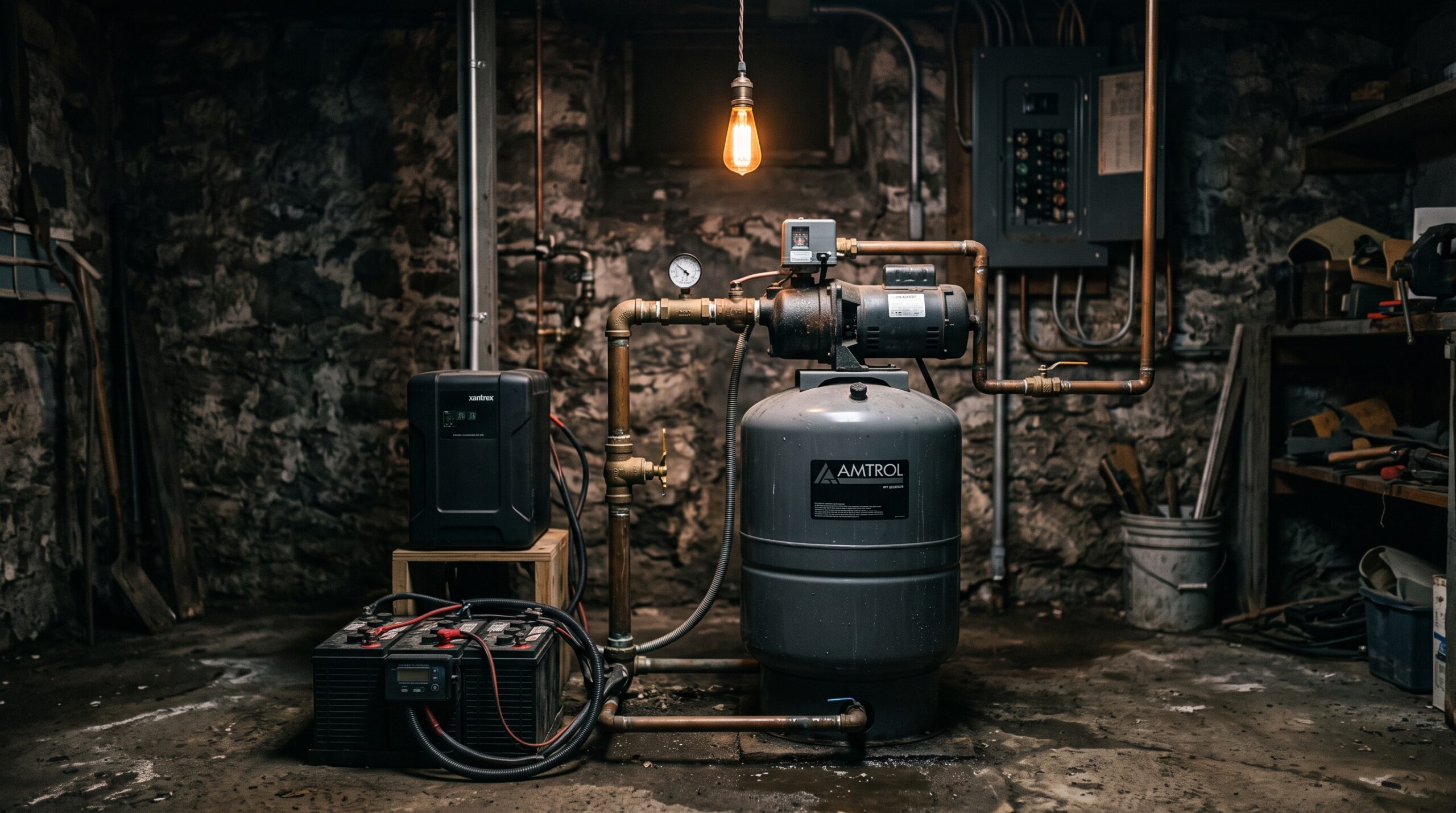
If your home runs on a private well, the plumbing only works while the electricity does. No power means no well pump, and no pump means no running water — no tap, no shower, and no flushing toilet once the pressure tank empties. That is the part of a power outage well owners forget until the faucet sputters and stops.
About 23 million U.S. households draw their drinking water from private wells, according to the EPA, and every one of those wells depends on an electric pump. Below is how to keep water available when the grid goes down: store water ahead, understand why a well pump is so hard on backup power, weigh your options, and know what to do about water safety after the outage — especially if flooding is involved.
⚠️ Treat well water as unsafe after flooding
If your well is flooded or you suspect contamination, do not drink the water; follow local health guidance and the CDC, and test or disinfect before use. Boiling does not make water safe if fuel or toxic chemicals may have gotten in — use bottled water until your well is tested and cleared.
Why an outage stops your water
A private well system has no city water main behind it. An electric pump — usually a submersible pump sitting deep in the well, or a jet pump for a shallow well — lifts water up and pushes it into a pressure tank near your house. That tank holds a small reserve under pressure, which is why the tap still runs for a minute or two after the power dies. Once the stored pressure bleeds off, you have nothing until the pump can run again.
The pressure tank buys you only a handful of toilet flushes or a few gallons at the sink, not a day’s worth of water. So the moment the grid drops, your usable water is whatever is already in that tank plus whatever you stored ahead of time. Everything else — drinking, cooking, hand-washing, flushing — depends on either getting the pump running on backup power or having water set aside in advance.
Store water ahead
The simplest insurance against a dead well pump is water you already have on hand. Ready.gov and the CDC both recommend storing at least one gallon of water per person, per day — for drinking and basic sanitation — with a three-day supply as the minimum and a two-week supply as the goal if you have room. Well households arguably need that buffer more than anyone on city water, because there is no municipal pressure to fall back on.
Commercially bottled water is the easiest reliable option; keep it sealed until you need it. If you fill your own food-grade containers, the CDC says to sanitize them first and replace self-stored tap water about every six months. For the full method and a by-household-size breakdown, see our guide on how much water to store. And don’t forget non-drinking water: keeping a few jugs or a filled bathtub on hand means you can still flush a toilet by pouring water into the bowl when the pump is down.
Why well pumps are hard on backup power — surge
A well pump is an induction-motor load, so it has two wattage numbers that matter. Running watts are what it draws once the motor is up to speed. Starting watts (also called surge or inrush) are the brief spike the instant the motor kicks on, and that spike is commonly two to three times the running figure. Size your backup power to the running number alone and the pump may simply refuse to start, tripping the unit on overload at the worst possible time.
The table below shows typical ranges for residential submersible pumps. Numbers vary with how deep the well is, how high the pump has to lift water, motor age, and design, so treat these as ranges and always check your own pump’s nameplate.
| Pump size | Running watts | Starting / surge watts |
|---|---|---|
| 1/2 HP | 700–1,000 W | 1,500–3,000 W |
| 3/4 HP | 1,000–1,500 W | 2,000–4,000 W |
| 1 HP | 1,400–2,000 W | 3,000–4,000 W |
| 1.5 HP | 2,000–2,500 W | 4,000–5,500 W |
| 2 HP | 2,300–3,200 W | 5,000–7,500 W |
There is a second trap specific to wells: voltage. Many submersible deep-well pumps run on 240 volts, not the 120 volts a standard generator outlet or portable battery station provides. A 120-volt-only unit cannot run a 240-volt pump at all, no matter how many watts it is rated for. Before you buy anything, check your pump’s nameplate for both its horsepower and its voltage. The same surge-first logic that applies to a sizing for a pump’s surge applies here, with the added voltage hurdle on top.
Backup options: power station, generator, hand pump
There is no single right answer for keeping water flowing in an outage. Most well owners land on one of these four approaches, often in combination.
- Stored water. The cheapest, most reliable backup of all. It covers drinking and sanitation no matter what is wrong with the grid or the pump, and it has no surge or voltage problem to solve. The downside is volume: storing two weeks of water for a family takes real space.
- Battery power station. Quiet, fume-free, and safe to run indoors, a large lithium power station can cycle a well pump — if it is pure sine wave, has enough surge headroom, and can supply your pump’s voltage. This is the catch: smaller stations are 120 volts only and won’t run a 240-volt pump. Some larger units offer a 240-volt output; confirm it on the spec sheet before counting on it.
- Generator. A 240-volt-capable generator is the traditional answer for a deep-well pump, because it can deliver both the high startup surge and the right voltage. A portable model can be wired to the pump through a proper transfer switch (a job for a licensed electrician), or a permanently installed standby generator can power the whole house. See our guide to whole-house generator sizing. Never run any fuel-powered generator indoors or in a garage — the CDC warns that generator exhaust carries carbon monoxide that can kill within minutes; keep it outside, far from windows and doors.
- Manual / hand pump. A hand pump or a deep-well hand pump installed alongside your existing pump draws water with no electricity at all. It is slow and physical, and it has to be matched to your well’s depth, but it is the one option that works during an outage of any length. For some rural homes it is the ultimate fallback.
Whatever you choose, remember the pump cycles on and off rather than running constantly, so battery runtime depends heavily on how much water you actually use. A pump that only runs a few minutes per hour stretches a battery far further than the running-watts figure alone suggests.
Water safety after the outage
Restoring power is only half the job. The bigger risk to a private well is contamination, and flooding is the classic cause. The same storm that knocks out your power can push surface water, sewage, fuel, agricultural runoff, or chemicals into the well. The EPA does not regulate private wells under the Safe Drinking Water Act — as the owner, you are responsible for your own water’s safety — so no one will tell you it is bad unless you check.
If your well has been flooded or you suspect contamination, the CDC’s guidance is direct: do not drink the water. Use bottled water until you are certain the well is safe. A few rules to keep in mind:
- Stay clear of a flooded well pump. The EPA warns to keep away from the pump while it is flooded to avoid electric shock.
- Boiling helps only with germs. A rolling boil for one minute kills bacteria and other microbes, but the CDC is clear that water contaminated with fuel or toxic chemicals will not be made safe by boiling or disinfection. If chemical contamination is possible, use bottled water.
- Disinfect, then test. A flooded well should be cleaned and disinfected (shock-chlorinated) — a job the CDC and EPA recommend leaving to a well or pump contractor for safety reasons — and the well pumped until it runs clear. After disinfection, wait until the chlorine has flushed out, then have the water tested for total coliform and E. coli before you trust it.
- Follow local guidance. Contact your local or state health department or extension office. The right steps depend on what got into the water, and they can point you to a certified lab.
Even without flooding, it is worth knowing your well’s normal condition. The EPA recommends testing a private well at least once a year, which gives you a baseline to compare against if anything seems off after a storm.
To match your specific pump to a backup unit, run the numbers through our Power-Station Sizing calculator to find the surge and capacity you need, then use the Appliance Runtime calculator to estimate how many hours of pumping a given battery will cover at your household’s water use. Confirm your pump’s voltage before you commit to any unit.
Frequently asked questions
Does a power outage stop well water?
Yes. A private well relies on an electric pump, so when the power goes out the pump stops and no new water reaches your taps. You’ll get a minute or two more from the pressure tank’s small reserve, then nothing until the pump runs again on backup power. That is why stored water matters so much for well households.
What size generator or power station do I need to run a well pump?
Size to the pump’s startup surge, not its running watts. A common 1/2 to 3/4 HP submersible pump runs on roughly 700 to 1,500 watts but can surge to 1,500 to 4,000 watts at startup, so you want a unit comfortably above that peak with margin to spare. Just as important, check the pump’s voltage: many deep-well pumps are 240 volts and need a 240-volt-capable generator or power station, not a 120-volt-only one.
Can a battery power station run a well pump?
Sometimes, if the station is pure sine wave, has enough surge headroom, and can supply your pump’s voltage. The sticking point is usually voltage: many submersible pumps need 240 volts, and smaller power stations only output 120 volts, so they can’t run those pumps at all. A large station with a true 240-volt output and a high surge rating may work for a smaller pump, but confirm both specs against your pump’s nameplate first.
Is my well water safe to drink after a flood or power outage?
Assume it is not safe after flooding. The CDC advises drinking bottled water until you are certain the well is free of contaminants. If the well was flooded, have it disinfected by a contractor, pump it until it runs clear, then test for bacteria before drinking. Boiling kills germs but does not remove fuel or toxic chemicals, so use bottled water if chemical contamination is possible, and follow your local health department.
How do I get water from my well without power?
Your options are backup power for the existing pump, a manual well pump, or stored water. A 240-volt-capable generator (or a large power station that supports your pump’s voltage) can run the electric pump. A hand pump matched to your well depth draws water with no electricity at all. And stored water set aside in advance covers drinking and sanitation regardless. Many well owners keep stored water plus at least one of the powered options.
Sources
- EPA – Private Drinking Water Wells (households served, not federally regulated, owner responsibility)
- EPA – Protect Your Home’s Water (annual testing, flooded-well steps)
- CDC – How to Disinfect Wells After an Emergency (assume unsafe, disinfect, test)
- CDC – How to Make Water Safe in an Emergency (boiling limits, fuel/chemical warning)
- Ready.gov – Water (one gallon per person per day, three-day minimum, two-week goal)
- Oakville Pump Service – Submersible well pump power use (running watts and breaker sizing by HP)