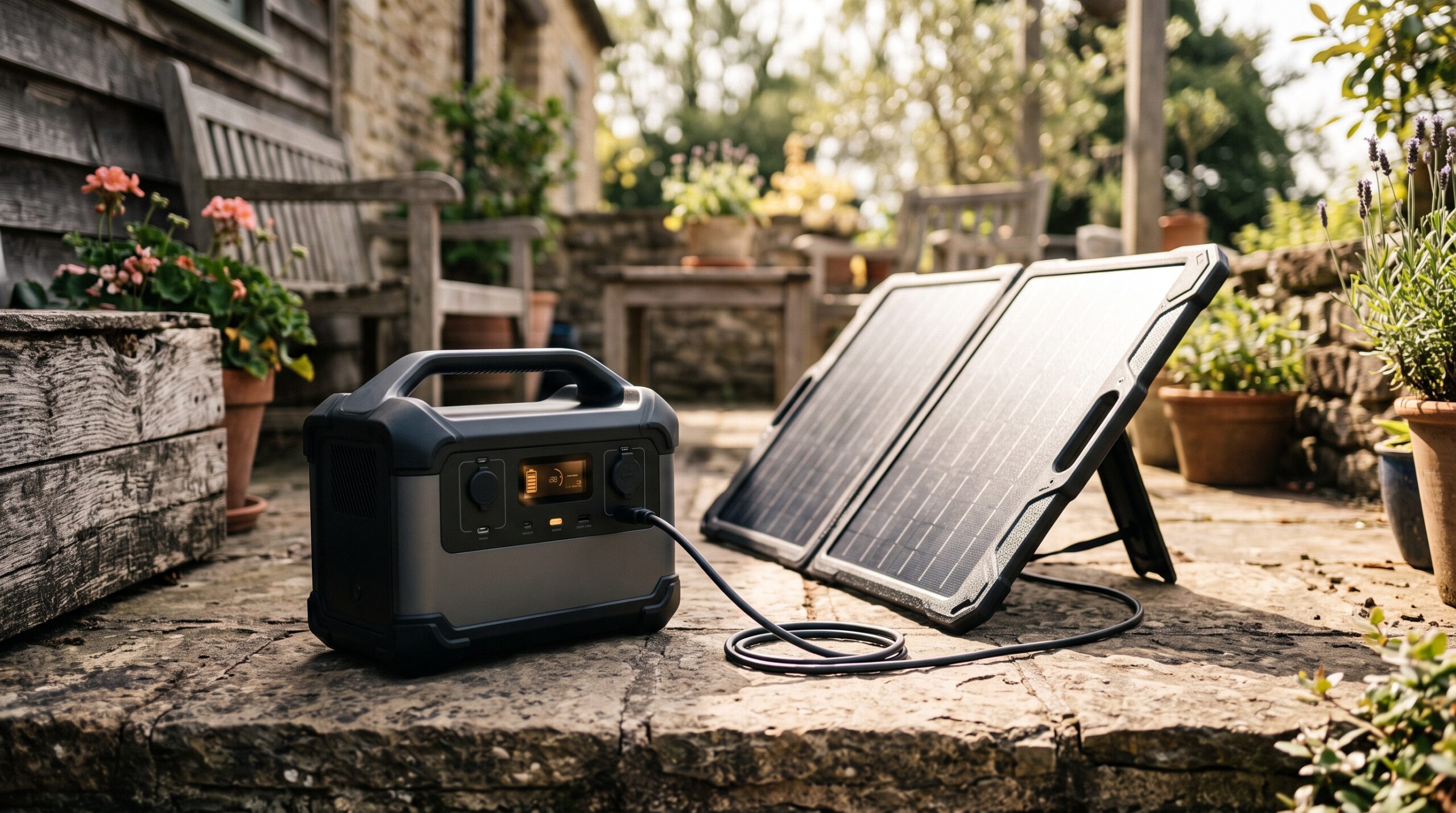
Here is the short version: a solar generator is a battery power station that charges from solar panels. The panels collect sunlight, the battery stores that energy as watt-hours, and a built-in inverter turns it back into the kind of power your devices expect. There is no engine and no fuel inside. The word “generator” is really a marketing label, borrowed from the gas units these things are meant to replace.
Inside that one box, four parts do all the work: a solar input, a charge controller, a battery, and an inverter. Once you see what each one handles, the whole device stops feeling like a black box.
What a solar generator actually is
Strip away the name and you have a portable battery that happens to accept solar charging. Wikipedia describes the term as a consumer label for a portable photovoltaic system with energy storage, not a generator in the engine sense. The makers use the word because these units compete with fuel generators for the same job: keeping the lights and the fridge on when the grid goes down.
That is why the lines blur. If you have read our breakdown of solar generator vs battery, the takeaway is simple: the core device is the same power station. “Solar generator” usually just means panels are bundled in, or at least that the unit has a solar input you can plug panels into.
The four parts inside
Every solar generator is built from the same four building blocks. Some makers combine the charge controller and inverter onto one board, but the functions are still there.
| Part | What it does |
|---|---|
| Solar panels | Capture sunlight and turn it into DC (direct current) electricity. More panel watts means faster charging on a sunny day. |
| Charge controller | Sits between the panels and the battery. It regulates voltage and current so the battery charges safely and does not overcharge. |
| Battery | Stores the energy as watt-hours (Wh). This is the tank. Most modern units use lithium-ion or LiFePO4 cells. |
| Inverter | Converts the battery’s DC power into AC (alternating current), the type of power that standard wall-outlet devices run on. |
The panels are the only part you might buy separately. For a sense of what to look for in that piece, see our guide to the best portable solar panels.
How the energy flows, step by step
Follow a single sunbeam through the system and the whole thing makes sense:
- Sunlight hits the panels. Photovoltaic cells turn that light into DC electricity that flows in one direction.
- The charge controller cleans it up. It regulates the incoming voltage and current so the battery gets a safe, steady charge instead of a damaging spike.
- The battery stores it. Energy banks up as watt-hours and waits there until you need it, day or night.
- The inverter hands it to your devices. When you plug something into an AC outlet, the inverter converts the stored DC back into household AC power on demand.
USB and 12V DC ports skip the inverter step, since those devices already run on DC. That is why charging a phone draws so little from the battery compared to running an AC appliance.
What a solar generator can power
Capacity is measured in watt-hours, and it sets the limit on what you can run and for how long. As a rough guide, a 1,000 Wh battery can run a 100-watt load for somewhere near 10 hours, or a 1,000-watt load for roughly an hour, before real-world losses are counted. Treat those as ballpark ranges, not promises, since inverter efficiency and the device itself both eat into the number.
Portable units commonly land between about 250 Wh and 750 Wh for the small ones, and 1 kWh up to several kWh for the larger household models, with some lines expandable further. In practice that covers phones, laptops, lights, routers, CPAP machines, and a fridge for a stretch. It does not mean whole-home backup. High-draw items like central air conditioning, electric heat, and well pumps will outrun most portable units fast.
Charging from solar vs the wall
The “solar” in solar generator describes one charging method, not the only one. Nearly every unit can also recharge from a standard wall outlet, and many accept a car 12V socket too. Solar is the off-grid option; the wall is the fast, reliable one when you have power.
Solar charge speed depends on panel watts, sun angle, and weather. A cloudy day still charges, just slower, because the panels produce less. Working out how many panels and how many hours it takes to refill a given battery is its own small math problem, which we walk through in the solar recharge math guide.
Where solar generators fall short
A solar generator is quiet, fuel-free, and safe to run indoors, but it has limits. The battery is finite: once the watt-hours are gone, you have to recharge before you can power anything again. Solar recharging is weather-dependent and slow compared with a wall plug. And the upfront cost per watt-hour is higher than a comparable gas generator, even though you save on fuel later.
The honest way to think about it: a solar generator is a battery you can top up with the sun, not an endless source of power. Size it to the loads you actually care about during an outage, and it does that job well.
Run the numbers yourself
Two quick tools turn this from theory into your own numbers. Use the Power-Station Sizing calculator to match a battery’s watt-hours to the devices you want to keep running, then use the Solar Recharge calculator to estimate how long it takes to refill that battery from a given panel setup.
Frequently asked questions
Is a solar generator the same as a battery power station?
Essentially, yes. The core device is a battery power station. It earns the “solar generator” label when it can recharge from solar panels, and especially when panels are bundled in the box.
Do the solar panels come included?
Sometimes. A kit sold as a “solar generator” often includes panels, while a unit sold as a “power station” usually does not. Always check whether panels are in the bundle or sold separately before you buy.
Can a solar generator run my whole house?
Most portable units cannot. They are built to power specific devices like a fridge, lights, and electronics, not high-draw loads such as central air or electric heat. Whole-home backup needs a much larger, professionally installed system.
Can it charge on a cloudy day?
Yes, but slower. Panels still produce power under clouds, just less of it, so the battery fills at a reduced rate. Strong, direct sun gives the fastest solar charging.
How long does it take to recharge from solar?
It depends on the battery’s watt-hours and the panels’ total watts, plus sun conditions. As a rough rule, divide capacity by usable panel output to estimate the hours. The Solar Recharge calculator does this math for your specific setup.
Sources
- U.S. Department of Energy — what a solar inverter does and how it converts DC to AC.
- Morningstar — how a solar charge controller regulates voltage and current and protects the battery.
- Wikipedia: Solar generator — definition of the term and the four core components.
- EcoFlow — manufacturer walkthrough of the energy flow and typical capacity ranges.