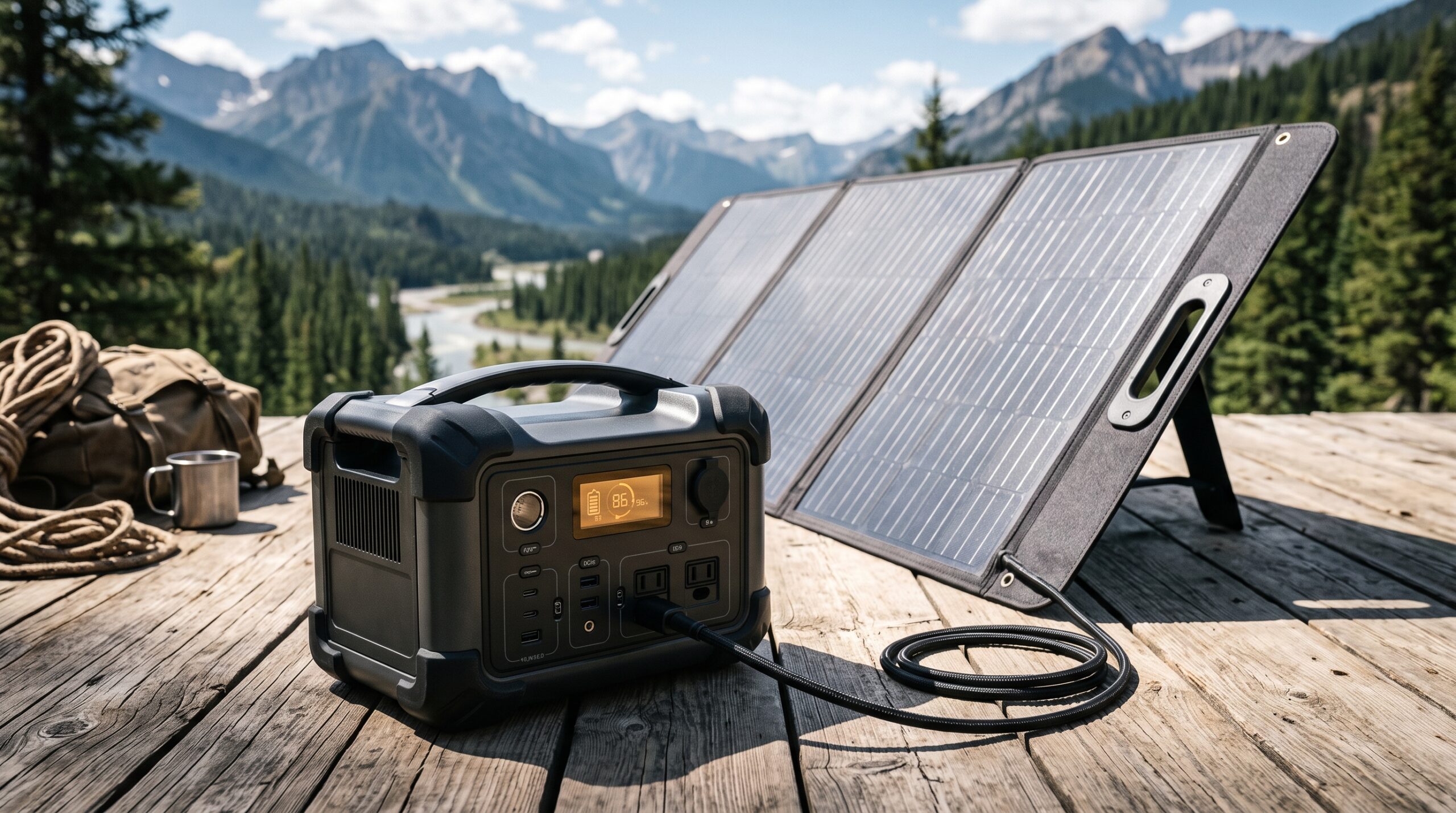
To recharge a 1,000Wh power station in a single sunny day you need roughly 200 watts of solar, give or take, depending on your sun hours. In a cloudy week or a northern winter, the same job can take two or three days, or call for a bigger panel.
The number that trips people up is not the panel rating. It is how few hours of strong sun an actual day gives you, and how much of the rated wattage you lose to heat, wiring, and a panel that almost never faces the sun head-on. Once you can do the math yourself, every spec sheet makes sense.
The recharge formula
Start with how much energy a panel actually harvests in a day. A 100W panel does not make 100 watt-hours per hour all day. It makes close to its rating only when the sun is high and bright, which is what “peak sun hours” measures. The rest of the daylight counts for less.
Here is the working equation:
Daily harvest (Wh) = panel watts × peak sun hours × ~0.7
That 0.7 is a real-world derate. Panels rarely hit their lab rating once you add heat losses, charge-controller overhead, dust, cable resistance, and a less-than-perfect tilt toward the sun. Real numbers land somewhere around 0.6 to 0.85, so 0.7 is a sensible middle for planning. Flip the equation around and you get the two answers people usually want:
- Days to refill from empty = station Wh ÷ (panel watts × peak sun hours × 0.7)
- Panel watts for a one-day refill = station Wh ÷ (peak sun hours × 0.7)
Peak sun hours is the lever that moves everything. Plug in your own figure and the rest follows.
A worked example
Say you own a 1,000Wh station, you run a 200W solar panel, and you live somewhere that averages 5 peak sun hours on a decent day. Daily harvest is 200 × 5 × 0.7 = 700Wh. To refill 1,000Wh from empty: 1,000 ÷ 700 = about 1.4 days of sun. So with average light, that 200W panel tops you off in roughly a day and a half, not one tidy afternoon.
Now move to Arizona in summer with 7 peak sun hours. Daily harvest jumps to 200 × 7 × 0.7 = 980Wh, which is basically a full recharge in a single day. Same panel, same station, very different result, all because of where and when you point it. This is why a manufacturer can advertise an “8-hour” solar recharge and your own experience lands closer to two days. Their figure assumes strong, uninterrupted sun feeding the panel at close to its rating.
The table below maps common station sizes against panel wattage. The numbers are hours of strong (peak) sun the panel needs to collect, assuming the 0.7 derate. Divide by your daily peak sun hours to get the number of days. For example, 1,000Wh with a 200W panel needs about 7 peak sun hours, which is roughly one good day in the Southwest or closer to two days in the cloudy North.
| Station capacity | 100W panel | 200W panel | 400W panel |
|---|---|---|---|
| 500Wh | ~7 peak sun hrs | ~3.5 peak sun hrs | ~1.8 peak sun hrs |
| 1,000Wh | ~14 peak sun hrs | ~7 peak sun hrs | ~3.5 peak sun hrs |
| 2,000Wh | ~29 peak sun hrs | ~14 peak sun hrs | ~7 peak sun hrs |
Why sun hours matter more than panel size
Peak sun hours are not the same as daylight hours. They count only the time the sun delivers full-strength irradiance, so a place with 14 hours of daylight might still give just 5 peak sun hours. The national range across the United States runs roughly 3 to 5 peak sun hours, but the spread by location and season is wide.
- Region. The desert Southwest is the high end. Arizona sees about 7 to 8 peak sun hours, Nevada about 6 to 7.5, and California about 5 to 7.5. Cloudier and northern areas sit lower: Washington around 2.5 to 5, Michigan and the Northeast in the low 4s, and Alaska as little as 1 to 3.
- Season. Winter can cut your daily solar gain by 25 to 50 percent versus the yearly average. Chicago, for instance, drops below 4 peak sun hours for about half the year. A panel that refills your station in a day in July may need most of a week in December.
- Weather and angle. Heavy overcast can knock output down to a small fraction of clear-sky numbers, and a panel lying flat or shaded for part of the day collects far less than one tilted to track the sun. Even thin haze and high temperatures shave watts off.
NREL’s PVWatts calculator and its solar resource maps will give you a defensible peak sun hours figure for your exact location, which beats guessing from a national average.
Panel-to-station compatibility
Before you buy a bigger panel, check three numbers on your station’s spec sheet, because the math only holds if the hardware actually accepts the power.
- Maximum solar input (watts). Every station caps how much solar it will take. The Jackery Explorer 1000, for example, accepts up to 200W of solar, so hanging a 400W array on it does not charge it twice as fast. The EcoFlow Delta 2 (1,024Wh) takes up to 500W and the larger Delta 2 Max (2,048Wh) up to 1,000W. Match the panel to the cap.
- Input voltage window. Stations charge only within a voltage range, often something like 11 to 60V. A panel below the minimum will not start charging, and one above the maximum can shut the input off or risk damage. Panels wired in series add voltage, so a long series string can overshoot a small station.
- Connector and adapter. Most third-party panels use MC4 connectors, while brands like EcoFlow use XT60 at the station. That usually means a cheap MC4-to-XT60 adapter cable, not a dealbreaker, but worth confirming before the trip.
The built-in MPPT charge controller in most modern stations handles the optimization within those limits, but it cannot exceed the rated input cap or the voltage window. Those are hard ceilings.
Realistic expectations versus AC charging
Solar is slower and less predictable than a wall outlet, and that is fine if you plan for it. The same Delta 2 that needs about 3 hours on 500W of solar in strong sun can hit 80 percent from an AC outlet in roughly an hour. Solar’s job is to extend runtime off-grid or keep a station topped up during a multi-day outage, not to match the speed of grid power.
A practical way to think about it: size your panel so it can replace a full day’s energy use in a day of sun, with margin for clouds. If you draw 600Wh a day from a 1,000Wh station, a 200W panel in average light (about 700Wh harvested) keeps pace and slowly refills the buffer. If you draw more than the panel can gather, the battery trends toward empty no matter how sunny it is. Treat the published recharge times as best-case lab figures and give yourself headroom.
Want the numbers for your own gear and location without doing the arithmetic by hand? Run them through our Solar Recharge calculator, which takes your station capacity, panel wattage, and local sun hours and returns a realistic recharge estimate. If you are still deciding how big a station you need in the first place, start with the Power-Station Sizing calculator and then come back to size the solar.
Frequently asked questions
How many solar panels do I need to recharge a 1,000Wh station in one day?
In strong sun (6 to 7 peak sun hours) a single 200W panel can do it. In average light (around 5 peak sun hours) plan on roughly 300W, or accept that 200W takes about a day and a half. The exact figure is station Wh ÷ (peak sun hours × 0.7), so for 1,000Wh at 5 sun hours that is about 285 watts.
Can a solar panel charge the station and power my devices at the same time?
Yes, most stations pass solar power through to your loads while charging. Just remember the battery only gains the difference between what the panel brings in and what your devices pull out. If your draw exceeds the solar input, the battery still drains, only slower.
Why does my 200W panel never actually produce 200 watts?
Panel ratings come from lab conditions: full standardized sunlight, a cool panel, and perfect alignment. Real life adds heat, haze, dust, cable losses, and an imperfect angle, which is why planning around about 70 percent of the rating is realistic. Seeing 130 to 160W from a 200W panel in good sun is normal.
Does cloudy weather stop solar charging completely?
No, but it slows it sharply. Light overcast might drop output to half or less, and heavy storm clouds to a small fraction. You will still trickle in some charge, which is why a slightly oversized panel pays off: it gathers usable power even on marginal days when a minimal panel would barely move the battery.
Is solar charging always slower than the wall outlet?
Usually, yes. A station that charges to 80 percent in about an hour on AC may need several hours of strong sun to do the same on solar, and far longer in poor light. Solar shines for off-grid and outage use where there is no outlet, not for the fastest possible top-up.
Sources
- Jackery Explorer 1000 portable power station (specs, 200W max solar input)
- EcoFlow Delta 2 (1,024Wh, 500W solar input, ~3-hour solar recharge)
- EcoFlow Delta 2 Max (2,048Wh, 1,000W solar input)
- NREL PVWatts calculator (location-specific solar production estimates)
- NREL solar resource maps and data
- SolarReviews: peak sun hours explained (state-by-state figures)