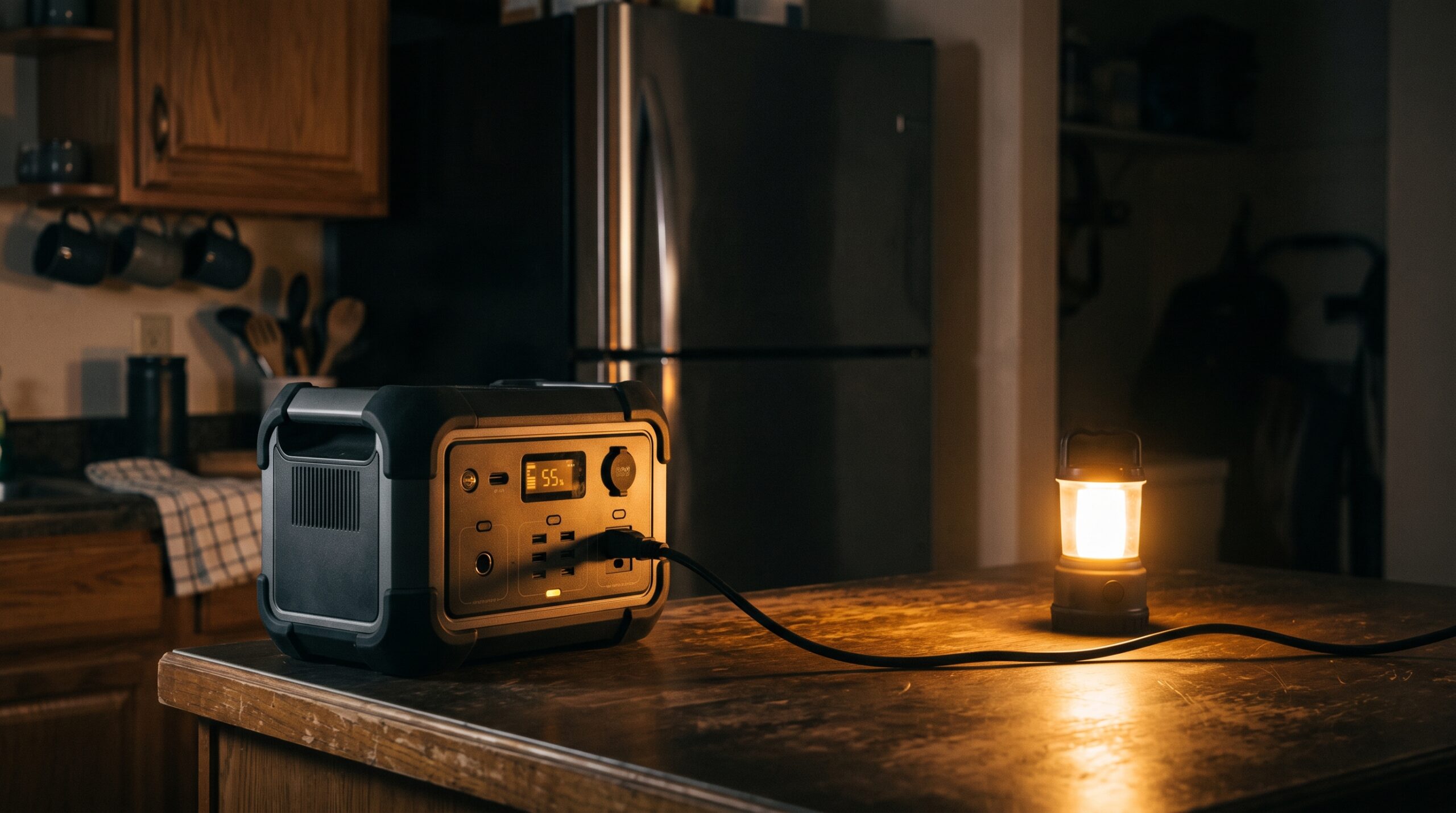
To keep a typical kitchen refrigerator running through an outage, a portable power station with about 1,000 to 2,000 watt-hours of capacity covers most of a day to a full day for a modern, efficient fridge. Just as important as capacity is output: the station’s surge or peak rating needs to clear the compressor’s startup spike, which is usually somewhere between 600 and 2,000 watts for a second or two.
So the answer comes down to two separate numbers, not one. This guide explains both, gives you a capacity-to-runtime table you can sanity-check against your own fridge, and points you to a calculator so you can size it for the exact model in your kitchen.
The two numbers that actually matter
A refrigerator asks two different things of a power station, and a unit can pass one test while failing the other.
Surge (peak) output, measured in watts. When the compressor switches on, it briefly pulls far more power than it does while running. For most household fridges that startup spike lands roughly between 600 and 2,000 watts and lasts only a second or two. Your power station’s surge or peak rating has to be higher than that spike, or the unit can trip and shut off the moment the compressor tries to start. Running watts are tame by comparison: a modern full-size fridge typically draws somewhere around 100 to 250 watts while the compressor is actually running.
Capacity, measured in watt-hours (Wh). This is the size of the tank, and it sets how long the fridge can run before the battery is empty. A station can have plenty of surge headroom and still die in a few hours if its capacity is small. The two specs are independent, so check both on the spec sheet before you buy.
One practical note: refrigerator compressors are motors, and they generally run more smoothly on a pure sine wave inverter. Most quality power stations already output pure sine wave, but it is worth confirming on a budget unit.
How capacity turns into runtime
A fridge does not run its compressor continuously. It cycles on and off to hold temperature, so its average draw over a full day is much lower than its running wattage. The U.S. Department of Energy suggests a rough rule of thumb: to estimate how many hours a fridge actually runs at full wattage, divide the total time it is plugged in by about three. That puts a typical modern refrigerator in the range of roughly 1 to 2 kilowatt-hours per day, or an average of somewhere around 40 to 85 watts spread across 24 hours. Older or larger units, and anything in a hot garage, can use noticeably more.
Because the average draw is what drains the battery over time, capacity (Wh) divided by that average draw gives you an approximate runtime. The table below uses that math. Keep it in airtight ranges, not promises, because every fridge and every ambient temperature is different.
Capacity-to-fridge-runtime guide
| Rated capacity | Approx. usable (Wh) | Approx. fridge runtime | Rough real-world meaning |
|---|---|---|---|
| 500 Wh | ~425–450 Wh | ~5–11 hours | Bridges a short outage |
| 1,000 Wh | ~850–900 Wh | ~10–22 hours | Covers most of a day |
| 2,000 Wh | ~1,700–1,800 Wh | ~20–44 hours | Roughly a full day to nearly two |
| 4,000 Wh | ~3,400–3,600 Wh | ~40–88 hours | Roughly two to three-plus days |
Why you can’t use the full rated capacity
A power station labeled 1,000 Wh does not deliver a full 1,000 Wh to your fridge. Two things eat into it. First, the inverter that converts the battery’s DC power into the AC power your fridge plugs into is not perfectly efficient, and it loses roughly 10 to 15 percent in that conversion. Second, the battery management system holds back a small reserve to protect the cells. Add those up and you can usually count on about 85 to 90 percent of the rated number reaching the appliance.
That is why the table lists usable watt-hours below the rated figure. When you size a station, work from the usable number, not the headline spec, and leave yourself a margin.
Size it for your own fridge
The ranges above are a starting point, but your fridge has its own running watts, startup surge, and daily kilowatt-hours, often printed on the nameplate inside the door or in the manual. To turn those into a recommendation, run your numbers through the Power-Station Sizing calculator, which matches both surge output and capacity to your appliance. If you mainly want to know how many hours a given station will keep your fridge cold, the Appliance Runtime calculator does that math directly. Using your fridge’s actual figures will give you a far tighter answer than any general table.
The 1,000Wh and 2,000Wh classes, live prices


As an Amazon Associate we earn from qualifying purchases. Prices are pulled automatically from Amazon and may have changed.
Frequently asked questions
Will a 1,000Wh power station run a refrigerator?
For most modern, full-size refrigerators, yes, as long as the station’s surge rating clears the compressor’s startup spike (often 600 to 2,000 watts). On capacity, a 1,000 Wh unit delivers roughly 850 to 900 usable watt-hours, which tends to keep an efficient fridge cold for about 10 to 22 hours, covering most of a day. A larger or older fridge will land toward the shorter end.
How many watts does a refrigerator need to start?
When the compressor kicks on, a typical household fridge briefly demands more than its running wattage, usually somewhere between 600 and 2,000 watts for a second or two. This startup surge is the number your power station’s peak or surge output has to beat. Inverter-compressor refrigerators tend to ramp up more gently and surge less.
Can a power station run a fridge overnight?
A station with roughly 1,000 watt-hours or more of capacity will generally carry an efficient refrigerator through a typical overnight stretch of 8 to 12 hours, with margin to spare for many units. If your fridge is large or older, or the room is warm, step up to about 2,000 watt-hours for a more comfortable buffer.
Do I need a pure sine wave power station for a refrigerator?
It is the safer choice. Refrigerator compressors are motors, and they typically run cooler and more reliably on a pure sine wave output than on a modified sine wave. Most reputable portable power stations already produce pure sine wave AC, but it is worth confirming on the spec sheet, especially with very inexpensive models.
How long will a power station keep my food safe?
Runtime depends on your fridge and the station’s usable capacity, but food safety also depends on temperature. The USDA notes that a refrigerator keeps food safe for about 4 hours if you keep the door closed, even without power. Running the fridge intermittently on a power station, and minimizing door openings, helps hold it below the 40°F safe zone for much longer. When in doubt about any item, follow USDA guidance rather than runtime estimates.
Sources
- U.S. Department of Energy – Estimating Appliance and Home Electronic Energy Use
- EnergySage – How Many Watts Does a Refrigerator Use?
- ENERGY STAR – Refrigerators
- FoodSafety.gov (USDA/HHS) – Food Safety During a Power Outage