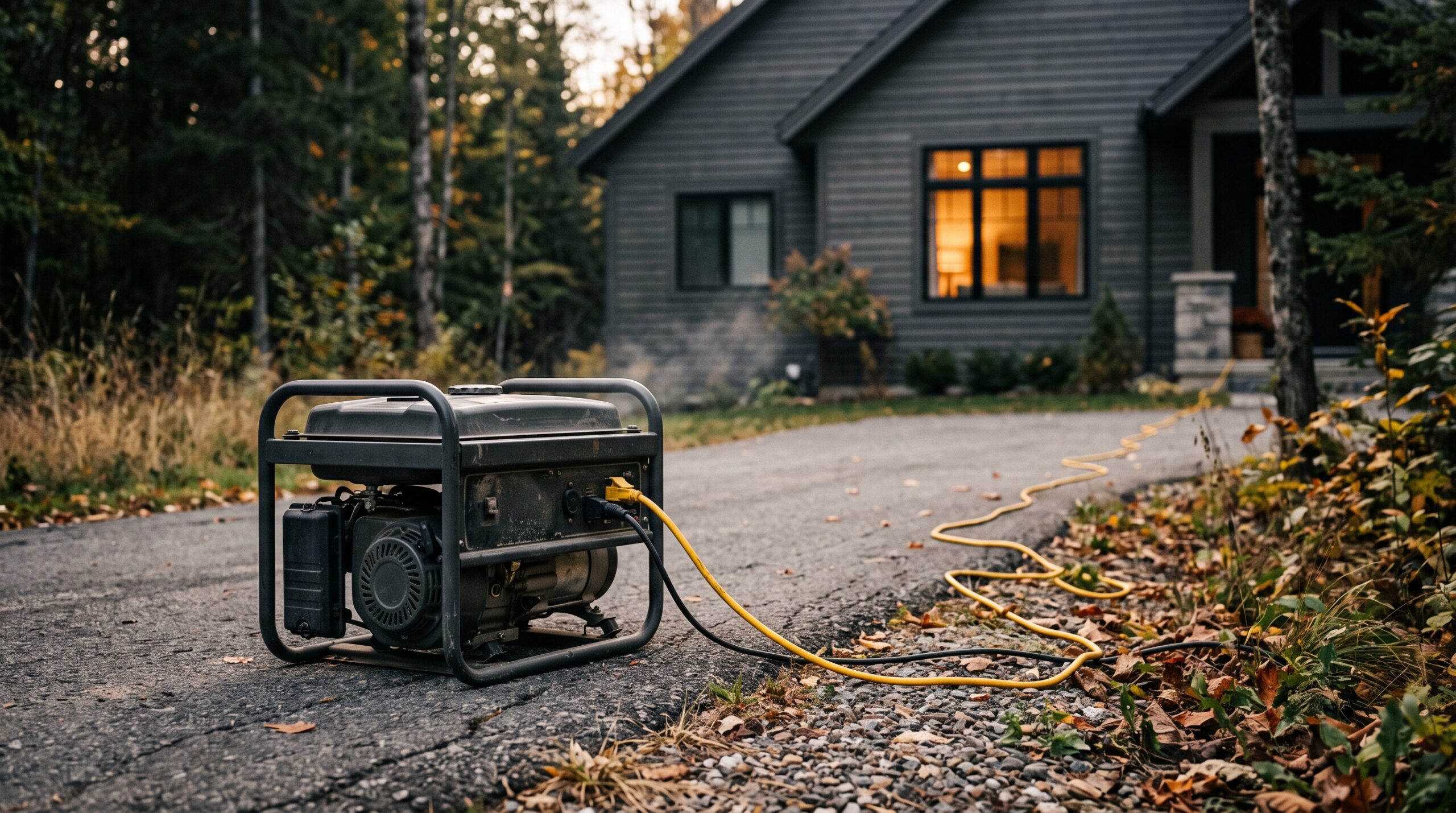
Run a portable generator at least 20 feet from your house, outside, with the exhaust pointed away from every door, window, and vent. That single rule prevents the most common way people die in an outage: carbon monoxide poisoning from a generator placed too close, or worse, run in a garage. Carbon monoxide (CO) is colorless, odorless, and can kill in minutes, so where you put the generator matters as much as the generator itself.
The short answer: 20 feet, exhaust away from the house
The U.S. Consumer Product Safety Commission (CPSC) is specific about this. Operate a portable generator outside only, at least 20 feet from the home, and keep it that far from any doors, windows, and vents that could let exhaust drift back inside. Then point the exhaust away from the house and any other building where people might be.
Twenty feet is a minimum, not a target. Wind can push exhaust back toward the house, so if you have the cord length and a safe spot, farther is better. The exhaust direction is just as important as the distance: a generator 25 feet away but blasting its fumes straight at an open window is still dangerous.
Why a garage, porch, or shed can kill you
Never run a generator in a garage, carport, shed, basement, crawlspace, or on a porch, and this holds even with the door open. CPSC is blunt about it: opening doors or windows does not provide enough ventilation to prevent a lethal buildup of carbon monoxide. A running generator can produce as much CO as hundreds of cars, and in a partially enclosed space it accumulates faster than you’d expect. People have died from generators running in an open garage while they slept one room away.
An attached garage is the worst case because CO seeps through shared walls and doorways into living space. If your only sheltered spot is a garage or porch, the answer isn’t “crack the door,” it’s “move the generator outside and 20 feet out.” For keeping it dry in bad weather without enclosing it, see how to run a generator in the rain safely.
How to position the generator
- Distance: 20 feet or more from the house, measured to the nearest door, window, or vent, not just the wall.
- Exhaust direction: point the exhaust outlet away from your home and from neighbors’ homes.
- Upwind, not downwind: place it so the breeze carries fumes away from the house, not toward it. Reposition if the wind shifts.
- Clear overhead and around: open air on all sides. No tarps draped over it, no tucking it against the foundation or under a deck.
- Dry, level surface: on dry ground, ideally under a purpose-built open canopy if it’s wet out.
- Seal the path: close windows and vents that are near the generator or in line with its exhaust.
Carbon monoxide alarms are your backup
Distance is your first defense; a working CO alarm is your second. Install battery-powered or battery-backup CO alarms on every level of the home and near sleeping areas, and test them before storm season. Because you can’t see or smell carbon monoxide, an alarm is often the only warning you’ll get if exhaust finds its way inside. If a CO alarm sounds, get everyone to fresh air immediately and call 911, then check on anyone who feels dizzy, drowsy, or nauseous.
Many newer generators include built-in CO sensors that shut the engine off when CO climbs (sold under names like CO-Minder or CO Guard). That’s a helpful safety net, but it doesn’t change the placement rules, it backs them up.
Powering the distance: extension cords done right
Keeping the generator 20-plus feet away means you need cords that can reach without overheating. Use heavy-duty, outdoor-rated extension cords sized for the load: longer runs need a thicker wire (lower gauge number). A cord that’s too thin for the distance and wattage drops voltage and gets hot, which can damage appliances or start a fire. Keep cords out of puddles and walkways, and don’t daisy-chain several together.
Never plug a generator into a wall outlet to power your home (“backfeeding”), which can electrocute utility workers and damage your system. If you want the generator to feed household circuits, have an electrician install a transfer switch or interlock, as covered in connecting a generator to your house. For the rest of the basics, see our generator safety guide, and store it correctly between outages so it actually starts next time.
The CO-free alternative for indoor power
The placement rules exist because a gas generator burns fuel and produces exhaust. A battery power station doesn’t, so it can run safely indoors with no CO risk at all. It won’t match a big generator’s output, but for keeping a fridge, CPAP, phones, and lights going through an outage, it’s a far safer choice inside the home. If you’re weighing the two, our guide on choosing a generator or a power station walks through the tradeoffs.
Frequently asked questions
How far should a generator be from the house?
At least 20 feet, per CPSC, measured to the nearest door, window, or vent, with the exhaust pointed away from the home. More distance is better if your cords allow it.
Can I run a generator in the garage with the door open?
No. CPSC warns that an open door or window does not provide enough ventilation to prevent deadly carbon monoxide buildup. Generators must run outside, never in a garage, carport, shed, or basement.
Which way should the exhaust point?
Away from your house and any nearby building, and ideally downwind so the breeze carries fumes away from people. Close any windows or vents near the generator or in the path of the exhaust.
Do I still need a CO alarm if the generator is outside?
Yes. Wind shifts and exhaust can drift back toward the house, so keep battery-backup CO alarms on every level and near bedrooms. They’re the only reliable warning since CO is invisible and odorless.
How far should a generator be from the neighbor’s house?
Apply the same 20-foot rule to their doors and windows, and point the exhaust away from their home too. CO doesn’t respect property lines, and a generator tucked between two houses can poison either one.