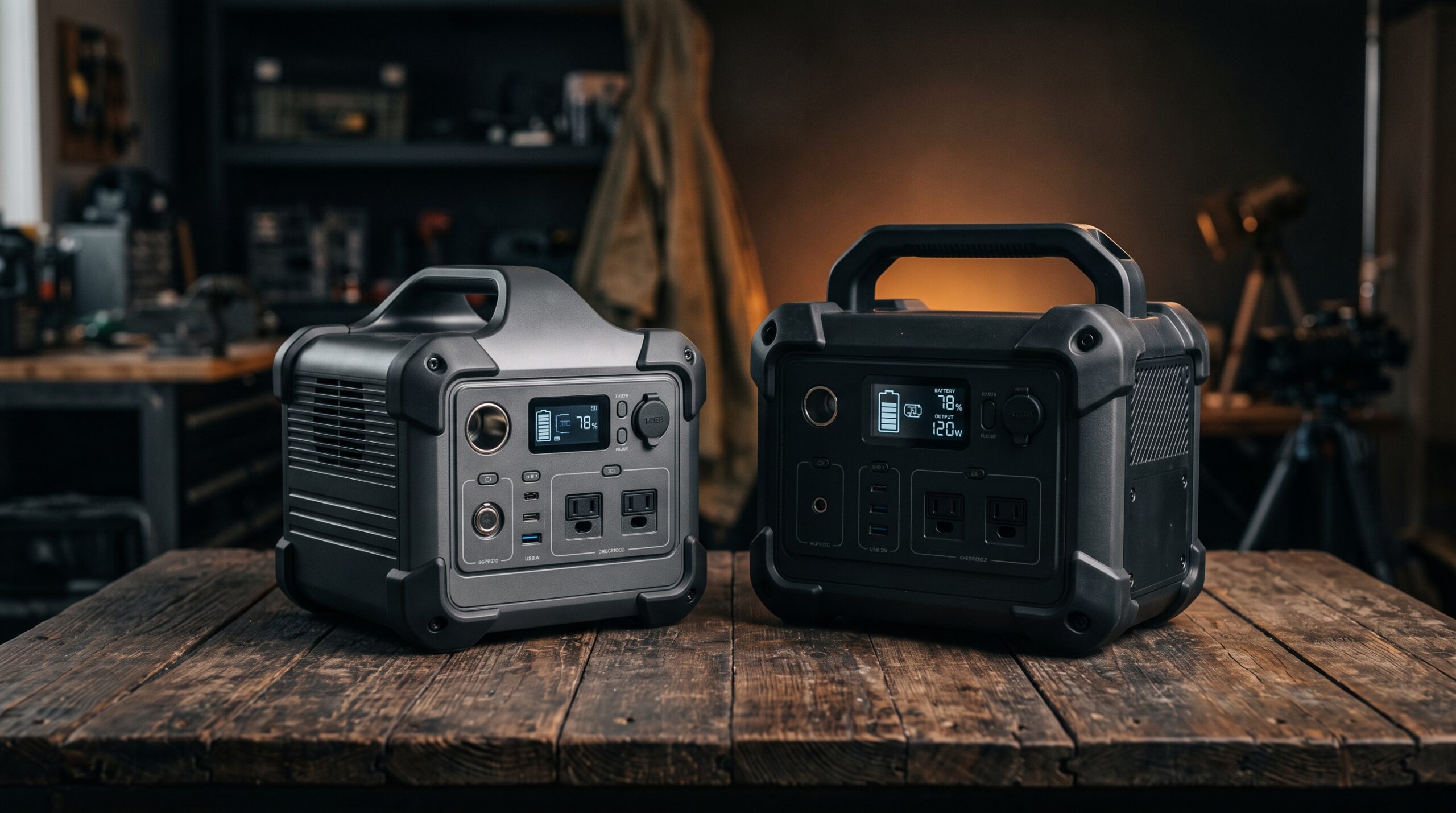
Bluetti and Jackery are two of the most common names you will run into when shopping for a portable power station, and both make solid gear. The short version: Bluetti tends to win on expandable capacity, charging speed, and battery longevity, which makes it the better pick for serious home backup. Jackery leans into lightweight, plug-and-play simplicity that suits camping and grab-and-go emergency use. Honestly, getting the right capacity for your loads matters more than the badge on the front.
Battery chemistry and lifespan
This is the area where the two brands have converged the most. Bluetti standardized on LiFePO4 (lithium iron phosphate) across its current lineup, and Jackery moved most of its newer Explorer and Plus models to LiFePO4 as well. LiFePO4 cells run cooler, last far longer, and are more thermally stable than the older NMC lithium-ion chemistry. If you want the background, see our explainer on LiFePO4 vs lithium-ion power stations.
Where they still differ is rated cycle life. Jackery’s current LiFePO4 models, like the Explorer 2000 v2, are rated for roughly 3,000 cycles to 80% of original capacity. Bluetti’s newer flagship cells push higher, with the Elite 200 V2 rated for 6,000+ cycles. Both numbers are large enough that most households will never wear the battery out. One caveat worth knowing: a few older or higher-output Jackery units, such as the Explorer 3000 Pro, still use NMC lithium-ion rather than LiFePO4, so check the spec sheet on the exact model you are eyeing.
Capacity and expandability
Capacity is measured in watt-hours (Wh), and it is the single number that decides how long a unit runs your gear. Both brands sell models from a few hundred watt-hours up past 2,000Wh, so for a single fixed unit they are roughly matched. The real difference is expandability, and this is Bluetti’s home turf.
Bluetti built much of its mid-to-high range around modular expansion. Units like the AC200L, AC300, and AC500 accept external battery packs, letting you scale from around 2,000Wh into the double-digit kilowatt-hour range as your needs grow. Jackery has entered this space too, mainly through the Explorer 2000 Plus, which chains add-on battery packs to reach up to 24kWh. But across the broader lineup, expandable models are still the exception for Jackery, where many popular units (including the well-liked Explorer 2000 v2) are sealed at a fixed capacity. If you think you will want to add capacity later, that is a point for Bluetti.
Not sure how much capacity you actually need? Don’t guess. Plug your appliances into our power station sizing calculator or estimate hours of coverage with the runtime calculator before you commit to a model.
Charging speed and solar input
Both brands have gotten genuinely fast at wall charging, and this is no longer a clear win for either one. Jackery’s Explorer 2000 v2 reaches a full charge in roughly 1.7 hours from an AC outlet, with an emergency super-charge mode in the app. Bluetti’s Elite 200 V2 hits 0 to 80% in about 50 minutes using combined AC and DC input. In practice, both recharge fast enough that you can top off during a brief grid window.
For solar, Bluetti models generally accept higher maximum input on their larger units (the Elite 200 V2 takes up to 1,000W, for example), which means faster off-grid recharge when paired with enough panels. Jackery’s SolarSaga panels are easy to set up and well integrated with its app, but maximum solar input is typically lower on comparable models. If solar recharging is central to your plan, work through our solar charging calculator to match panel wattage to the unit.
Output, surge, and app features
Both brands ship pure sine wave inverters, which is what you want for sensitive electronics and motor-driven appliances. Continuous output is comparable at similar price points (the Explorer 2000 v2 delivers 2,200W, the Elite 200 V2 delivers 2,600W), and both use a temporary “power lifting” or surge mode to start higher-draw devices for a short burst. If you plan to run anything with a motor or compressor, like a fridge or a sump pump, read up on running watts vs starting watts so the surge figure makes sense.
On software, both companies offer Wi-Fi and Bluetooth app control for monitoring charge, toggling charging modes, and checking estimated runtime. The Bluetti app exposes more granular controls (multiple charging speed and noise profiles), while the Jackery app is simpler and arguably easier for a first-time owner. Neither is a dealbreaker; it comes down to whether you want more knobs or fewer.
Portability, design, and warranty
Jackery has long marketed itself around portability, and its newer units back that up. The Explorer 2000 v2 weighs about 39.5 lbs, noticeably trimmer than many 2kWh rivals, and the rounded enclosure with folding handles is easy to carry and stow. Bluetti units in the same capacity class tend to be similarly competitive on size now, but Jackery still has the edge in feel for true grab-and-go use.
On warranty, the two are close. Bluetti currently lists 5-year coverage on its main current models. Jackery offers a standard multi-year warranty (commonly 3 years) with an option to extend further when you buy direct or through major retailers. Read the fine print for the specific SKU, because terms vary by model and region.
Head-to-head: Bluetti vs Jackery
Here is the comparison boiled down. These are general brand tendencies on current lineups, not a verdict on any single unit; always confirm specs on the exact model and check the live price.
| Dimension | Bluetti | Jackery |
|---|---|---|
| Battery chemistry | LiFePO4 across current lineup | LiFePO4 on newer models; some older/high-output units still NMC |
| Rated cycle life | Up to 6,000+ cycles on flagship cells | Around 3,000 cycles on current LiFePO4 models |
| Expandability | Strong; modular add-on batteries across mid-to-high range | Limited; mainly the Explorer 2000 Plus (up to 24kWh) |
| AC charging speed | Very fast (e.g. ~50 min to 80% on Elite 200 V2) | Very fast (e.g. ~1.7 hr full on Explorer 2000 v2) |
| Max solar input | Higher on larger units (up to ~1,000W) | Generally lower on comparable units |
| Inverter | Pure sine wave, with surge/power-lifting | Pure sine wave, with surge/power-lifting |
| App features | More granular controls and charging profiles | Simpler, beginner-friendly |
| Portability | Competitive; larger units focus on capacity | Lightweight, grab-and-go design ethos |
| Warranty | 5 years on main current models | ~3 years standard, extendable |
| Best for | Expandable capacity, home backup, off-grid/solar | Simplicity, portability, value, camping |
Which one should you buy?
There is no universal winner here, so match the brand to how you will use it:
- Pick Bluetti if you want expandable capacity, plan to grow a home-backup system over time, lean heavily on solar, or value the longest rated cycle life and the longer warranty.
- Pick Jackery if you want the simplest possible plug-and-play experience, prize light weight for camping and grab-and-go kits, and want strong value at a fixed capacity you already know fits your needs.
- Either is fine for occasional outage coverage of a fridge, lights, phones, and Wi-Fi, provided you size the unit correctly.
If you are still narrowing the field, our guide on how to choose a power station walks through the decision step by step, and if you want to see how these two stack up against a third major brand, read Jackery vs EcoFlow vs Bluetti. For outage-specific picks, our roundup of the best portable power station for home backup is a good next stop.
How to buy without overpaying
Power station prices swing a lot, so treat any sticker as a moving target. A few honest tips: both brands run frequent sales, and units like the Explorer 2000 v2 have sold for hundreds below their original list price during seasonal events, so it pays to wait for a discount rather than buy at full price. Compare cost per watt-hour (price divided by Wh) across models to judge value fairly, and buy from the manufacturer or an authorized retailer so your warranty is valid. We do not sell these units or post live prices here; always confirm the current price and warranty terms on the seller’s page before you check out.
Bluetti and Jackery, live prices


Jackery Explorer 1000 v2
1,070Wh, 1,500W — light and simple for outages
$499.00Check price on Amazon →

Jackery Explorer 2000 v2
2,042Wh, 2,200W — big capacity, not expandable
$899.00Check price on Amazon →
As an Amazon Associate we earn from qualifying purchases. Prices are pulled automatically from Amazon and may have changed.
Frequently asked questions
Is Bluetti or Jackery better for home backup?
For home backup, Bluetti generally has the edge because more of its lineup is expandable and its flagship cells carry higher rated cycle life. That said, a correctly sized fixed-capacity Jackery handles short outages well. The right call depends on how much capacity you need and whether you want to expand later.
Do both brands use LiFePO4 batteries?
Bluetti uses LiFePO4 across its current lineup. Jackery uses LiFePO4 on its newer Explorer and Plus models, but a few older or higher-output units still use NMC lithium-ion. Always check the chemistry on the exact model before buying.
Which brand charges faster?
Both are fast and roughly comparable at similar price points. Bluetti’s Elite 200 V2 reaches 80% in about 50 minutes, and Jackery’s Explorer 2000 v2 reaches a full charge in roughly 1.7 hours. Bluetti tends to allow higher maximum solar input on its larger units, which speeds up off-grid recharging.
Is a more expensive brand always worth it?
No. Getting the right capacity and output for your actual loads matters more than the brand name. A well-sized unit from either company will outperform an oversized or undersized unit from the “better” brand. Use a sizing tool first, then compare cost per watt-hour.
Can either run a refrigerator during an outage?
Yes. A 2,000Wh-class unit from either brand can typically run a standard fridge for many hours, as long as the inverter handles the compressor’s startup surge. Pure sine wave output (which both provide) is important for fridge motors. Confirm runtime by entering your fridge’s wattage into the runtime calculator.