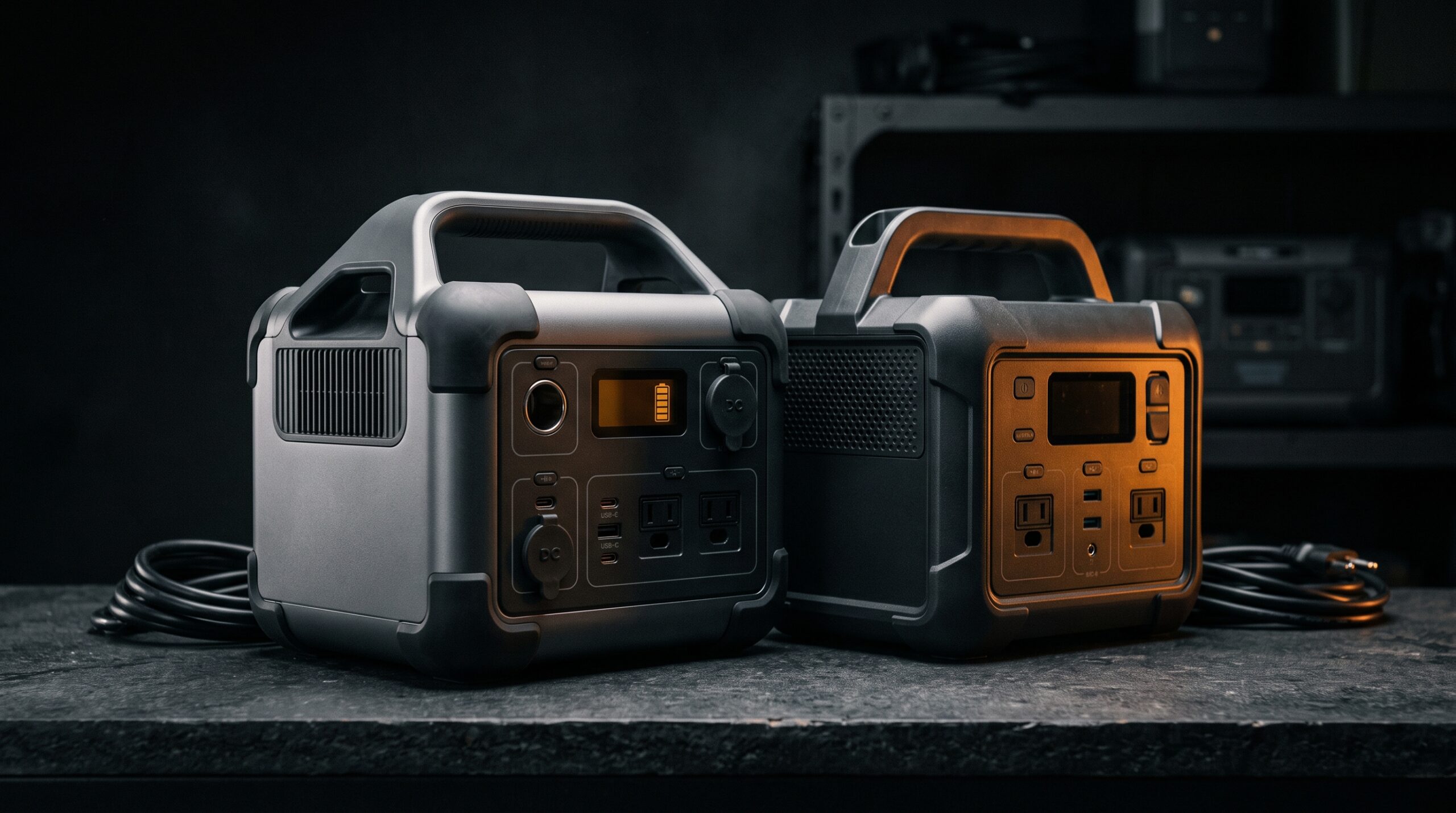
Short version: for a backup power station you keep for years and use a few times a season, LiFePO4 is the battery to want. It lasts several times as many charge cycles as the older lithium-ion (NMC) chemistry, holds up better to heat, and is the safer of the two if something ever goes wrong. The trade-offs are that a LiFePO4 unit is heavier and bulkier for the same stored energy, and it used to cost more. Today most quality power stations have already switched to LiFePO4, so for the majority of buyers this is less a hard choice and more a box to check before you spend money. Below is what actually separates the two and the few cases where lighter lithium-ion still makes sense.
The names get muddled because LiFePO4 is itself a type of lithium-ion battery. When a spec sheet says “lithium-ion” without naming the chemistry, it almost always means NMC (nickel manganese cobalt), the lighter, more energy-dense cells used in phones, laptops, and older power stations. So the real comparison is LiFePO4 (lithium iron phosphate) against NMC, and the differences below come straight from how those two chemistries behave.
Cycle life and lifespan: how long each lasts
A charge cycle is one full discharge and recharge, and it’s the fairest way to compare battery longevity because it ignores how fast or slow you use the unit. This is where the gap is widest. A quality LiFePO4 battery is commonly rated for roughly 3,000 to 6,000 charge cycles before it falls to about 80 percent of its original capacity, and some manufacturers rate their newest units even higher. EcoFlow, for example, rates its Delta 3 Ultra at 6,500 cycles to 50 percent capacity and its River 3 Plus at 3,000 cycles to 80 percent. Battery University and other references put well-built LiFePO4 cells well above 3,000 cycles under normal conditions.
Older lithium-ion (NMC) cells in power stations are typically rated for far fewer, often in the range of about 500 to 800 cycles to 80 percent, with some better cells reaching higher. EcoFlow notes that many lithium-ion batteries degrade noticeably after around 500 charge and discharge cycles. The practical result is a large lifespan difference: a LiFePO4 station used regularly is often described as lasting ten years or more, while an NMC unit cycled the same way may show real capacity loss in a few years. Exact numbers depend on temperature, depth of discharge, and how the unit is stored, so treat all cycle ratings as planning estimates rather than guarantees.
Safety and thermal stability
Both chemistries are safe in a well-built power station with a working battery management system, and serious failures are rare. The difference shows up at the extremes, under abuse such as overcharging, physical damage, a manufacturing defect, or high heat. LiFePO4 is the more thermally stable of the two. Battery University lists its thermal runaway onset at about 270°C (518°F), versus roughly 210°C (410°F) for NMC, and describes LiFePO4 as a very safe battery even when fully charged. A higher threshold means it takes more to push the cell into a runaway state in the first place.
The chemistry also behaves better once a failure starts. The iron-phosphate cathode in LiFePO4 does not shed oxygen as it heats the way the layered oxide cathodes in NMC do, so if a cell does fail it tends to release less heat and less flammable gas and is less likely to spread to neighboring cells. That is a big part of why LiFePO4 has become the default for home and stationary storage, where the unit may sit charged indoors for years. For a power station you keep next to the bed or run overnight, that extra margin is worth having, even if you never test it.
Weight and size
This is the one clear category where lithium-ion (NMC) wins. NMC packs more energy into the same mass: references put NMC at roughly 150 to 220 watt-hours per kilogram, against about 90 to 160 for LiFePO4. For the same stored capacity in watt-hours, the LiFePO4 unit is the heavier, larger box. As a rough illustration, a 1,000 watt-hour NMC station might land in the low-to-mid 40-pound range, while a comparable LiFePO4 unit can run heavier. If you plan to carry the station to a campsite, lift it into a vehicle often, or store it somewhere cramped, that weight difference is real and worth weighing against the longevity gains.
Two things soften this. First, for a unit that mostly lives in a closet and comes out during outages, weight matters far less than it does for a backpack or a phone. Second, newer LiFePO4 designs have narrowed the gap: some current models pack 2,000 watt-hours into around 45 pounds. So while NMC is genuinely lighter per watt-hour, the penalty for choosing LiFePO4 is smaller than it was a few years ago, and for stationary backup use it is often a non-issue.
Cost
The cost story has shifted. LiFePO4 stations once carried a noticeable premium, and even now some makers describe LiFePO4 as slightly more expensive watt-for-watt than comparable lithium-ion. But cell prices have fallen as LiFePO4 has scaled up, and because it uses no cobalt or nickel it is often cheaper to produce at the cell level. The net effect is that the sticker-price gap has shrunk to the point where most quality power stations now ship with LiFePO4 by default, and you often pay little or no premium for it.
Cost per use tells an even clearer story. If a LiFePO4 unit lasts several times as many cycles as an NMC one, its cost spread across its lifetime is far lower, even when the upfront price is similar or a bit higher. A cheaper NMC station that needs replacing in a few years can easily cost more over a decade than a LiFePO4 unit you buy once. The main place NMC still wins on price is at the very small, ultra-portable end, where its lighter weight and energy density keep tiny units cheap and packable.
Head-to-head comparison
| LiFePO4 (lithium iron phosphate) | Lithium-ion (NMC) | |
|---|---|---|
| Cycle life | Long; commonly about 3,000 to 6,000+ cycles to 80% | Shorter; often about 500 to 800 cycles to 80% |
| Lifespan | Roughly 10 years or more with regular use | Often a few years under similar use |
| Safety | More thermally stable; higher runaway threshold (~270°C); less heat and gas if it fails | Less stable; lower threshold (~210°C); releases oxygen and more heat if it fails |
| Weight | Heavier and larger for the same watt-hours | Lighter and more compact for the same watt-hours |
| Cost | Similar to slightly higher upfront; lower cost per cycle over its life | Can be cheaper upfront, especially in tiny units; higher cost per cycle |
When each one makes sense
Home backup and emergency power: LiFePO4, in almost every case. A backup station spends most of its life sitting charged, then has to deliver during an outage years after you bought it. The long cycle life, decade-plus lifespan, and better thermal stability all line up with exactly that job, and the extra weight barely matters for a unit that mostly stays put. This is the default pick for the readers this site is written for.
Running gear indoors and overnight: LiFePO4, for the safety margin. If the station will sit on a nightstand, run a CPAP, or stay plugged in inside the house for long stretches, the more stable chemistry is the reassuring choice. For any life-critical device, also check the equipment manual and talk with the device provider, and size the battery with visible assumptions rather than trusting a single runtime claim.
Ultralight, packable, or budget-tiny use: lithium-ion (NMC) can still be the right call. For a small unit you carry on your back, toss in a bag, or buy as a cheap, occasional top-up for phones and a light, NMC’s lower weight and price can outweigh the shorter lifespan, because you are not asking it to last a decade of regular cycling. In moderately cold conditions some NMC cells also hold their discharge a little better, though both chemistries lose capacity in the cold and charging a battery below freezing should be done with care.
Whatever chemistry you land on, size the unit to your real loads before you buy. Our Power-Station Sizing calculator turns your appliance list into the watt-hours and surge watts to look for, and the Appliance Runtime calculator shows how many hours a given battery would hold those loads. Chemistry decides how long the unit lasts over the years; capacity decides what it can run during a single outage.
LiFePO4 picks, live prices


Jackery Explorer 1000 v2
1,070Wh, 1,500W — light and simple for outages
$499.00Check price on Amazon →

As an Amazon Associate we earn from qualifying purchases. Prices are pulled automatically from Amazon and may have changed.
Frequently asked questions
Which battery lasts longer, LiFePO4 or lithium-ion?
LiFePO4 lasts much longer. Quality LiFePO4 cells are commonly rated for about 3,000 to 6,000 or more charge cycles before dropping to roughly 80 percent capacity, while older lithium-ion (NMC) cells in power stations are often rated for around 500 to 800. In everyday terms that can mean a decade or more of regular use for LiFePO4 versus a few years for NMC, though real lifespan depends on heat, depth of discharge, and storage.
Is LiFePO4 safer than lithium-ion (NMC)?
Both are safe in a well-made station with a working battery management system, but LiFePO4 is the more thermally stable chemistry. Its thermal runaway threshold is higher (around 270°C versus roughly 210°C for NMC), and its cathode does not release oxygen as it heats, so a failing cell tends to give off less heat and gas. That extra margin is a big reason LiFePO4 has become standard for home and indoor storage.
Why are LiFePO4 power stations heavier?
LiFePO4 stores less energy per kilogram than NMC, roughly 90 to 160 watt-hours per kilogram against about 150 to 220 for NMC. To hold the same total watt-hours, a LiFePO4 unit needs more cell mass, so the box is heavier and larger. Newer designs have narrowed the gap, and for a station that mostly stays in one place the added weight rarely matters.
Is LiFePO4 more expensive than lithium-ion?
It used to carry a clear premium, but the gap has shrunk as LiFePO4 has scaled and because it uses no cobalt or nickel. Some makers still describe it as slightly pricier watt-for-watt, yet most quality power stations now ship with LiFePO4 by default at little or no extra cost. Spread over its much longer life, its cost per cycle is usually lower than an NMC unit’s.
How do I tell which battery a power station uses?
Check the spec sheet for the battery type and the cycle-life rating. “LiFePO4,” “lithium iron phosphate,” or “LFP” means the longer-lived chemistry, often listed with a 3,000-plus cycle rating. If it just says “lithium-ion” or “Li-ion” with a cycle rating around 500 to 800, it is most likely NMC. When in doubt, the cycle number is the clearest tell.
Sources
- Battery University, BU-205: Types of Lithium-ion (cycle life, energy density, and thermal runaway thresholds for LiFePO4 and NMC)
- Wikipedia, Lithium iron phosphate battery (cycle life above 3,000 cycles, 95 to 172 Wh/kg specific energy, thermal stability vs layered-oxide chemistries)
- EcoFlow, LiFePO4 vs. Lithium Ion Batteries (product cycle ratings, ~500-cycle lithium-ion note, energy density, temperature ranges, cost)
- EcoFlow, LiFePO4 vs Li-ion Batteries (3,000+ cycle LiFePO4 lifespan and chemistry comparison)
- Portable Energy Lab, LiFePO4 vs NMC: weight, cold-weather performance, safety, and cycle life
- Anker SOLIX, LiFePO4 vs NMC batteries: safety, lifespan, and cold-weather performance