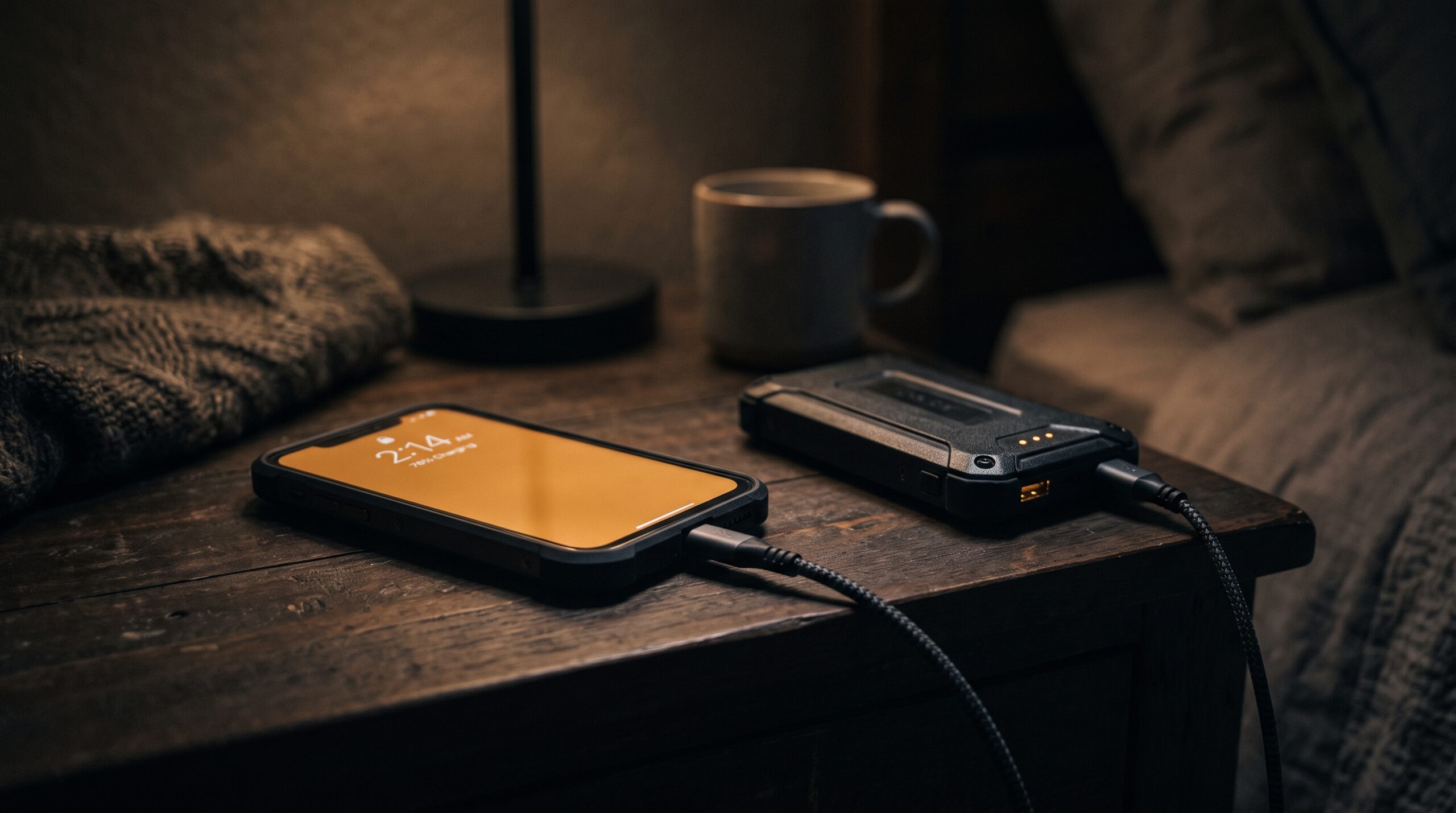
The simplest way to keep your phone charged in a power outage is a power bank: a 10,000mAh bank gives roughly two full charges for most phones, and it works the moment the lights go out with nothing to plug in.
Keep one charged in a drawer and you have a backup that needs no sun, no running engine, and no setup. Below is the simple capacity math, plus the other ways to charge and how to stretch the battery you have.
Power banks: the math from mAh to phone charges
The number printed on a power bank does not equal the charge your phone actually receives. That rating is measured at the cell’s 3.7 volts, but your phone charges at 5 volts. Stepping the voltage up, plus a little resistance in the cable, burns off energy as heat. In the real world you keep about 60 to 70 percent of the printed capacity, so the rest is lost before any power reaches your battery.
So a 10,000mAh bank delivers somewhere around 6,000 to 7,000mAh of usable charge. Divide that by your phone’s battery size to estimate charges. Most phones today carry a 3,000 to 5,000mAh battery, with around 5,000mAh now common. A phone with a 3,000 to 3,500mAh battery tops up close to twice from a 10,000mAh bank; a big 5,000mAh phone gets a little over one full charge.
| Power bank capacity | Usable charge (approx.) | Phone charges (approx.) |
|---|---|---|
| 5,000 mAh | ~3,000–3,500 mAh | About 1 charge (less for a 5,000mAh phone) |
| 10,000 mAh | ~6,000–7,000 mAh | Roughly 2 charges |
| 20,000 mAh | ~13,000–14,000 mAh | About 3 to 4 charges |
Other ways to charge when the power’s out
A power bank is the easy answer, but it is not the only one. If the outage runs long, or you have more than one phone to keep alive, these fill the gap.
Your car. A car is a giant battery on wheels. Plug your phone into a USB port or a 12V cigarette-lighter adapter and you have a charger that works as long as you have fuel. You can often charge off the port without the engine running, but if the engine does need to run, park outside or in an open driveway. Never run a car to charge inside a closed garage, since carbon monoxide builds up fast.
A solar charger. A small folding solar panel or a solar power bank turns daylight into phone charges, which matters in a multi-day outage when wall power is gone for good. They are slower than a wall outlet and need direct sun to work well, so treat solar as a top-up that keeps a power bank or phone alive rather than a fast charge.
A portable power station. If you need to keep several phones, a tablet, and maybe a laptop going, a power station is the workhorse. These are large batteries with USB ports and AC outlets, rated in watt-hours rather than mAh. A unit under 1,000Wh easily handles phones and laptops through a day or two, and many can be topped back up with a solar panel to stretch the runtime further.
Make your phone’s battery last
Charging is half the job; the other half is slowing the drain. A few quick settings can turn a single charge into a much longer stretch of standby.
- Turn on Low Power Mode (iPhone) or Battery Saver (Android). These dial back background activity, mail fetching, and visual effects in one tap.
- Dim the screen. The display is the single biggest battery drain. Drop the brightness and shorten the auto-lock time.
- Use airplane mode when there is no signal. A phone hunting for a tower it cannot reach can burn through power far faster than normal. If you are in a dead zone, airplane mode stops the search, then flip it off briefly to check for messages.
- Close apps and turn off what you are not using. Background apps, location services, Wi-Fi, and Bluetooth all sip power. Shut them down until you need them.
- Keep calls short. Texts use far less power than calls and get through more reliably when networks are strained.
Charge everything before an outage hits
The cheapest backup power is the charge you already have. When a storm is in the forecast or a utility warns of a planned shutoff, top up your phone, your power banks, your laptop, and any tablets to 100 percent. A laptop with a full battery doubles as a charger: plug your phone into its USB port and it will pass along some juice, though it drains the laptop in the process.
A good power bank holds its charge for months, so there is no harm in keeping one full and ready in a drawer year-round. Make a habit of recharging it a few times a year and you will never reach for a dead one.
Trying to keep more than a phone running, or planning for an outage that could last days? Use our Appliance Runtime calculator to see how long a battery or power station will keep a device going, and the Power-Station Sizing calculator to find the right capacity for charging many devices through a longer outage.
Frequently asked questions
How many phone charges does a 10,000mAh power bank give?
For most phones, about two full charges. After voltage conversion and cable losses you keep roughly 6,000 to 7,000mAh of usable power, so a phone with a 3,000 to 3,500mAh battery tops up nearly twice. A phone with a large 5,000mAh battery gets a little over one full charge.
Why does a power bank deliver less than its rated capacity?
The rating is measured at the battery cell’s 3.7 volts, but your phone charges at 5 volts. Boosting the voltage and pushing power through the cable loses about 30 to 40 percent of the energy as heat, which leaves roughly 60 to 70 percent of the printed number as usable charge.
Can I charge my phone from my car during a power outage?
Yes. Use a USB cable or a 12V cigarette-lighter adapter. Many cars charge from the port without the engine running. If the engine does need to run, park outside or in an open driveway, never in a closed garage, because of the carbon monoxide risk.
Does airplane mode really save battery?
Yes, especially when signal is weak or gone. A phone constantly searching for a tower can use up to three times the power, so switching on airplane mode in a dead-signal area is one of the biggest battery savers available. Flip it off now and then to check for messages.
What size power bank should I keep for outages?
A 10,000mAh bank is the practical sweet spot for one person: about two phone charges in a size that still fits a pocket. For a family or an outage that could last several days, step up to a 20,000mAh bank or a small power station with AC outlets that can charge many devices at once.