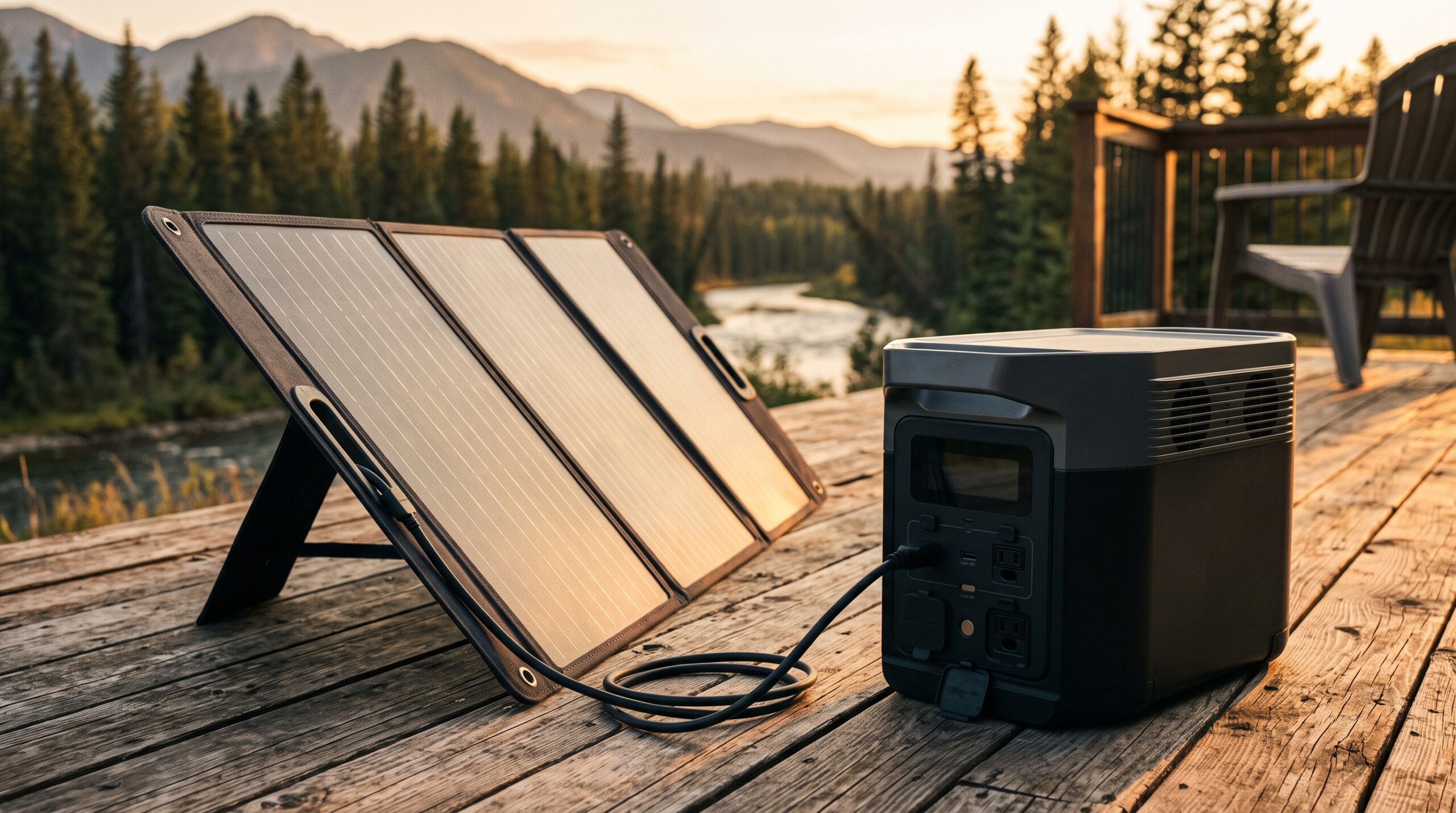
Short version: a “solar generator” is just a battery power station that can recharge from solar panels. The core device is the same. The makers themselves describe it that way, and Wikipedia calls the term a consumer-marketing label for a portable battery system with solar charging. Pair any power station that has a solar input with panels and you have, functionally, a solar generator. What actually changes between the two labels is whether solar panels are bundled in and whether the unit accepts solar at all, not the battery or the outlets you live with.
That matters because the two terms get sold side by side at very different prices, and shoppers assume they are buying different machines. Usually they are not. Below is what each word means, what is genuinely identical, what the solar part adds, and when paying for solar is worth it versus just recharging from a wall outlet.
What each term means
A battery power station is the box: a rechargeable battery, an inverter, and a set of AC outlets, USB ports, and DC sockets. It stores energy and hands it back out. You recharge it from a wall outlet, often a car socket, and, on most modern models, from solar panels. Think of it as a much larger, smarter version of a phone power bank.
A “solar generator” is that same power station sold with, or alongside, one or more solar panels, marketed around its ability to refill from the sun. There is no fuel and no engine despite the word “generator.” Manufacturers lean on the term because it competes with the gas generators people already picture for backup power. As Wikipedia puts it, these are really portable photovoltaic systems with storage, and the “solar generator” name is marketing language rather than a separate category of hardware.
What is actually the same
The part you interact with every day is identical. The battery capacity in watt-hours, the continuous and surge wattage of the inverter, the number and type of outlets, the screen, the app, the weight, the warranty, and the battery chemistry all live in the power station itself. A solar panel does not change any of those. If you compare a power station sold on its own against the “solar generator” kit built on the very same unit, you are looking at one machine with the same specs.
So when you read that a solar generator runs a fridge for X hours or surges to start a motor, that performance comes from the power station, not from the panels. The panels only refill the battery; they never increase its capacity or its output rating. This is why “does it have solar?” is the wrong first question. The right first questions are how many watt-hours it stores and how many watts it can push, which are decided by the station, kit or no kit.
What the solar part adds
What solar genuinely adds is a way to refill without the grid. That is the whole point and it is a real one: when the power is out and stays out, a wall outlet is useless, but the sun still shows up. Solar lets a station top itself back up during a multi-day outage or anywhere off the grid, which a battery-only unit cannot do once it is empty.
Two things vary between models and decide whether solar is even on the table:
- Whether the unit has a solar input at all. Most current power stations do, but a few budget or older models charge only from AC and car sockets. If a unit has no solar input, no panel will help it, and it can never be a “solar generator.”
- How much solar it accepts, and whether panels are included. Every station caps its solar input in watts, and the cap varies widely by model. A smaller unit like the Jackery Explorer 1000 accepts up to about 200W of solar, while an EcoFlow Delta 2 takes up to 500W. A “solar generator” bundle simply ships matched panels in the box so you do not have to source and adapt them yourself; buying the station alone means adding compatible panels later if you want sun charging.
Solar input is also slower and weather-dependent. Panels rarely hit their rated wattage in the real world once you account for heat, haze, dust, cable losses, and an imperfect angle, so plan on roughly 70 percent of the panel rating in good sun and far less under cloud. The panels extend how long you can stay powered; they do not make the unit bigger or stronger.
When you need solar vs AC-only recharge
If your outages are short and you have grid power between them, AC recharging usually wins on speed and simplicity. A wall outlet is fast: an EcoFlow Delta 2, for example, reaches about 80 percent in roughly an hour from AC, where the same unit needs several hours of strong sun on a 500W array to do similar work. When the grid comes back within a day, you just plug in, refill quickly, and you are ready for the next event. Solar adds cost and bulk you may never need.
Solar earns its place when the outage is long or there is no outlet to use at all. The clear cases are multi-day outages where you cannot count on the grid returning, off-grid life such as camping, vans, and remote cabins, and anywhere you want energy independence from fuel and wall power. In those situations the panels are not a nice-to-have; they are the only thing standing between you and a dead battery. A reasonable middle path is to buy a station with a solar input now, recharge from AC day to day, and add panels later only if your needs shift toward long or off-grid use.
How to choose
Choose the power station first, the solar second. Start by sizing the battery to your loads: add up the watt-hours you need to cover and the highest continuous and surge watts you will pull at once, then pick a unit that clears both with margin. That decision is identical whether or not you ever attach a panel.
Only then ask about solar. Confirm the unit actually has a solar input and note its maximum solar watts. Decide whether your outage profile justifies panels at all using the AC-versus-solar logic above. If it does, you can buy the bundled “solar generator” kit for convenience and guaranteed compatibility, or buy the station alone and add matched panels separately, which is often cheaper and lets you tune the array size. Either way, do not pay a premium for the word “solar” on a unit you will only ever recharge from the wall.
| What you compare | “Solar generator” | Battery power station |
|---|---|---|
| The core device | A battery power station | A battery power station (same unit) |
| Solar panels | Usually bundled in the kit | Not included (add separately, or skip) |
| How it recharges | Solar, plus AC wall and often car | AC wall and often car; solar too if it has a solar input |
| Fastest way to refill | AC wall outlet | AC wall outlet |
| Capacity and output rating | Set by the station, not the panels | Set by the station |
| Best fit | Long or off-grid outages, no wall power | Shorter outages with grid access between them |
| Upfront cost | Higher (panels included) | Lower (unit only) |
Want to put numbers behind the decision? Size the unit first with the Power-Station Sizing calculator, which turns your loads into the capacity and continuous-watt rating you actually need. Then, if solar is on your list, run your station capacity, panel wattage, and local sun hours through the Solar Recharge calculator to see a realistic refill estimate before you buy panels. Size the station, then decide on solar.
Solar-ready picks, live prices


EcoFlow DELTA 2 Max
2,048Wh, 2,400W — fast solar, runs most of a kitchen
$1,049.00Check price on Amazon →
As an Amazon Associate we earn from qualifying purchases. Prices are pulled automatically from Amazon and may have changed.
Frequently asked questions
Is a solar generator the same as a battery power station?
Essentially, yes. A solar generator is a battery power station marketed with its ability to recharge from solar panels, usually sold as a kit that includes the panels. The core device, the battery, inverter, and outlets, is the same. Pair any power station that has a solar input with panels and you have a solar generator.
Does every power station charge from solar?
Most current models do, but not all. A few budget or older units charge only from AC and car sockets and have no solar input. If a unit has no solar input, no panel can charge it, so check the spec sheet for a maximum solar input figure in watts before assuming sun charging is possible.
Do I actually need the solar panels?
Only if you face long outages or go off the grid. If your power usually returns within a day, AC recharging from a wall outlet is faster and simpler, and the panels add cost and bulk you may not use. Solar matters when there is no outlet to plug into, such as a multi-day outage, camping, or a remote cabin.
Is solar charging slower than a wall outlet?
Usually, yes. A station that reaches about 80 percent in roughly an hour from AC can need several hours of strong sun to do the same on solar, and far longer under cloud. Panels also tend to deliver around 70 percent of their rated wattage in real conditions. Solar is for refilling when there is no grid, not for the fastest top-up.
Should I buy the bundled kit or the station and panels separately?
A bundled “solar generator” kit guarantees the panels and station are compatible and saves you sourcing adapters. Buying the station alone and adding matched panels later is often cheaper and lets you size the array to your needs. Either works; just confirm the panel wattage and connector fit the station’s solar input window before you buy.
Sources
- EcoFlow: portable power station vs solar generator (pairing a power station with panels creates a solar generator)
- Jackery: solar generator vs portable power station vs solar panel (a solar generator is a power station plus panels)
- Wikipedia: Solar generator (term is a consumer-marketing label for a portable photovoltaic system with storage)
- EcoFlow Delta 2 (1,024Wh, up to 500W solar input, about 80% from AC in roughly an hour)
- Jackery Explorer 1000 (specs, up to 200W maximum solar input)
- NREL PVWatts calculator (location-specific solar production estimates and peak sun hours)