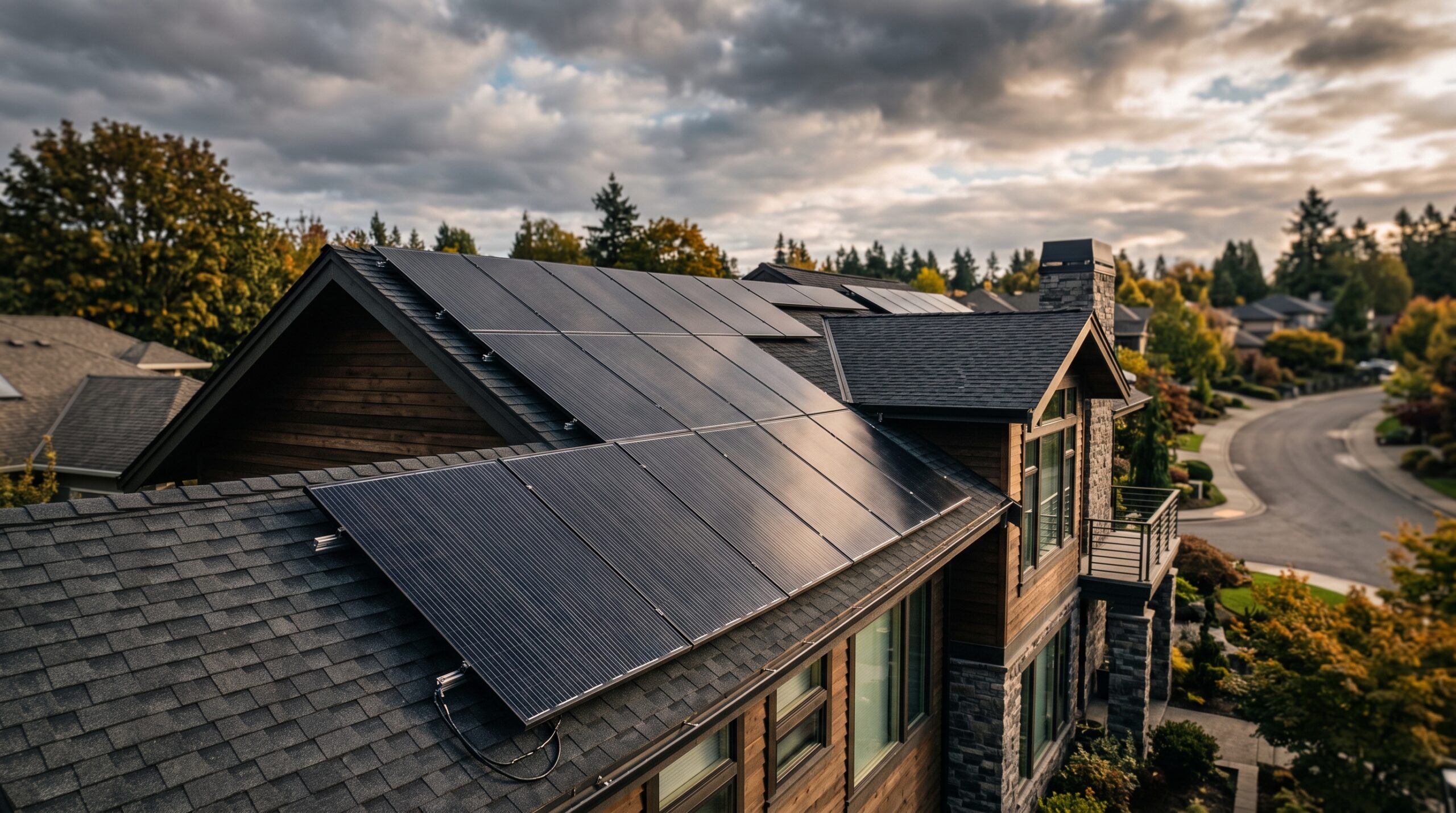
Here is the part almost nobody tells you when they sell you panels: a standard grid-tied rooftop solar system with no battery shuts off the moment the grid goes down. It is not a glitch or a wiring problem. The inverter is built to disconnect for safety, which means most homes with solar sit in the dark right alongside their neighbors during an outage.
If you want the lights on when the power fails, you need more than panels. Below is exactly why grid-tied solar quits during a blackout, and the three setups that actually keep electricity flowing.
The short answer: battery-free solar goes dark too
Roughly 95% of residential solar in the U.S. is grid-tied, and a plain grid-tied system has no way to power your house once the utility drops. The panels are still making DC electricity on a sunny day, but the inverter that turns that into usable household AC power refuses to run. So the energy has nowhere to go.
This catches a lot of people off guard. They assume a roof full of panels guarantees backup power. It does not. Whether your system keeps working in an outage depends entirely on one thing: do you have battery storage with backup capability, or some other off-grid source? If the answer is no, your solar shuts down with everything else.
Why the inverter shuts off on purpose
The shutdown is a safety feature called anti-islanding, and it is required by code. Under UL 1741 (the U.S. safety standard for grid-tied inverters, aligned with IEEE 1547), a solar inverter has to detect a grid failure and disconnect within about two seconds.
The reason is line-worker safety. When the grid goes down, utility crews go out to repair downed or de-energized lines. They expect those wires to be dead. If thousands of rooftop systems kept pushing power back onto the lines, those conductors would be live where workers assume there is zero voltage, creating a real electrocution hazard. Backfeed can also damage equipment and interfere with the utility’s effort to restore service.
There is a second, more technical reason too. A standard grid-tied inverter needs a stable grid signal to synchronize with. Take away that reference and it has nothing to lock onto, so it cannot safely produce AC power on its own. To run independently, the system needs hardware that can create its own stable “island” of power. That is exactly what the setups below add.
Three ways to actually keep power during an outage
There are three real paths to having electricity when the grid is down. They differ a lot in cost, capacity, and how much installation they need.
| Setup | Works in an outage? | What to know |
|---|---|---|
| Grid-tied solar, no battery | No | Inverter disconnects for safety; the whole house goes dark |
| Solar + home battery with backup | Yes | “Islands” your home; battery runs your loads and the panels recharge it by day |
| Inverter with a “secure power supply” outlet | Daytime only, limited | One dedicated outlet, up to about 2,000 W, only while the sun shines, no battery |
| Portable power station + portable panels | Yes | Off-grid by design; plug-and-play, no electrician needed |
That middle “secure power supply” option is worth a quick word, because few homeowners know it exists. Some inverters (SMA’s Sunny Boy line is the best-known example) include a single backup outlet that can deliver up to around 2,000 watts of daytime power straight from the panels, no battery required. It is genuinely useful for charging phones, a laptop, or running a small appliance while the sun is up. But it stops at sundown, the output is capped, and it powers one outlet, not your house. Treat it as a bonus, not a backup plan.
The real fix for a solar home: a battery with backup
If you already have rooftop solar and want it to keep working in a blackout, the answer is adding battery storage that supports backup, paired with a hybrid or backup-capable inverter and usually a dedicated backup loads panel. A Tesla Powerwall is the household name here, but BFP units from Enphase, FranklinWH, and others do the same job.
Here is how it behaves when the grid fails. The system detects the outage and “islands” your home, electrically isolating it from the utility lines in a fraction of a second. That isolation is what makes it safe and code-compliant: no power flows back to the grid, so line workers stay protected. Inside that island, the battery powers your home, and because the grid is safely disconnected, your solar panels are allowed to switch back on and recharge the battery during daylight. On a sunny day with enough storage, you can ride out a multi-day outage on solar and battery alone.
The catch is cost and scope. Most homeowners back up a chosen set of “essential” circuits (fridge, some lights, internet, a few outlets) rather than the whole house, and a single battery only stores so many kilowatt-hours. If you want to understand the price range and what drives it, see our breakdown of home battery backup cost, and our comparison of a portable power station vs. a home battery backup to weigh installed storage against a plug-in unit.
The no-installation route: a portable power station
You do not need a roof full of panels or an electrician to have solar power in an outage. A portable power station (a big battery in a box, sometimes called a solar generator) paired with foldable solar panels works through a blackout for one simple reason: it is never tied to the grid. There is no synchronization, no backfeed risk, and therefore no anti-islanding shutdown to worry about. It is its own little off-grid island the moment you turn it on.
You charge the unit from a wall outlet ahead of a storm, then top it back up with portable panels during the outage. It runs phones, laptops, lights, a CPAP, routers, and many fridges, and the better units put out clean pure sine wave power that is safe for sensitive electronics. It will not run central air or your whole house, but for keeping the essentials alive it is the fastest, cheapest entry point.
If this route fits you, start with how a solar generator works, then look at the difference between a solar generator and a battery power station and which portable solar panels recharge it fastest.
How to figure out what you actually need
Before you spend anything, work backward from the loads you truly need to keep running and for how long. Add up the watts of the gear you care about, then multiply by the hours you want to cover to get a rough watt-hour target. A fridge, a few LED lights, phone charging, and a router is a modest load you can carry on a mid-size power station or a single home battery. Heating, cooling, or well pumps push you toward larger storage or a different plan.
- Already have rooftop solar? A backup-capable battery (Powerwall and similar) is the upgrade that makes your panels useful in a blackout.
- No solar, want flexibility fast? A portable power station plus portable panels gets you off-grid backup this week with no install.
- Renting or in an apartment? A portable unit is usually your only realistic option, since you cannot rewire the building.
To size a system to your real usage instead of guessing, run the numbers through our solar calculator.
Frequently asked questions
Why do my solar panels shut off when the power goes out?
Because your inverter is required to. UL 1741 and IEEE 1547 mandate anti-islanding protection, so a grid-tied inverter detects the outage and disconnects within about two seconds. This keeps your panels from energizing downed power lines and protects the utility crews repairing them. Without a battery or another backup source, your system has no safe way to run on its own.
Can I get power from my solar panels during an outage without a battery?
Only in a very limited way. A few inverters offer a “secure power supply” outlet that delivers up to roughly 2,000 watts of daytime power straight from the panels, with no battery. It only works while the sun is shining, the output is capped, and it powers a single outlet rather than your home. For real backup you need storage or a separate off-grid setup.
Will adding a battery let my solar run the whole house in a blackout?
Usually it runs your essential circuits, not literally everything. A backup-capable battery isolates (“islands”) your home and powers the loads you designate, while your panels recharge it during the day. Whole-home backup is possible but needs enough battery capacity and the right setup, which raises the cost. Most homeowners back up a fridge, lights, internet, and key outlets.
Why does a portable power station work in an outage but rooftop solar doesn’t?
Because a portable power station is never connected to the grid. Anti-islanding rules only apply to equipment that could push power back onto utility lines. A power station is a self-contained battery, so there is nothing to synchronize and nothing to back-feed. You can charge it from portable solar panels and use it freely during a blackout.
Does my solar system feed the grid when the power is out?
No, and that is the whole point of anti-islanding. The instant the grid drops, your inverter disconnects so no electricity flows back to the utility. Even a battery-backed system electrically isolates your home before it powers your loads, so it never energizes the lines outside. That is what keeps repair crews safe.
Sources
- EnergySage — Do Solar Panels Work During a Power Outage?
- Tesla — Powerwall Best Practices During Power Outages
- Eurofins MET Labs — UL 1741 Safety Testing and the Anti-Islanding Requirement
- SMA — How to Explain Secure Power Supply to Homeowners
- SolarReviews — What Happens If You Have Solar and the Power Goes Out?