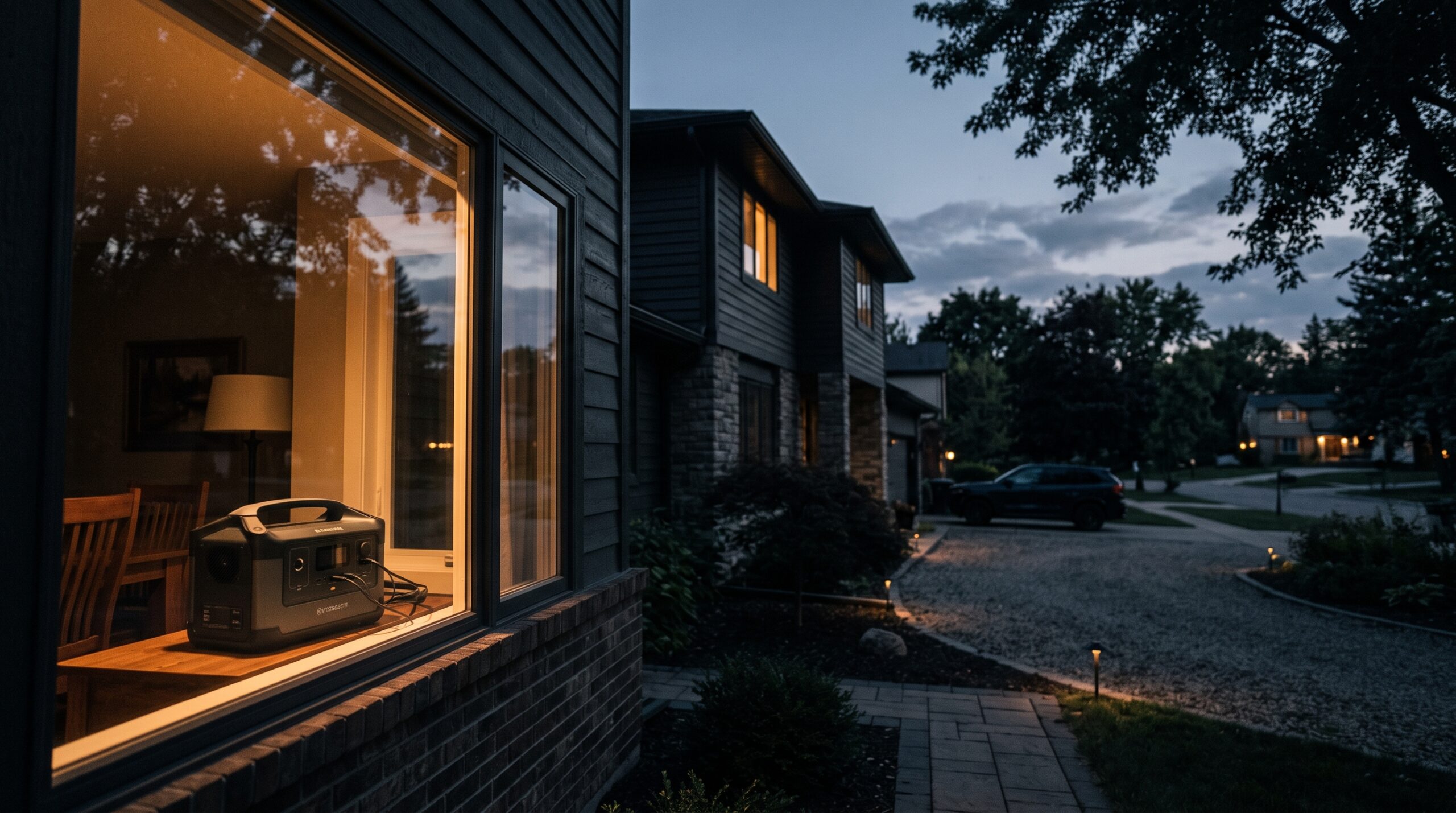
To prepare for rolling blackouts, sign up for grid and utility alerts, keep an outage kit and a charged battery ready, and treat each blackout as a short block you bridge rather than a multi-day emergency. Rolling blackouts are planned, rotating power cuts a grid operator orders during extreme heat or cold, usually lasting about one to two hours per area but repeating through the day. Ready.gov recommends signing up for local alerts, planning for backup power, and keeping refrigerators and freezers closed when the lights go out.
This guide explains what rolling blackouts are and why they happen, how to get notice before one hits, how to prep ahead, what to do during each block, and how a battery power station can bridge the gaps. The single most dangerous mistake comes first, because it kills people in both heat waves and cold snaps.
⚠️ Never run a generator, grill, or stove indoors
Portable generators, gas and charcoal grills, camp stoves, and gas ovens all give off carbon monoxide (CO), an odorless, colorless gas, and must never be used indoors, in a garage, or near a window to heat, cool, or cook through a blackout. Ready.gov and the CDC say to run a generator outdoors only, at least 20 feet from any window, door, or vent, and to keep a battery-powered or battery-backup CO alarm in your home. Because rolling blackouts repeat, the temptation to improvise comes back every block, so set a safe plan once and stick to it.
What rolling blackouts are and why they happen
A rolling blackout, also called a rotating outage or controlled load shed, is a planned, temporary power cut that a grid operator orders and your local utility carries out. The operator disconnects one area at a time, holds it off for a short stretch, then restores it and moves to the next area, rotating the cuts across the region. The goal is to shed just enough demand to keep supply and demand in balance and avoid a much larger, uncontrolled blackout that could take days to recover from.
They happen when demand on the grid threatens to outrun supply, almost always during extreme weather. In a summer heat wave, air conditioning drives demand up just as solar output falls off in the early evening; California’s grid operator typically calls for conservation between 4 p.m. and 9 p.m. for exactly that reason. In a hard winter freeze, heating load spikes while power plants and gas supply can be knocked offline by the cold. Operators like Texas’s ERCOT treat customer outages as a last resort, used only in their most severe emergency level after voluntary conservation and other tools have run out.
Two things make rolling blackouts different from a storm outage. First, they are usually short: each block often runs about one to two hours, and some utilities rotate in shorter 15-to-45-minute stretches. Second, they repeat. The same household can lose power more than once on a strained day as the rotation comes back around, so the right mindset is to plan for several short blocks rather than one long blackout.
How to get alerts before the lights go out
Rolling blackouts rarely come out of nowhere. Grid operators usually issue conservation appeals hours or even days ahead, and that early warning is your cue to charge up and pre-cool or pre-heat. The catch is that the final order to cut power can arrive with very little notice. Southern California Edison, for example, warns that it may have as little as 10 minutes after an emergency is declared before rotating outages begin, which is not enough time to call every affected home. So sign up for alerts now, while you can, rather than waiting for the first dark hour.
| How you’ll hear about it | What it tells you | Where to get it |
|---|---|---|
| Your utility’s outage alerts | Whether your area is in line for a rotating block, sometimes with only minutes of warning | Turn on text, email, or phone alerts in your online utility account |
| Grid operator alerts | Region-wide conservation appeals and emergency levels before any blackouts start | ERCOT’s TXANS and Emergency Alerts in Texas; Flex Alert in California |
| Local emergency alerts | Official warnings plus open cooling or warming center locations near you | Sign up for your county or city alert system; keep a battery or hand-crank radio |
| Your rotating outage block | Which rotation group you’re in, so you know roughly when your turn may come | Look up your block or group number on your utility’s rotating-outage tool ahead of time |
Looking up your rotating outage block or group number before a heat wave or cold snap is worth a few minutes. Major utilities publish a tool that maps your address to a block, and knowing yours helps you guess when the rotation is likely to reach you so you can be ready instead of caught off guard.
How to prep ahead
Most of what keeps a rolling-blackout day comfortable happens before the first cut. Ready.gov recommends taking an inventory of what you rely on electricity for, then planning batteries and alternative power to cover it. Handle the basics while the grid is still up:
- Charge everything. Top off phones, laptops, battery banks, and any portable power station the moment a conservation appeal or heat or cold warning goes out. A full battery is worth far more once your block goes dark, and you’ll want to recharge between blocks too.
- Build an outage kit. Keep flashlights for everyone, spare batteries, a battery or hand-crank radio, drinking water, some no-cook food, a manual can opener, and any medications in one place. Plan on at least one gallon of water per person per day.
- Install CO alarms. Put carbon monoxide detectors with battery backup on every level of your home, since CO risk climbs whenever people improvise heat or cooling during an outage.
- Make a medical plan. If anyone depends on electric medical equipment or refrigerated medicine, talk to your provider about a power-outage plan and ask how long medication can sit at higher temperatures. Register with your utility’s medical baseline or priority list if one exists.
- Pre-cool or pre-heat. When you know a block is coming, run the air conditioning to cool the house down or the heat to warm it up beforehand, then close blinds and doors to hold that temperature through the cut.
What to do during a block
When your power drops, the goal for the next hour or two is simple: hold your temperature, protect your food and electronics, and stay safe until the rotation moves on. Keep the refrigerator and freezer doors shut. A closed refrigerator keeps food cold for about 4 hours, a full freezer for roughly 48 hours, and a half-full freezer for about 24 hours, and a string of short blocks will not threaten that as long as you resist opening the doors.
Unplug sensitive electronics and appliances during the block. Ready.gov advises disconnecting them so a surge does not damage them when power snaps back on, which matters more with rolling blackouts because power returns and cuts out repeatedly. Leave one light switched on so you can tell at a glance when your block comes back. Use flashlights rather than candles, which are a fire risk in the dark. If it is safe to do so, lower your overall load before power returns, since a whole neighborhood switching everything on at once can stress the grid all over again.
If the heat or cold is extreme and your home is getting dangerous between blocks, do not tough it out. Ready.gov says to check with local officials about heating and cooling locations open near you and to go to a community location with power if the temperature inside becomes unsafe, especially for older adults, young children, and anyone with a chronic condition.
Backup power to bridge them
Because rolling blackouts are short and repeated, they are almost the ideal job for a battery power station. A station is quiet, gives off no fumes, and is safe to run indoors, so you can keep a fan, a few lights, the Wi-Fi router, phone chargers, a CPAP machine, or a fridge going straight through a one-to-two-hour block without stepping outside to a generator. When your block ends and the power returns, you recharge the station from the wall and you are ready for the next cut. That recharge-between-blocks rhythm is what makes a battery such a good fit for rolling outages specifically.
Size it for two things: the running watts of what you want to keep on, and the higher surge watts some appliances need to start. A refrigerator might draw only 100 to 400 watts while running but spike to several times that at startup, so the station’s surge rating has to clear that spike or it will trip. Capacity, measured in watt-hours, decides how long the battery lasts; a mid-size station in the 500 to 2,000 watt-hour range covers fans, lights, electronics, and short fridge cycles across several blocks, while a 1,500-watt space heater or window AC will drain most portable batteries fast. A heated blanket, a fan, or a small AC unit is usually a smarter use of limited backup power.
A gas generator makes more power for a longer haul, but it has to run outdoors only, at least 20 feet from the house, and is overkill for outages that last an hour at a time. For rolling blackouts, a charged battery you can use safely indoors and top off between blocks is usually the better tool. Whatever you choose, do the math before the heat wave or freeze arrives. Our Power-Station Sizing calculator helps you match a station to the loads you actually need to keep running, and the Appliance Runtime calculator shows how long a fridge, fan, or CPAP will last on a given battery before it runs flat.
Heat and cold safety
Rolling blackouts strike during the exact weather that makes losing power risky, so safety comes down to the heat or cold itself. In a summer event, the CDC’s guidance is to stay cool, stay hydrated, and stay informed: drink water before you feel thirsty, wear loose, light clothing, and keep blinds closed to block the sun. Do not rely on a fan as your main way to cool down in extreme heat, because once the air is hot enough a fan just moves hot air around. Watch for heat illness, including heavy sweating, muscle cramps, headache, nausea, and dizziness, and treat confusion, fainting, or hot, dry skin as a possible heat stroke and call 911.
In a winter event, the danger flips to cold. Close off one small room, layer up with a hat, gloves, and dry socks, and use blankets or a sleeping bag to trap body heat. Drink warm fluids and watch children, older adults, and pets, who lose heat fastest. In both seasons the rule from the warning above holds: never burn anything indoors for heat, cooling, or cooking. Older adults, young children, and people with chronic medical conditions are the most at risk in either extreme, so check on neighbors who live alone and move to a cooling or warming center if your home becomes unsafe between blocks.
Frequently asked questions
What is a rolling blackout, and how is it different from a normal outage?
A rolling blackout, or rotating outage, is a planned power cut a grid operator orders and your utility carries out to balance supply and demand during extreme heat or cold. Unlike a storm outage, it is deliberate, usually short, and rotates from area to area, so power is cut on purpose for a stretch and then restored. It is used as a last resort to prevent a much larger, uncontrolled blackout.
How long do rolling blackouts last?
Each block usually lasts about one to two hours, and some utilities rotate in shorter 15-to-45-minute stretches. The important part is that they repeat: the rotation can come back around to your area more than once on a strained day, so plan for several short blackouts rather than one long one. Treat any duration you hear as a planning estimate, not a promise, since it depends on how stressed the grid is.
How will I know a rolling blackout is coming?
Grid operators usually issue conservation appeals or Flex Alerts hours or days ahead, but the final order to cut power can come with very little notice, sometimes only minutes. Sign up for your utility’s outage alerts and your local emergency alert system, follow your grid operator’s notifications, and look up your rotating outage block number ahead of time so you know roughly when your turn may come.
Can a battery power station get me through rolling blackouts?
Yes, and rolling blackouts are one of the best uses for one. A battery power station is quiet, gives off no fumes, and is safe indoors, so it can keep a fan, lights, Wi-Fi, a CPAP, or a fridge running through a one-to-two-hour block. Because the blocks repeat, you recharge the station from the wall once power returns and you are ready for the next cut. Size it for both the running watts and the startup surge of what you want to power.
How do I stay safe in the heat during a rolling blackout?
The CDC advises staying cool, hydrated, and informed: drink water before you are thirsty, wear loose, light clothing, close blinds against the sun, and do not rely on a fan as your only cooling in extreme heat. Pre-cool the house before your block, and if the inside gets dangerously hot, go to a cooling center. Watch for heat illness, and treat confusion, fainting, or hot, dry skin as a possible heat stroke and call 911.