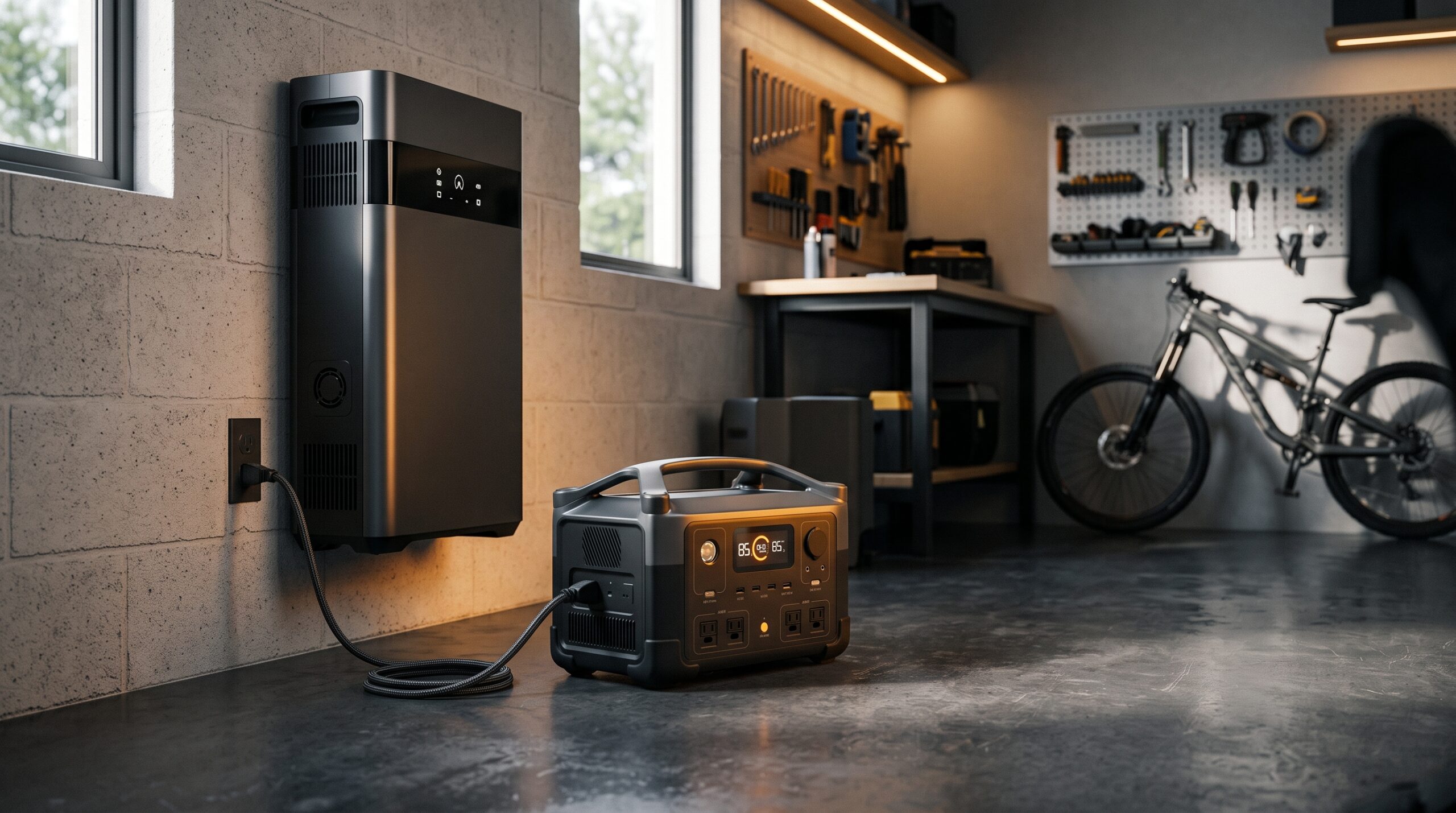
The short answer: a portable power station is the cheaper, movable, plug-and-play way to keep essentials running, while a home battery backup is wired into your electrical panel for automatic whole-home or partial backup at several times the price. One you carry out of a closet and plug into; the other an electrician installs into your house and you mostly forget about. Which one fits comes down to your budget, how much you need to keep on, and whether you want to involve an electrician at all.
They are not really competing for the same job. A power station covers a fridge, a router, phones, and a few lights through the outages most people actually see. A home battery aims to keep the lights, HVAC, and big appliances running across the whole house, the way a wired-in system does. Below is a plain comparison across the things that decide it.
⚠️ Home battery wiring is a licensed-electrician job
A home battery backup connects to your main electrical panel at 240 volts and ties into your home’s wiring, so it has to be installed by a licensed electrician and permitted and inspected to local code. Many manufacturers require a certified installer, and some, including Tesla, sell only through one. This is not a DIY project: incorrect wiring can backfeed the grid and endanger utility crews, cause a fire, or void the warranty. A portable power station needs no wiring at all; you just plug into it.
What each one is
A portable power station is a self-contained battery in a box with outlets on the front. It charges from a wall socket, from a car, or from solar panels you plug in, and then you run appliances straight off it with regular plugs. There is nothing to install. EcoFlow’s DELTA Pro, for example, is a wheeled unit that charges from a standard outlet in a few hours and powers appliances directly, with the option to expand its capacity by chaining extra batteries. Bluetti, Jackery, Anker, and Goal Zero make comparable units across a wide range of sizes.
A home battery backup is a permanently installed system that wires into your electrical panel. A Tesla Powerwall 3, an EcoFlow DELTA Pro Ultra with a Smart Home Panel, or a Bluetti EP900 with B500 batteries all sit on a wall or in the garage, connect through your breaker box, and back up either selected circuits or the whole house. Because they are tied into the panel, they can switch on automatically the instant the grid drops, and they are usually sized to carry far more than a single appliance.
Capacity: essentials vs whole-home backup
This is the clearest split. Portable power stations hold anywhere from a couple hundred watt-hours at the small end up to roughly 3,600 watt-hours in a large single unit, with some models expandable into the tens of kilowatt-hours by adding battery modules. That is plenty to keep a fridge, a router, phones, a CPAP, and some lights going through a typical outage, but it is a fixed tank: when it is empty, it is empty until you recharge it. If you are weighing one size against another, our 1000Wh vs 2000Wh comparison walks through what each tier actually covers.
Home batteries start where portables top out. A single unit typically stores in the neighborhood of 10 to 15 kilowatt-hours, and most systems are designed to stack: a Powerwall 3 holds 13.5 kilowatt-hours and scales to multiple units, while modular systems from EcoFlow and Bluetti can reach several tens of kilowatt-hours. With enough capacity and a high continuous output, often around 7 to 11 kilowatts per unit, a home battery can run central HVAC, the kitchen, and the laundry, not just a handful of plugs. Whether you get true whole-home backup or just your “essential” circuits depends on how many units you install and how the electrician sets up the panel.
Installation: plug-in vs wired-in
A portable power station has no installation step. It arrives charged or nearly so, and you plug devices into it the same way you would a power strip. When the lights go out, you carry it to where you need it and run extension cords to the fridge or set it next to the bed. That portability is the whole point, and it is also why a power station can do double duty for camping, tailgating, or a job site.
A home battery is the opposite. It is bolted in place and hard-wired into your panel, with a permit, an inspection, and usually a certified installer. The upside of all that work is automation: when the grid fails, a home battery switches over on its own in a fraction of a second, fast enough that lights and computers usually do not even blink. You do nothing. With a portable station, you are the automatic transfer switch, which means someone has to be home, awake, and willing to go plug things in.
Cost
The price gap is large, and it is the single biggest reason most households land on a power station. A portable unit sits in the lower tier, roughly the mid-hundreds to low-thousands of dollars depending on capacity, with no install bill because there is nothing to install. You buy it, charge it, and you are done.
A home battery is an order of magnitude more. A single installed unit generally runs into the high four figures, and a multi-battery, whole-home system can reach well into five figures once you add the panel work, the permit, and labor. Home batteries paired with solar may qualify for federal tax incentives, which can soften the net cost, but the upfront number is still in a different league. For the price of one home battery you could buy several large power stations, which is exactly the trade-off the next sections are about.
Pairing with solar
Both can take solar, but in different forms. A portable power station accepts foldable or rigid panels that you plug straight into it, which lets it refill during a long outage with no fuel and no noise. Recharge time swings with the weather and the unit’s size, from a few hours of strong summer sun for a small station to most of a day for a large one, and slower still under winter cloud. It is a genuine advantage over a fuel-burning option, and it is one reason power stations are often called solar generators.
Home batteries are built around solar from the start. They typically tie into a rooftop array, storing the excess your panels make during the day so you can use it at night or hold it in reserve for an outage. For a household that already has, or plans to add, rooftop solar, the battery is the piece that turns daytime production into round-the-clock power and seamless backup. That tight solar integration, plus the automatic switchover, is much of what you are paying the premium for.
Head-to-head comparison
| Portable power station | Home battery backup | |
|---|---|---|
| Capacity | ~200Wh to 3,600Wh per unit; some expandable into the tens of kWh | ~10 to 15 kWh per unit; stacks to several tens of kWh |
| Install | None; plug and play out of the box | Hard-wired into your panel by a licensed electrician, with a permit |
| Automatic? | No; you plug devices in by hand | Yes; switches over on its own in milliseconds |
| Cost | Lower; roughly mid-hundreds to low-thousands of dollars | Far higher; high four to five figures installed |
| Portable? | Yes; carry it room to room or take it with you | No; fixed to the wall |
| Solar | Portable panels you plug in | Ties into rooftop solar; stores excess for night and backup |
Which should you choose
Occasional outages and a tight budget: a portable power station, easily. If your power goes out a few times a year for a few hours, spending five figures to automate something that happens rarely is hard to justify. A mid-size station keeps the fridge, the router, phones, and a CPAP alive, costs a fraction as much, and earns its keep on camping trips and at the curb between storms.
Frequent or long outages and whole-home needs: a home battery starts to make sense, especially if you already have or want rooftop solar. When you need central AC, a well pump, and the whole kitchen to ride through outages automatically, and you want it to happen without anyone touching a thing, the wired-in system is what does that. The catch is cost and the install, so it is the right call mainly for people who lose power often or rely on equipment that cannot pause.
Renters and apartments: a portable power station, full stop. You cannot bolt a battery into a panel you do not own, and you can take a power station with you when you move. If you have looked at fuel-burning options too, our gas generator vs power station comparison covers why a battery unit is the only one safe to run indoors.
Heavy whole-house loads on a budget: this is where many people pair tools instead of buying the most expensive single one. A portable station handles quiet overnight essentials, and a generator covers heavy daytime loads if you have a safe place to run it. If you are sizing for the whole house, our guide on what size generator to run a whole house shows how big those loads really get before you commit to a five-figure battery.
Not sure how much capacity your gear actually needs? Size it before you spend. Our Power-Station Sizing calculator turns your appliance list into the watt-hours and surge watts to look for, and the Appliance Runtime calculator shows how many hours a given battery will hold those loads, whether you end up with a portable unit or a wall-mounted one.
Large and expandable picks, live prices


EcoFlow DELTA 2 Max
2,048Wh, 2,400W — fast solar, runs most of a kitchen
$1,049.00Check price on Amazon →


As an Amazon Associate we earn from qualifying purchases. Prices are pulled automatically from Amazon and may have changed.
Frequently asked questions
Can a portable power station back up my whole house?
Generally no. A portable station powers what you plug into it, so it covers essentials like a fridge, a router, phones, and lights rather than the entire home at once. Some larger units can connect to a transfer switch or a smart panel to feed a few circuits, but true automatic whole-home backup is the job of a wired-in home battery sized for those loads.
Does a home battery have to be installed by a professional?
Yes. A home battery wires into your main panel at 240 volts and must be installed by a licensed electrician, with a permit and an inspection to local code. Many manufacturers require a certified installer, and some sell only through their installer network, so it is not a DIY project. A portable power station, by contrast, needs no installation at all.
Which is cheaper, a portable power station or a home battery?
A portable power station, by a wide margin. Portables sit in the mid-hundreds to low-thousands of dollars with no install cost, while a single installed home battery usually runs into the high four figures and a whole-home system reaches well into five figures once labor and panel work are included. Home batteries paired with solar may qualify for federal tax incentives that reduce the net cost.
Do both work with solar panels?
Yes, but differently. A portable power station charges from foldable or rigid panels you plug straight into it, which lets it refill during a long outage. A home battery normally ties into a rooftop array and stores the excess your panels make during the day for use at night or during an outage. Recharge speed in both cases depends on panel size and how much sun you get.
Will the lights flicker when the power goes out?
With a home battery, usually not. It detects the outage and switches over automatically in a fraction of a second, fast enough that most lights and electronics never notice. With a portable power station you are the switch: the outage hits, and you go plug your devices into the unit. A few stations offer near-instant passthrough for a single connected device, but for the house as a whole, the seamless cutover is what the wired-in battery buys you.
Sources
- Tesla, Powerwall 3 Datasheet
- EnergySage, Tesla Powerwall 3 Review (capacity, output, and installation)
- EcoFlow, DELTA Pro Ultra Whole-Home Backup Power
- EcoFlow, DELTA Pro Portable Power Station
- Bluetti, EP900 + B500 Home Battery Backup System
- EcoFlow, Home Battery vs Portable Power Station Compared