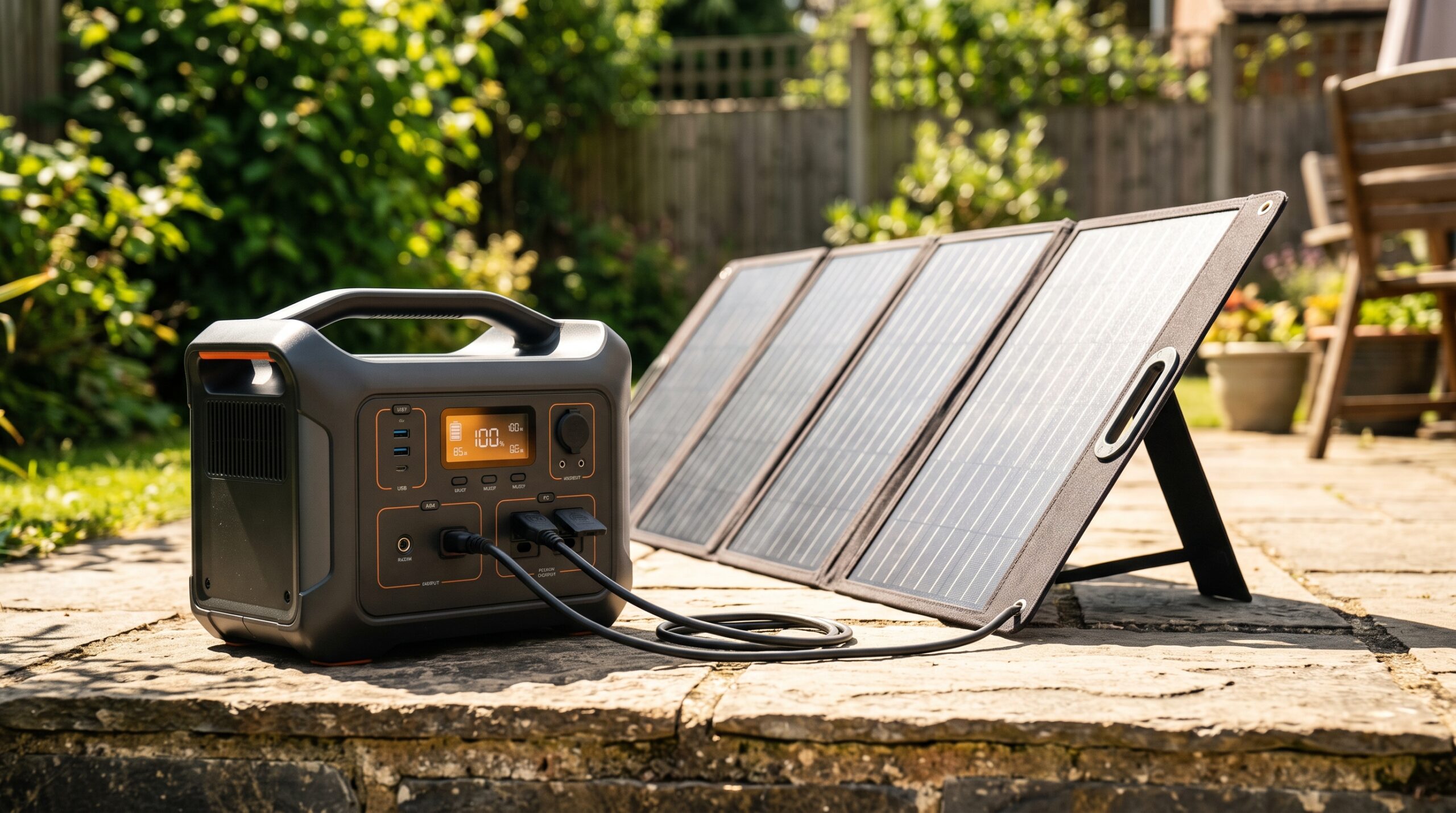
A “solar generator” is not really a generator at all. It is a battery power station that recharges from solar panels instead of gasoline, so there is no fuel, no fumes, no engine noise, and nothing that stops it from running safely indoors. The right size depends entirely on what you want to keep alive during an outage: a portable unit in the 500–1,000Wh range covers phones, laptops, lights, and a CPAP for a night, while a 2,000–4,000Wh+ expandable system can carry a fridge plus the essentials through a multi-day blackout. Below is how to choose, plus genuinely popular current kits by size tier presented as strong options, not a fake tested ranking.
What a solar generator actually is
A solar generator pairs two things: a portable battery power station (the box with the outlets and the screen) and one or more solar panels that plug into it. The panels feed direct current into a built-in charge controller, the battery stores it, and an inverter turns it back into the household AC power your devices expect. Because nothing burns, you can run it on a kitchen counter or next to a bed without carbon monoxide risk, which is the whole reason people pick one over a gas unit for indoor use. If you want the longer explanation, see how a solar generator works.
One naming note that trips people up: the power station and the “solar generator” are the same hardware. Sold on its own, it is a power station; bundled with a panel, the marketing calls it a solar generator. We break down the distinction in solar generator vs. battery power station. The practical takeaway is that you are buying a battery first and a charging method second.
How to choose: the specs that matter
Five numbers decide whether a unit fits your situation. Get these right and the brand matters less than you would think.
- Capacity (watt-hours). This is the size of the tank. A 1,000Wh battery holds roughly 1,000 watt-hours of usable energy before real-world losses. A phone is a few watt-hours; a fridge might pull 1,000–2,000Wh over a full day. Add up what you need to run and for how long. Our solar calculator does this math for you, and if watt-hours are new to you, start with what is a watt-hour.
- Output and surge (watts). Capacity is how much; output is how fast it can deliver. A 1,800W unit can run most household devices, but motors and heating elements briefly spike well above their running watts. Check the surge rating against anything with a compressor or a heating coil, and read running watts vs. starting watts before you assume a number is enough.
- Solar input watts + MPPT. This sets how fast the battery refills from the sun. A station that accepts 500W of solar will recharge far quicker than one capped at 200W. MPPT (maximum power point tracking) is the charge-controller technology that squeezes the most out of the panels; nearly all current units from the major brands have it.
- Battery chemistry (LiFePO4). Today’s serious units use lithium iron phosphate (LiFePO4 / LFP) cells, typically rated for 3,000+ charge cycles to 80% capacity, often a decade or more of regular use. Older or cheaper units use standard lithium-ion with shorter lifespans. More on this in LiFePO4 vs. lithium-ion.
- Expandability. If you are buying for home backup, look for a base unit that accepts add-on battery packs. It lets you start smaller and grow capacity later instead of buying a whole new system.
If you would rather work through this step by step, our guide on how to read power station specs walks through every line on a typical spec sheet.
One more decision sits on top of those specs: buy the bundled kit or assemble the pieces yourself. Brands sell the power station alone or bundled with matching panels as a “solar generator” kit. A kit is the simplest path, since the connectors fit, the panel wattage is matched to what the station can accept, and you are running on day one; the trade-off is that bundles often cost more than buying the same pieces during separate sales. Buying panels separately can save money and lets you over-panel (add more watts than the bundle includes, up to the station’s input limit) for faster charging on cloudy days, but connector type, voltage range, and the station’s maximum input all have to line up. If you go that route, our roundup of the best portable solar panels covers what pairs well with current stations. For most first-time buyers who just want outage insurance, a matched kit is the lower-stress choice.
Portable tier: roughly 500–1,000Wh
This is the sweet spot for apartments, camping, road trips, and keeping the critical small stuff going through a short outage: phones, a laptop, a router, LED lights, a fan, and many CPAP machines overnight. Units here generally weigh 25–40 lbs and accept 400–600W of solar, which means a sunny afternoon can meaningfully refill them. Strong current options in this class include:
- Jackery Explorer 1000 v2 — about 1,070Wh, 1,500W output, LiFePO4, light and beginner-friendly. A common pick for people who want simple.
- EcoFlow Delta 2 — about 1,024Wh, 1,800W output (2,700W surge), up to 500W solar, with one of the more polished companion apps.
- Bluetti AC180 — about 1,152Wh, 1,800W output (2,700W surge), up to 500W solar; often among the better value-per-watt-hour units.
- Anker Solix C1000 — about 1,056Wh, 1,800W output (2,400W surge), up to 600W solar, frequently cited for fast solar recharge.
If your goal is specifically keeping a sleep-apnea machine running, see the best power station for CPAP, since humidifier use changes the math a lot.
Home-backup tier: roughly 2,000–4,000Wh and expandable
If you want to carry a refrigerator plus lights, internet, and device charging through a multi-day outage, you need more tank and, ideally, room to grow. Units in this class accept far more solar (often 1,000W+) and take add-on batteries so you can scale capacity over time. They are heavier and pricier, but they are what “whole essentials” backup actually looks like. Strong current options include:
- Jackery Explorer 2000 Plus — 2,042Wh base, expandable, dual solar inputs accepting up to 1,200W of panels. Modular for people who expect to add capacity.
- Bluetti AC200L — 2,048Wh base (expandable to roughly 8kWh with add-on packs), 2,400W output, up to 1,200W solar input.
- EcoFlow Delta Pro 3 — a 4,096Wh LFP unit with 4,000W output and 120V/240V capability, expandable to tens of kilowatt-hours. This is the heavy-duty end, for running larger loads.
Deciding between a portable unit and something this size? Our piece on 1000Wh vs. 2000Wh power stations and the broader best portable power station for home backup guide help you place yourself on the curve before you spend.
Comparison of popular solar generator kits
Specs below reflect commonly published manufacturer figures; prices are rough street ranges that move constantly with sales, so treat them as ballpark, not a quote.
| Kit / class | Capacity | Solar input (max) | Panel pairing | Approx. price (station) |
|---|---|---|---|---|
| Jackery Explorer 1000 v2 (portable) | ~1,070Wh | ~400–600W | 100W / 200W SolarSaga panels | ~$700–900 |
| EcoFlow Delta 2 (portable) | ~1,024Wh | up to 500W | 220W / 400W EcoFlow panels | ~$700–999 |
| Bluetti AC180 (portable) | ~1,152Wh | up to 500W | 200W / 350W Bluetti panels | ~$700–900 |
| Anker Solix C1000 (portable) | ~1,056Wh | up to 600W | 100W / 200W Anker panels | ~$700–999 |
| Bluetti AC200L (home backup) | ~2,048Wh, expandable | up to 1,200W | multiple 200W+ panels | ~$1,300–1,700 |
| Jackery Explorer 2000 Plus (home backup) | ~2,042Wh, expandable | up to 1,200W | multiple 200W SolarSaga panels | ~$1,500–2,000 |
| EcoFlow Delta Pro 3 (heavy backup) | ~4,096Wh, expandable | up to ~2,600W | multiple 400W+ panels | ~$3,000–3,800 |
Be honest about solar recharge speed
The marketing input number is a ceiling you rarely hit. A “500W” solar setup almost never produces 500W in the real world. Panels are rated under ideal lab conditions, and actual output is dragged down by clouds, haze, panel angle, heat, dust, and the simple fact that the sun is only strong for part of the day. A useful rule of thumb is to expect something like 60–80% of the rated panel wattage in good conditions, and much less when it is overcast.
The other factor is “sun hours,” the number of hours per day your location gets strong, usable sunlight, which is far fewer than daylight hours. That is why a 1,000Wh battery with 400W of panels does not refill in 2.5 hours in practice. For the full method, see how long it takes to charge a power station with solar and how many solar panels you need to recharge a power station. The practical move is to buy more panel wattage than you think you need so cloudy days still make progress.
How to buy without overspending
Start with the number, not the brand. Run your devices through the solar calculator to land on a target capacity and panel wattage, then shop for a unit that clears it with a little headroom. A few honest pointers:
- Buy roughly 20–30% more capacity than your calculated need, because real-world losses and future appliances eat into the rating.
- Prioritize LiFePO4 chemistry and solar input watts over a slightly bigger battery, especially if outages where you live tend to run long.
- Prices on these swing hard around holiday sales. If you are not in an emergency, watching for a sale often beats paying the bundle’s sticker price.
- If you are weighing this against fuel-burning options, read gas generator vs. power station so the trade-offs (runtime, refueling, indoor safety) are clear before you commit.
We do not sell hardware or post affiliate prices, so the model names above are starting points for your own research, not a paid ranking. Check current specs and pricing on the manufacturer’s own page before you buy.
Portable and home-backup tiers, live prices


Jackery Explorer 1000 v2
1,070Wh, 1,500W — light and simple for outages
$499.00Check price on Amazon →


As an Amazon Associate we earn from qualifying purchases. Prices are pulled automatically from Amazon and may have changed.
Frequently asked questions
Is a solar generator the same as a power station?
Effectively, yes. The hardware that stores and delivers the power is a battery power station. “Solar generator” is the term brands use when the station is sold bundled with solar panels. You can also add panels to a power station you already own and it becomes a solar generator.
Can a solar generator run my refrigerator during an outage?
A mid-size fridge often uses somewhere around 1,000–2,000 watt-hours per day, so a 1,000Wh portable unit may carry it part of a day, while a 2,000Wh+ unit can usually cover a full day or more, especially if you are recharging from the sun. Check the surge rating, since a fridge compressor spikes when it kicks on. Our guide to sizing a power station for a refrigerator has the specifics.
How big a solar generator do I need?
It depends on your device list and how long the power tends to stay out. List what you need to run, multiply each device’s watts by the hours you need it, and add it up. The solar calculator does this and suggests both a battery size and a panel wattage so you are not guessing.
Is LiFePO4 worth paying more for?
For most buyers, yes. LiFePO4 cells typically last several times longer than standard lithium-ion (often 3,000+ cycles versus a few hundred) and handle heat more safely. If you expect to use the unit for years of outages and camping, the longer lifespan usually justifies the cost.
Should I buy the panel kit or just the power station?
If you want a guaranteed-compatible, ready-to-go setup, the matched kit is easiest. If you want to save money or add more panel wattage than the bundle includes, buying panels separately can work, as long as the connectors, voltage range, and the station’s maximum solar input all match. Beginners are usually happier with the kit.
Sources
- Outdoor Life — Best Portable Power Stations, tested and reviewed
- GearJunkie — The Best Portable Power Stations, tested
- Anker Solix — C1000 official specifications
- EcoFlow — Delta Pro 3 official product page
- Jackery — Explorer 2000 Plus official product page