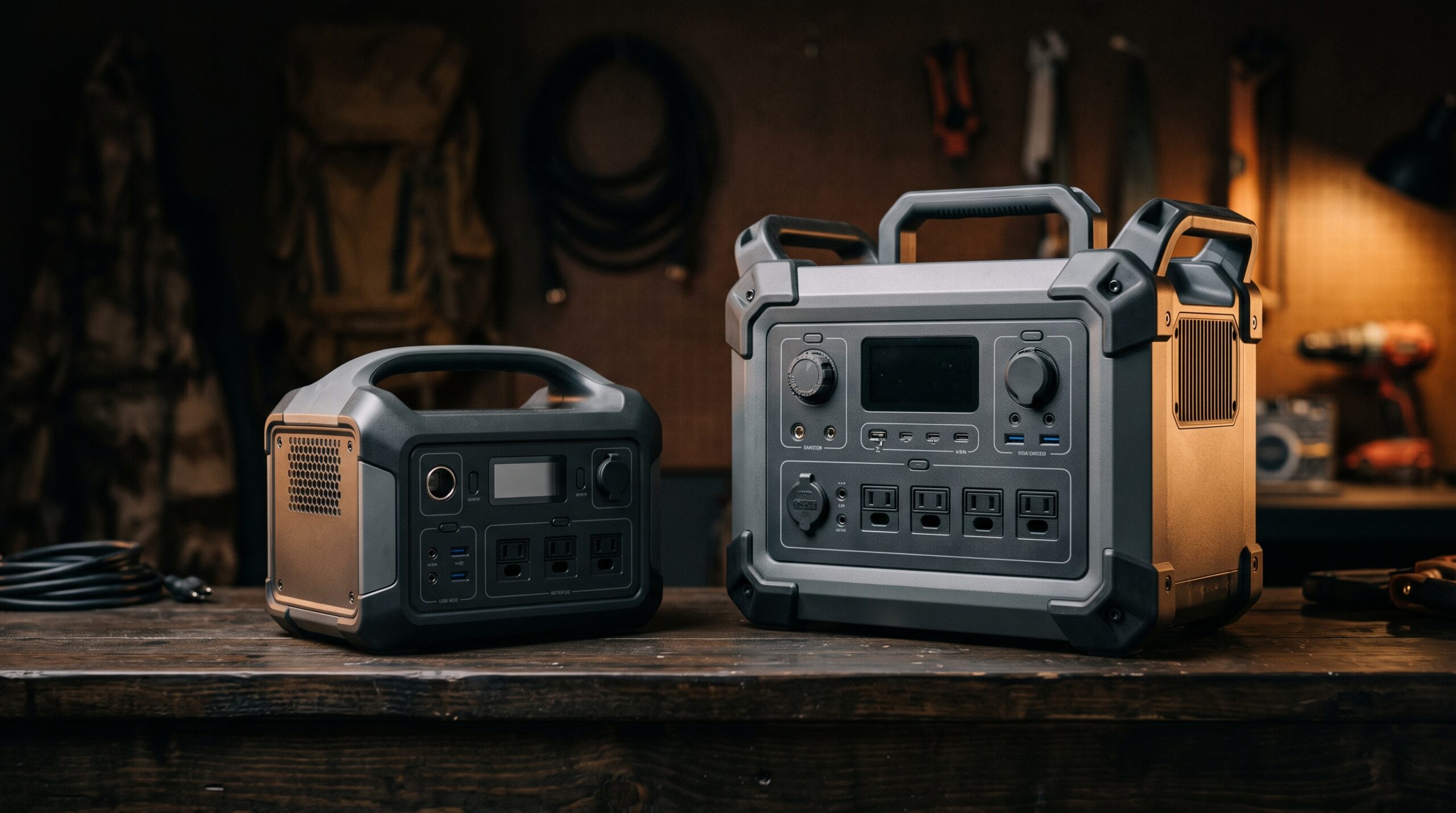
Short version: a 1,000Wh power station covers an overnight outage, running a fridge for roughly 12 to 17 hours or charging phones and laptops for days, while a 2,000Wh unit roughly doubles that, carrying a refrigerator close to a full day or running several things at once. If your outages are short and you mostly want to protect the fridge and stay connected, 1,000Wh is usually enough. If they stretch past a day, or you want more than one appliance running at the same time, 2,000Wh buys the headroom.
Watt-hours are the size of the fuel tank, not the size of the engine. A 1,000Wh battery holds about half the energy of a 2,000Wh battery, so on the same load it runs about half as long. Both numbers shrink a little in practice: an inverter loses roughly 10 to 15 percent turning the battery’s DC into household AC, and most units hold back the bottom of the pack to protect the cells, so a 1,000Wh station delivers closer to 850 to 900Wh and a 2,000Wh station closer to 1,700 to 1,850Wh of real, usable energy. Every runtime below is figured on those usable numbers.
What 1,000Wh runs and for how long
A 1,000Wh station is the overnight-and-essentials class. After inverter losses you have roughly 850 to 900Wh to spend, enough to keep the core of a home going through a typical outage. A full-size refrigerator, drawing 100 to 200 watts but cycling its compressor on and off, runs for about 12 to 17 hours, often long enough to bridge a single-night outage without the food warming up. Low-draw electronics last far longer: a WiFi router and modem can run a day or more, a CPAP without a heated humidifier covers a couple of nights, and phone and laptop charging is measured in dozens of refills.
Where a 1,000Wh unit gets tight is heavy and simultaneous loads. Many models in this class cap continuous output around 1,000 to 1,800 watts, so a 1,500-watt space heater either runs alone for under an hour or will not start at all on the smaller units. Running a fridge plus lights plus internet at the same time is comfortable; adding a microwave or a heater on top is where you watch the battery drop fast.
What 2,000Wh runs and for how long
A 2,000Wh station is the most-of-a-day class. With about 1,700 to 1,850Wh usable, it carries the same refrigerator close to a full day, sometimes a day and a half once you account for the compressor cycling, and it has the capacity to run several things together rather than one at a time. A fridge, a few lights, WiFi, a TV, and phone charging can all share the budget and still leave room. The higher continuous-output rating on these units, commonly 2,000 to 2,400 watts, also means a 1,500-watt heater or a microwave runs without straining the inverter, though either still drains the pack in an hour or two.
The practical difference is not simply “twice the hours.” It is the difference between rationing one appliance and keeping a small household’s essentials on through a longer event. If an outage runs into a second day, a 2,000Wh battery is far more likely to still be useful in the morning, especially if you can recharge it from solar during daylight.
Hours by device: 1,000Wh vs 2,000Wh
The table below shows roughly how long each load runs on a usable ~850 to 900Wh battery (the 1,000Wh class) versus a usable ~1,700 to 1,850Wh battery (the 2,000Wh class). Treat these as ranges, not promises. Real runtime moves with the specific model, the temperature, and how hard the appliance is working, and fridges and freezers in particular run far longer than the raw math suggests because their compressors cycle on and off.
| Device | Running watts | Approx. hours on ~1,000Wh | Approx. hours on ~2,000Wh |
|---|---|---|---|
| Full-size refrigerator | 100–200 W (cycles) | ~12–17 hr | ~a full day to 1.5 days |
| Chest or upright freezer | 100–400 W (cycles) | ~8–14 hr | ~16–30 hr |
| CPAP (no humidifier) | 30–60 W | ~15–25 hr | ~30–50 hr |
| WiFi router + modem | 10–35 W | ~25–60+ hr | ~50–120+ hr |
| Laptop | 30–100 W | ~10–25 hr | ~20–50 hr |
| LED TV (50–55 in) | 70–200 W | ~5–12 hr | ~10–24 hr |
| LED lights (a room) | 10–60 W | ~15–60+ hr | ~30–120+ hr |
| Box or ceiling fan | 35–100 W | ~9–25 hr | ~18–50 hr |
| Space heater | 750–1,500 W | ~0.5–1 hr (may exceed output limit) | ~1–2.5 hr |
| Microwave (burst) | 600–1,200 W | minutes of cook time, not hours | minutes of cook time, not hours |
These are ballpark figures. To pin down your own gear, run the numbers through the Appliance Runtime calculator, which divides a given watt-hour rating by your actual loads. And if you are still deciding between the two sizes, the Power-Station Sizing calculator adds up your devices plus their startup surge and tells you whether 1,000Wh covers it or you need 2,000Wh.
How to decide by outage length and devices
Start with how long your power tends to go out, then add up what you actually need running. For most US homes, outages are short, a few hours on average, with the occasional multi-day event from a storm. If your typical outage is overnight and your goal is to keep the fridge cold and your phones, internet, and a light or two alive, a 1,000Wh station is usually enough, and it costs and weighs less.
Step up to 2,000Wh when one of three things is true: your outages run longer than a day, you want to run more than one meaningful appliance at the same time, or you need a higher-draw item like a 1,500-watt space heater or a microwave without it dominating the whole battery. Medical loads change the math too. A single CPAP runs for nights on either size, but if you depend on equipment overnight, size up for margin and keep a tested backup plan rather than cutting it close. For life-critical devices, confirm the station against the equipment’s own power requirements and talk to your device provider.
Weight, price, and output tradeoffs
Capacity is not free. A 1,000Wh unit like the Jackery Explorer 1000 v2 weighs about 24 pounds and is genuinely easy to carry with one hand; the EcoFlow DELTA 2 in the same class is around 27 pounds. A 2,000Wh unit like the Jackery Explorer 2000 v2 roughly doubles that to about 40 pounds, which is still movable but is a two-hands, set-it-and-leave-it weight. If you plan to carry the station between the house, the garage, and a vehicle, the lighter 1,000Wh class is much friendlier.
Price tracks capacity too: a 2,000Wh unit generally costs noticeably more than a 1,000Wh one, though both brands discount heavily and often, so compare at the moment you buy rather than sticker to sticker. Output is the third axis and it is easy to overlook. Watt-hours decide how long; the continuous-watt rating decides what you can plug in at once. A 1,000Wh unit often tops out lower on output, while a 2,000Wh unit typically delivers 2,000 watts or more continuous and a surge rating around double that for motor startups. If your loads include anything heavy, check the output rating, not just the watt-hours.
Expandability
If you are torn between the two sizes, expandability is a real tiebreaker. Several units in both classes accept add-on battery packs, so you can buy a smaller station now and grow it later instead of replacing it. The EcoFlow DELTA 2, a 1,024Wh unit, accepts an extra battery that brings it to about 2,048Wh, and a larger add-on pushes it past 3,000Wh, so a 1,000Wh purchase does not have to be a permanent ceiling. Jackery’s 2,000-class units expand into multi-kilowatt-hour kits the same way.
The catch is that expanding adds capacity, not output. An expansion battery gives you more hours, but the inverter’s continuous-watt limit stays the same, so it lets you run the same loads for longer, not run bigger loads. If you expect your needs to grow, buying an expandable base, even a 1,000Wh one, is often smarter than overbuying on day one.
1,000Wh and 2,000Wh side by side


Jackery Explorer 1000 v2
1,070Wh, 1,500W — light and simple for outages
$499.00Check price on Amazon →


Jackery Explorer 2000 v2
2,042Wh, 2,200W — big capacity, not expandable
$899.00Check price on Amazon →
As an Amazon Associate we earn from qualifying purchases. Prices are pulled automatically from Amazon and may have changed.
Frequently asked questions
Is 1,000Wh enough to get through a power outage?
For a typical short outage, yes. A 1,000Wh station holds roughly 850 to 900Wh of usable energy, enough to run a refrigerator for about 12 to 17 hours and keep phones, internet, and a light or two going alongside it. It is well matched to overnight outages. If your power regularly stays out longer than a day, or you want to run several appliances at once, step up to 2,000Wh.
How long will a 1,000Wh power station run a refrigerator?
Roughly 12 to 17 hours for a full-size refrigerator. The fridge draws 100 to 200 watts, but its compressor only runs about a third of the time, so the usable 850 to 900Wh stretches much further than the running wattage alone suggests. A 2,000Wh station roughly doubles that, carrying the same fridge close to a full day.
Will a 2,000Wh power station last a whole day?
For a refrigerator, usually yes. With about 1,700 to 1,850Wh usable, a 2,000Wh station carries a cycling fridge close to a full day, sometimes longer. Running several things at once, a fridge, lights, WiFi, and a TV together, shortens that, and high-draw items like a space heater or microwave will drain even a 2,000Wh battery in an hour or two.
What is the difference between 1,000W and 1,000Wh?
Watts (W) measure output, how much you can pull at one instant; watt-hours (Wh) measure capacity, how long you can pull it. A 1,000Wh battery running a 100-watt load lasts about ten hours on paper; the same battery running a 1,000-watt load lasts about one. When comparing 1,000Wh and 2,000Wh units, the Wh number tells you runtime and the separate continuous-watt rating tells you what you can plug in at once.
Can I expand a 1,000Wh power station to 2,000Wh later?
On some models, yes. Several 1,000Wh-class units, such as the EcoFlow DELTA 2, accept an add-on battery that roughly doubles capacity to around 2,048Wh, with larger packs pushing higher. Expansion adds hours, not output, so the continuous-watt limit stays the same. If you might need more capacity later, buying an expandable base is often smarter than overbuying upfront.
Sources
- Jackery Explorer 1000 v2 product page (1,070Wh, 1,500W output / 3,000W surge, ~24 lb)
- EcoFlow DELTA 2 product page (1,024Wh, 1,800W output, ~27 lb, expandable to ~2,048Wh and ~3,072Wh)
- Jackery Explorer 2000 v2 product page (2,042Wh, 2,200W output / 4,400W surge, ~39.5 lb)
- PowerOutage.us, How Long Will a Power Station Run My Refrigerator (usable capacity, ~12–17 hr on 1,000Wh)
- U.S. Department of Energy, Estimating Appliance and Home Electronic Energy Use