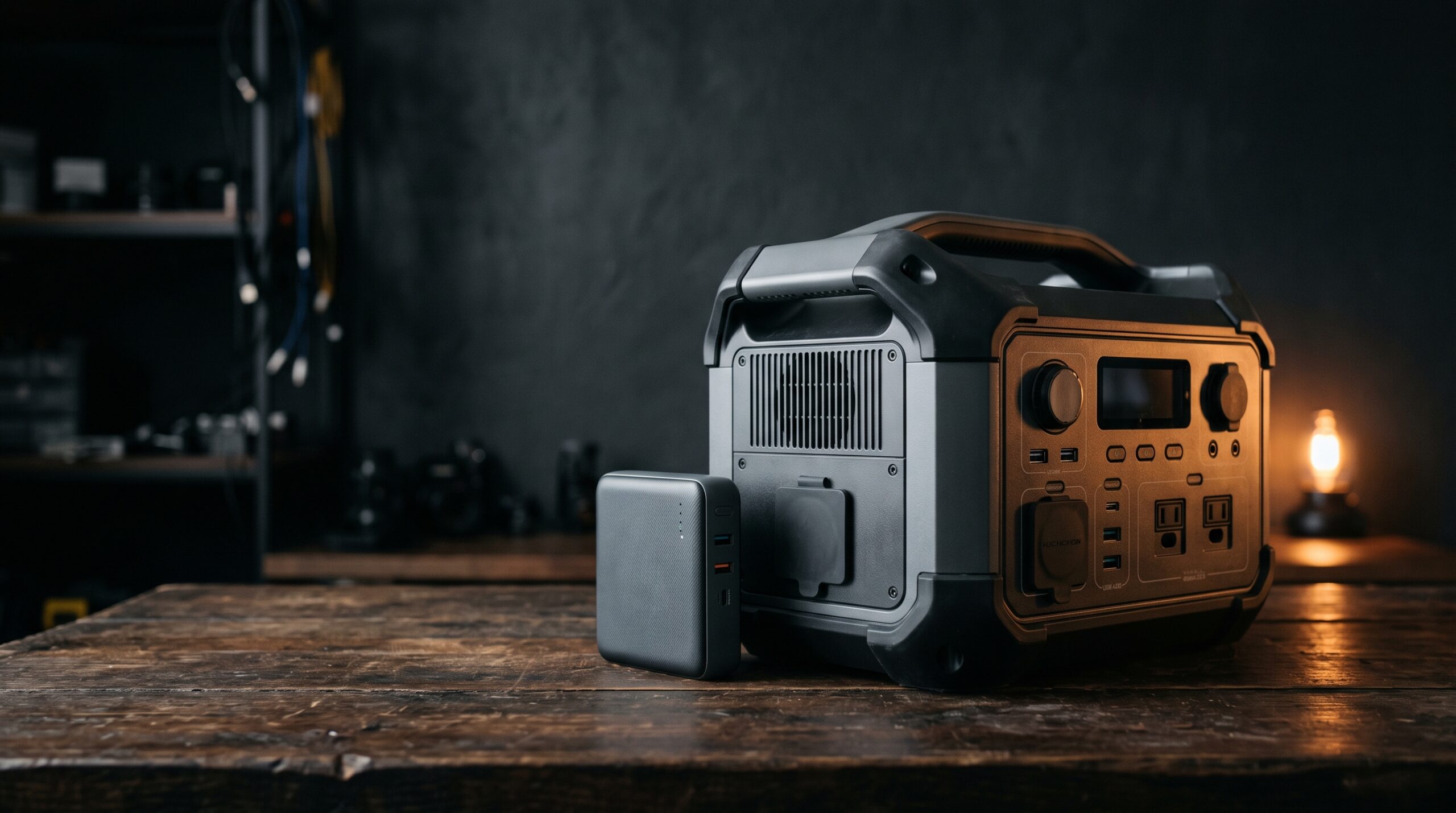
If the lights go out and you only need to keep phones and a flashlight alive, a power bank is enough. If you want to keep a refrigerator, a CPAP machine, or a lamp running, you need a power station. The short version: a power bank is a pocket battery measured in mAh that recharges USB devices, while a power station is a wall-outlet battery measured in Wh that runs real AC appliances. They sound similar, they get shelved next to each other, and they solve completely different problems during an outage.
Below is what each one is actually built to do, why mAh and Wh are not interchangeable, and how to decide whether you need one, the other, or both.
What a power bank is for
A power bank is a sealed lithium battery with USB ports. You charge it from a wall plug or a laptop, and it pushes that charge back out through USB-A or USB-C into phones, tablets, earbuds, smartwatches, headlamps, and similar small electronics. Capacity is printed in milliamp-hours (mAh), usually somewhere between 5,000 and 25,000 mAh, and the whole thing weighs less than a pound or two.
That is the entire job. A power bank has no AC outlet and no inverter, so it cannot send the kind of power a household appliance plugs into. During an outage it is the right tool for keeping your phone charged so you can reach family, check alerts, and use a flashlight app, and not much beyond that. A typical 20,000 mAh bank will refill a modern smartphone several times over before it needs a recharge of its own.
What a power station is for
A portable power station is a larger battery with a built-in inverter and standard household outlets, often alongside USB ports and a 12V socket. The inverter is the key piece: it converts the battery’s stored energy into the 120V AC that wall plugs deliver, so you can run things that were never designed for USB. Capacity is rated in watt-hours (Wh), commonly from about 200 Wh on the small end to 2,000 Wh or more on units meant for home backup.
That inverter and those outlets are why a power station can keep a refrigerator cycling, charge a laptop through its normal charger, run a CPAP overnight, or power lamps and a router. It is heavier and pricier than a power bank, and many models accept solar panels so you can recharge when the grid is down for days. This is the device people mean when they talk about backup power for an outage.
mAh vs Wh explained
The reason you cannot compare a power bank and a power station by their headline number is that they use different units. Milliamp-hours (mAh) measure electric charge. Watt-hours (Wh) measure energy. To turn one into the other you need the battery’s voltage, because energy equals charge times voltage.
The formula is simple: Wh = (mAh × V) ÷ 1000. Most lithium-ion cells have a nominal voltage of about 3.6 to 3.7V. So a 20,000 mAh power bank holds roughly (20,000 × 3.7) ÷ 1000 = 74 Wh of energy. A 10,000 mAh bank is about 37 Wh. Put another way, even a large phone charger stores well under 100 Wh, while a modest power station starts around 200 Wh and climbs from there. That is the gap, expressed in the same unit.
One more thing to keep in mind: the energy you can actually use is lower than the rating on the label. Inverters and voltage conversion lose a slice of the stored energy as heat, so plan for usable output below the nameplate Wh rather than assuming you get every watt-hour.
What each can run
A power bank handles anything that charges over USB. That means phones, tablets, wireless earbuds, fitness trackers, e-readers, handheld game consoles, and most rechargeable flashlights and headlamps. Some larger banks with USB-C Power Delivery can also top up a laptop that charges over USB-C. What a power bank cannot do is run anything with a standard two- or three-prong plug, because it has no AC outlet at all.
A power station covers the USB devices too, plus AC appliances within its wattage limit. A refrigerator is the classic example. A full-size fridge typically draws somewhere around 100 to 250 watts while the compressor runs, but it cycles on and off, so over a day it might use roughly 1 to 2 kilowatt-hours. The catch is the startup surge: the compressor can pull three to five times its running wattage for a split second when it kicks on, briefly spiking toward 800 to 1,200 watts. That is why fridge backup is usually paired with a station rated for at least 1,500 watts of surge and 1,500 to 2,000 Wh of capacity for overnight coverage. Smaller loads like a CPAP, a laptop, LED lights, and a Wi-Fi router are much easier and stretch a station’s runtime considerably.
Surge and capacity numbers vary by model and by your specific appliance, so treat these as ranges, not guarantees, and check the label on the device you actually plan to power.
How to choose (or own both)
Start with what you need to keep alive. If the answer is communication and light, a power bank is cheap, pocketable, and enough. If the answer includes a refrigerator, medical equipment, or anything that plugs into a wall, you need a power station sized to that load, not a bigger power bank.
Many households end up owning both, and that pairing makes sense. The power bank lives in a bag or by the door for grab-and-go phone charging and short outages. The power station stays home for the fridge, CPAP, and lights during a longer event, and recharges from solar if the grid stays down. They are not competitors so much as two layers of the same plan: mAh for the devices in your pocket, Wh for the appliances on the wall.
| Feature | Power bank | Power station |
|---|---|---|
| Capacity unit | mAh (milliamp-hours) | Wh (watt-hours) |
| Typical capacity | ~5,000–25,000 mAh (~18–90 Wh) | ~200–2,000+ Wh |
| Output ports | USB-A / USB-C only | AC outlets, USB, often 12V |
| Built-in inverter | No | Yes |
| What it runs | Phones, tablets, earbuds, headlamps, some laptops | Fridge, CPAP, lights, router, laptops, plus USB devices |
| Weight | Under ~2 lb | Several to tens of pounds |
| Solar recharge | Rare | Common on backup models |
| Best outage role | Keep phones and lights going | Keep appliances running |
Size it before you buy
If you are leaning toward a power station, the number that matters is whether its watt-hours and surge rating actually cover your appliances. Run your fridge, lights, and any medical gear through the Power-Station Sizing calculator to see the capacity you need, then use the Appliance Runtime calculator to estimate how many hours a given station will keep each device going. That turns the ranges above into numbers for your own setup.
Where a power station starts, live prices

Jackery Explorer 300
292Wh, 300W — the cheapest way into a real power station
$259.00Check price on Amazon →


As an Amazon Associate we earn from qualifying purchases. Prices are pulled automatically from Amazon and may have changed.
Frequently asked questions
Can a power bank run a refrigerator?
No. A power bank only has USB ports and no inverter, so it cannot supply the 120V AC a fridge plugs into, and even a large bank holds far less energy than a fridge needs. To run a refrigerator you need a power station rated for the appliance’s running watts, its startup surge, and enough watt-hours for the time you want to cover.
How do I convert mAh to Wh?
Multiply the milliamp-hours by the battery voltage and divide by 1,000: Wh = (mAh × V) ÷ 1000. Most lithium-ion power banks use a nominal voltage near 3.6 to 3.7V, so a 20,000 mAh bank is about 74 Wh and a 10,000 mAh bank is about 37 Wh. This lets you compare a power bank and a power station in the same unit.
Is a power station just a big power bank?
Not quite. A power station is bigger, but the real difference is the built-in inverter and AC outlets that let it run wall-plug appliances. A power bank, no matter how large its mAh rating, only outputs through USB and cannot power a fridge, lamp, or other AC device.
Can I take a power station or power bank on a plane?
Spare lithium batteries, including power banks, must travel in carry-on baggage, not checked. The FAA and TSA allow batteries up to 100 Wh freely, while 101 to 160 Wh units need airline approval and a limit of two spares, and anything over 160 Wh is prohibited. Most power banks fall under 100 Wh, but many power stations exceed 160 Wh and cannot fly. Check your device’s Wh rating and your airline’s policy before traveling.
Do I need both a power bank and a power station?
For many households, yes. A power bank is the light, grab-and-go option for keeping phones and flashlights charged during a short outage. A power station stays home to run the fridge, lights, and other appliances during a longer one. Owning both covers small devices and real appliances without overpaying for either.