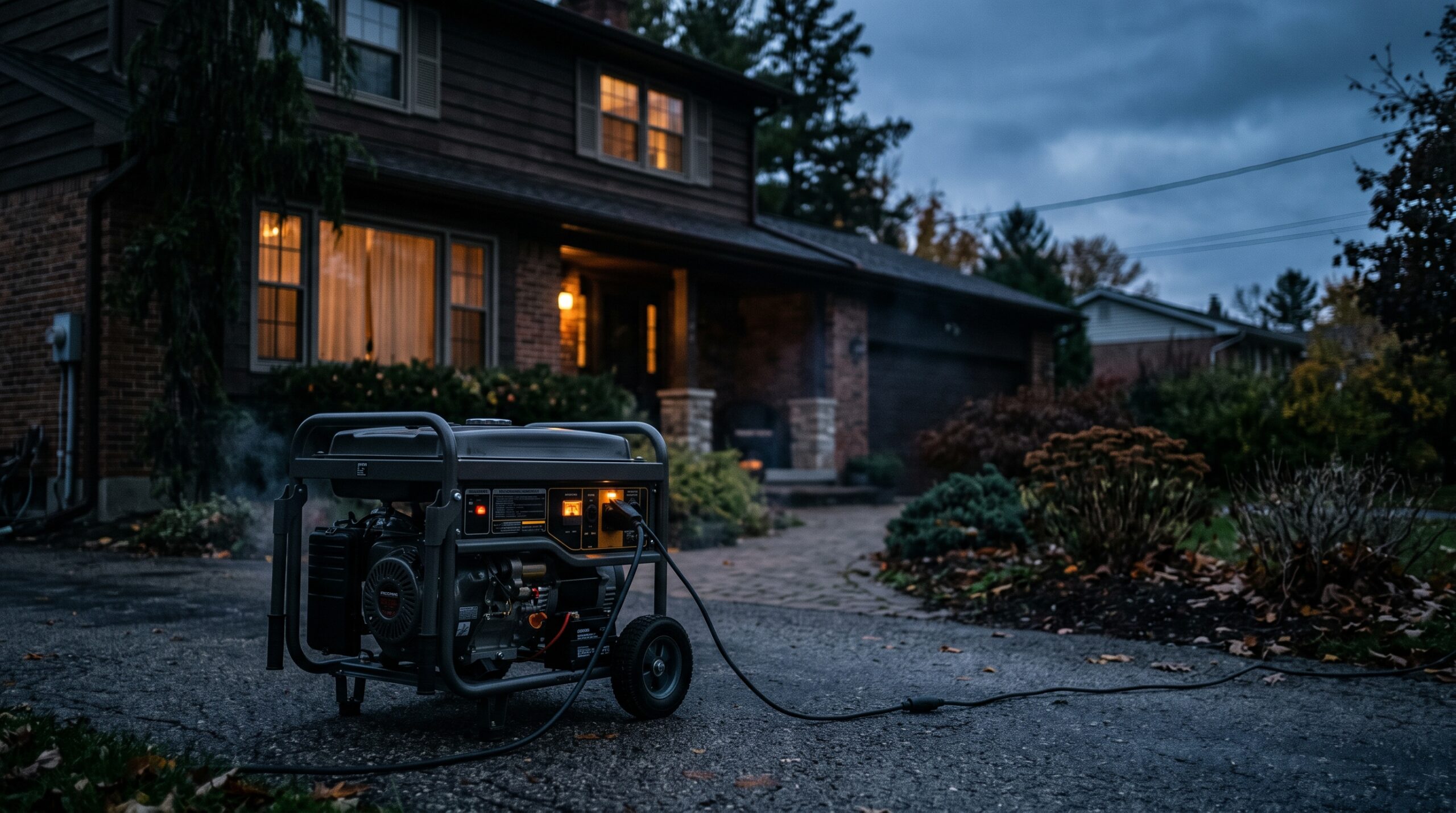
A whole-house standby generator is usually 10 to 22 kW, while a portable generator covering just the essentials needs roughly 5,000 to 7,500 watts. The right number depends on what you want running at the same time and the single appliance with the largest starting surge, not on your home’s square footage alone.
⚠️ Generators outside only; let a pro do the wiring
Run portable generators outdoors only, at least 20 feet from windows, doors, and vents, with the exhaust pointed away from the house. Carbon monoxide is colorless and odorless and can build to deadly levels in minutes, so never run a generator in a garage, basement, or shed, even with the door open. Any connection to your home’s panel, whether a transfer switch or an interlock, must be installed by a licensed electrician and meet local code. Never backfeed power through a regular outlet.
How generator sizing works
Generator capacity is measured in watts, or in kilowatts for larger units (1 kW equals 1,000 watts). Sizing comes down to two numbers for every appliance you plan to power: its running watts, the steady draw while it operates, and its starting watts, the brief surge a motor pulls the instant it kicks on. Anything with a motor or compressor, such as a refrigerator, well pump, sump pump, furnace blower, or air conditioner, can demand two to three times its running watts for a split second at startup.
The standard method, used by manufacturers like Generac and Honda, is to add up the running watts of everything you expect to run at once, then add the single largest starting surge on your list (not all of them, since motors rarely start at the same instant). Many guides then suggest padding the total by about 20 to 25 percent for a safety margin and future loads. So if your running watts total 6,000 and your biggest single surge is a 3,000-watt sump pump, you would plan for roughly 9,000 watts before the buffer, and around 11,000 watts with it.
Essentials-only vs whole-house
There are two common ways to keep the lights on, and they lead to very different sizes.
Essentials-only with a portable generator. You pick a handful of must-have circuits, a refrigerator, furnace blower, sump pump, some lights, and Wi-Fi, and power them through a transfer switch or an interlock kit. Most households land in the 5,000 to 7,500 watt range here. Portables are cheaper, you roll them out only when needed, and you refuel them yourself. They will not usually run central air conditioning or a full electric kitchen at the same time.
Whole-house with a standby generator. A permanently installed standby unit runs on natural gas or propane, starts automatically when the power drops, and feeds most or all of your home through an automatic transfer switch. For a typical 2,000 to 3,000 square foot home, that usually means 10 to 22 kW. Some installs use load management so a smaller unit can still cover a large home by shedding big loads, like the air conditioner, when demand peaks.
How to estimate your load
You can get close with a simple worksheet:
- List every appliance and circuit you want powered during an outage.
- Find each one’s running and starting watts from the nameplate label, the manual, or a published wattage chart.
- Add up the running watts of everything that would run at the same time.
- Add the single largest starting surge from your list.
- Multiply the total by about 1.25 for headroom.
Watch the motor loads, because they drive the size more than the steady draws. A central air conditioner can run near 3,500 watts but surge much higher when the compressor starts, and well pumps and sump pumps surge hard too. A refrigerator, by contrast, draws only about 400 to 800 running watts with a roughly 1,200 to 1,600 watt startup. These figures are typical ranges, not guarantees, so always size from your own appliances’ labels when you can.
Fuel types: gas, propane, and dual-fuel
Gasoline is the default for portables. It is widely available and units are inexpensive, but gas stores poorly, going stale in a few months even with stabilizer, and can be hard to find during a regional outage. Propane stores almost indefinitely, burns cleaner, and is common on both standby units and dual-fuel portables, though it delivers slightly less power than gasoline. Natural gas is the usual choice for standby generators, drawing from your utility line for an effectively unlimited supply. Dual-fuel portables run on either gasoline or propane, which gives you flexibility when one fuel runs short. (Diesel exists too, mostly on larger commercial units, and is less common for homes.)
Coverage and size at a glance
| Coverage goal | Typical size | Example loads |
|---|---|---|
| Bare essentials | 3,000–5,000 W (portable) | Refrigerator, a few lights, phone and Wi-Fi, sump pump, gas furnace blower |
| Essentials plus comfort | 5,000–7,500 W (portable) | The above plus a freezer, well pump, microwave, and one window AC or small space heater |
| Partial home | 7,500–10,000 W (large portable or small standby) | The above plus more circuits and a larger window or portable AC, staggered carefully |
| Whole house (2,000–3,000 sq ft) | 10–22 kW (standby) | Most or all circuits, including central AC and a well pump, with big electric loads managed |
Larger homes, all-electric heating, multiple central AC units, or an electric range and dryer running together can push you past 22 kW, sometimes to 24 kW or more.
Want a number for your own home instead of a range? Use our Power-Station Sizing calculator to add up your watts appliance by appliance, including starting surges, and our Appliance Runtime calculator to see how long a given setup would keep them running before refueling or recharging.
Whole-house options by tier, live prices


Generac 22kW Whole Home
Standby, transfer switch included, NG or propane
$6,506.10Check price on Amazon →
As an Amazon Associate we earn from qualifying purchases. Prices are pulled automatically from Amazon and may have changed.
Frequently asked questions
What size generator do I need to run my whole house?
For a typical 2,000 to 3,000 square foot home, a whole-house standby generator is usually 10 to 22 kW. Homes with electric heat, a large or multiple central AC systems, or several big appliances running at once may need 24 kW or more, or load management to make a smaller unit work. A professional load calculation gives you the most accurate size.
Will a 22 kW generator run my whole house?
For many average-sized homes, yes, a 22 kW standby unit can run most or all circuits, often including central air. Very large or all-electric homes may exceed its capacity when everything runs at once, in which case you would add load management or step up to a larger unit. Size it from your actual loads rather than assuming.
What size portable generator runs just the essentials?
A 5,000 to 7,500 watt portable usually covers the essentials: a refrigerator, a gas furnace blower, a sump pump, some lights, and Wi-Fi. If you also want a freezer and a window AC, aim for the higher end of that range, and remember to account for the largest single starting surge among those appliances.
How many watts do I need to run a refrigerator and furnace?
A refrigerator typically draws about 400 to 800 running watts with a roughly 1,200 to 1,600 watt startup surge, and a gas furnace’s blower motor adds a few hundred running watts (only the blower needs power, not the gas heat). A 3,000 to 4,000 watt generator generally handles both with comfortable margin.
Do I need a transfer switch?
To safely power hardwired circuits such as a furnace, well pump, or whole panel, yes. A transfer switch or an interlock kit isolates your home from the utility grid so you do not endanger line workers or your equipment. It must be installed by a licensed electrician to code. Never backfeed power through a wall outlet, which is dangerous and illegal in most places.
Sources
- Generac, “How Do I Correctly Size a Generator for My Home?” — support.generac.com
- Honda Power Equipment, “What Size Generator Do I Need?” — powerequipment.honda.com
- Lowe’s, “Generator Sizing Buying Guide” — lowes.com
- Ready.gov, “Power Outages” (generator safety) — ready.gov
- U.S. CPSC, Carbon Monoxide Information Center — cpsc.gov
- CDC, “When the Power Goes Out, Keep Your Generator Outside” — cdc.gov