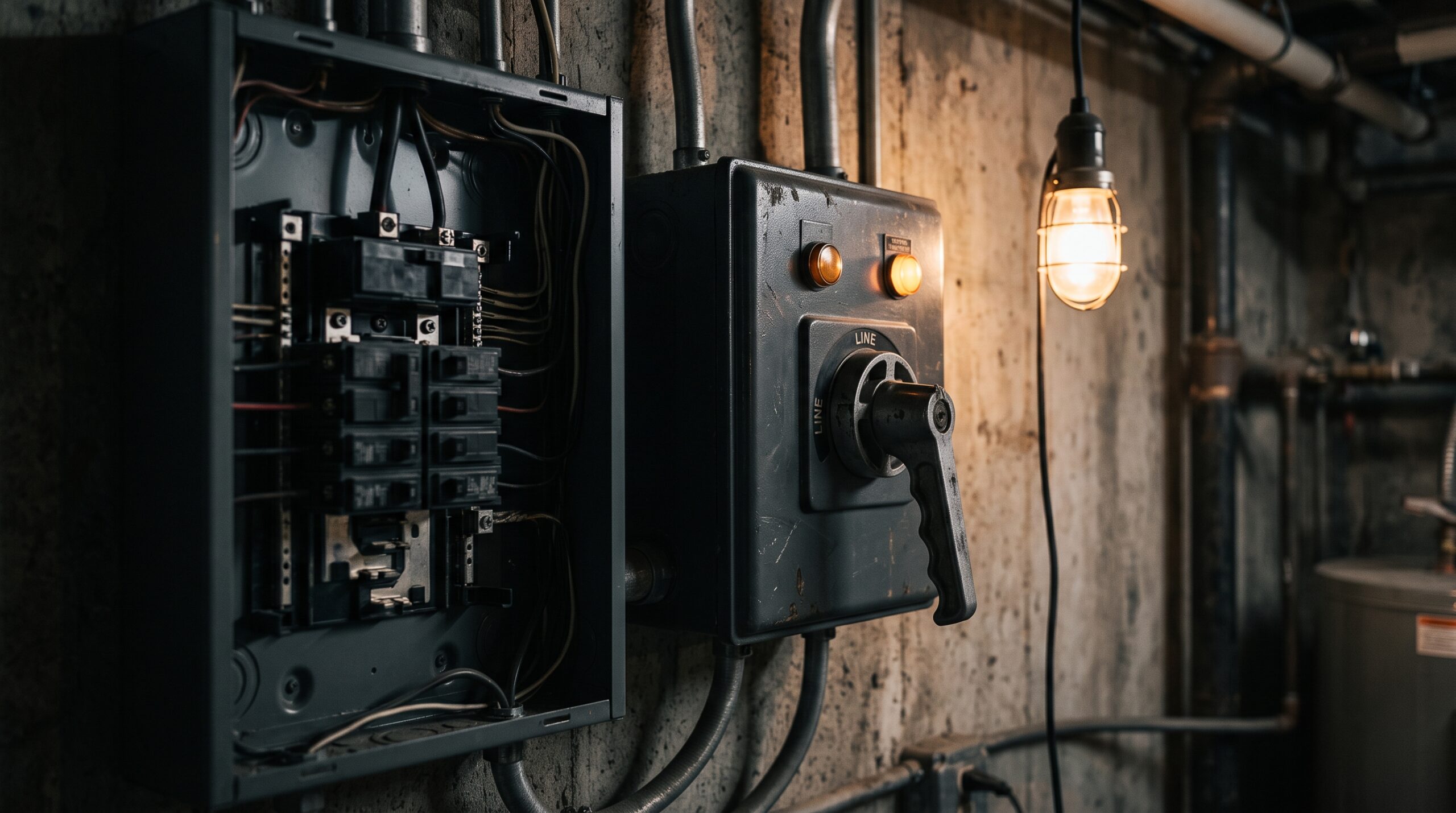
If you want a portable generator to power circuits inside your house, you have two code-compliant ways to wire it in: a manual transfer switch or an interlock kit. A transfer switch is the cleaner, pricier option that backs up a fixed set of preselected circuits, while an interlock kit is cheaper and lets you power any circuit in your panel but has to be the exact listed kit for your specific panel. Both do the same critical job: they physically prevent your generator from backfeeding the utility grid, which can electrocute a line worker repairing the outage. Whichever you choose, have a licensed electrician install it to local code, and never improvise with a double-male “suicide cord.”
The real job both devices do: stop backfeed
Backfeed is the dangerous part of connecting a generator to home wiring, and it is the reason both of these devices exist. If a generator feeds your panel while the panel is still connected to the utility, electricity flows backward out of your house and onto the grid. The neighborhood transformer that normally steps utility voltage down to your home runs in reverse, stepping your generator’s 120/240 volts up to 7,200 volts or more on the lines outside. A utility worker who believes a line is dead during an outage can be killed by that voltage.
A transfer switch and an interlock kit both prevent this by guaranteeing your generator and the utility can never feed the panel at the same time. The National Electrical Code (Article 702) requires exactly this kind of positive separation for any transfer equipment. That is also why a “suicide cord” (a cord with a male plug on both ends, plugged into the generator and a wall outlet) is illegal and deadly: it skips the disconnect entirely, energizes the whole panel, and can backfeed the grid. Do not use one under any circumstances. For the wider safety picture, see our guide on how to use a generator safely.
How a manual transfer switch works
A manual transfer switch is a separate switch box (often a small sub-panel) that an electrician mounts next to your main panel and wires to a handful of circuits you choose in advance, typically the furnace, refrigerator, well pump, a few lights, and outlets. An inlet box on the outside of the house lets you plug the generator in with a single heavy cord. When the power goes out, you start the generator, plug it in, and flip each circuit on the switch from “Line” to “Generator.” Many models include built-in watt meters so you can see your load and avoid overloading the generator.
The appeal is simplicity and a clean, code-clear install: the wiring is purpose-built, the circuits are labeled, and operation is obvious for anyone in the household. The trade-off is that you are limited to the circuits you wired up front (commonly 6 to 16), and the hardware and labor cost more. This is the most common way homeowners connect a portable generator; our overview of how to connect a generator to your house walks through the inlet and cord setup.
How an interlock kit works
An interlock kit is a small, panel-specific sliding metal plate that bolts onto the face of your existing main panel. Your electrician adds a dedicated double-pole “generator” breaker (commonly 30A or 50A), and the plate is shaped so that the main breaker and the generator breaker can never both be on at once. To use it, you turn the main breaker off, slide the plate, switch the generator breaker on, then turn your branch circuits on one at a time within the generator’s capacity.
The advantages are lower cost and flexibility: because the generator feeds the whole panel (with the main locked out), you can power any circuit you want, just not all of them at once. The catch is that the kit must be the listed kit made for your exact panel brand and model. An interlock is treated as a listed accessory to the panel (panels are listed to UL 67), so a generic or mismatched plate can void the panel’s listing and fail inspection. The back-fed generator breaker also typically must be secured with the manufacturer’s hold-down clip. Not every panel has a kit available, and some local jurisdictions are stricter about accepting them, which is one more reason to confirm with an electrician and your inspector first.
Transfer switch vs interlock kit at a glance
| Factor | Manual transfer switch | Interlock kit |
|---|---|---|
| What it is | Separate switch box / sub-panel wired to selected circuits | Sliding plate added to your existing main panel |
| Circuits you can power | Fixed set chosen at install (often 6–16) | Any circuit in the panel, a few at a time within capacity |
| Backfeed protection | Yes, isolates home from utility | Yes, main and generator breaker can’t both be on |
| Ease of operation | Very simple, labeled switches | Simple, but a multi-step routine each time |
| Panel compatibility | Works with virtually any panel | Must be the listed kit for your exact panel |
| Typical installed cost | Roughly $400–$1,300+ | Roughly $400–$850 |
| Permit + electrician | Yes | Yes |
| Best for | A curated set of must-have circuits, easy operation | Lower budget, flexibility to power different circuits |
What each one costs
Prices move with your region, your panel, how many circuits you want, and how much wiring the electrician has to run, so treat these as ballparks rather than quotes:
- Interlock kit: the plate itself is inexpensive (roughly $40–$150), plus a generator breaker (about $40–$80). Installed, including the inlet box and labor, expect roughly $400–$850.
- Manual transfer switch: the unit alone often runs about $200–$800, and installed cost commonly lands around $400–$1,300, higher for larger circuit counts or longer wiring runs.
- Electrical permit: frequently $50–$350 depending on your jurisdiction, and an inspection is usually required.
The interlock is usually the cheaper path. The transfer switch costs more but buys you a tidy, fixed, foolproof setup. If you have not bought the generator yet, size it before you spend on either device; our guides on how to choose a generator and the best portable generator for home use can help you match the generator to the loads you actually need.
Code, permits, and why an electrician should do it
Both devices tie directly into your service equipment, so this is not a casual DIY job, and many jurisdictions require a licensed electrician plus a permit and inspection. The NEC requires transfer equipment to prevent simultaneous utility and generator connection, the interlock must be the listed kit installed per the manufacturer’s instructions for your panel, and the back-fed breaker generally needs a hold-down. A wrong plate, an unsecured breaker, or an undersized inlet can fail inspection or, worse, leave a backfeed path open.
Codes and local amendments differ from town to town, so confirm what your jurisdiction accepts before you buy hardware. A licensed electrician will pull the permit, install to your local code, and verify the lockout actually works. This article is general information, not a substitute for that professional and your local authority having jurisdiction.
Which one should you choose?
Pick a manual transfer switch if you want the simplest possible operation, you already know the handful of circuits you must keep running, and the higher cost is acceptable for that peace of mind. It is a strong choice for households where anyone might need to run the generator without thinking through a sequence.
Pick an interlock kit if you want to spend less and value the flexibility to power different circuits on different days, and your panel has a compatible listed kit that your jurisdiction accepts. You will need to manage your load manually, turning breakers on one at a time and watching the generator’s capacity.
If you are still weighing whether a generator is even the right backup at all, compare the options in our generator or power station guide. Whatever you land on, the connection method should be a permitted, electrician-installed transfer switch or interlock, never a suicide cord.
Frequently asked questions
Is an interlock kit as safe as a transfer switch?
Yes, when it is the listed kit for your exact panel and installed correctly. Both prevent the main and generator from feeding the panel at the same time, which is the backfeed protection that matters. The difference is operation and flexibility, not whether one is fundamentally safer than the other.
Can I install either one myself?
It is strongly discouraged, and in many places it is not legal without a licensed electrician and a permit. The work involves opening your service panel, where mistakes can cause fire, electrocution, or an open backfeed path. Hire a licensed electrician and have the install inspected.
Do I need a permit?
Almost always, because both devices modify your home’s permanent wiring. Permits commonly run $50 to $350 and usually include an inspection. Check with your local building department, since requirements and accepted methods vary by jurisdiction.
Why not just use a cord from the generator to an outlet?
That is a “suicide cord,” and it is one of the most dangerous things you can do with a generator. It backfeeds your entire panel and can push lethal voltage onto utility lines, risking line workers and anyone near the wiring. It is illegal in most places and never worth it. Use a transfer switch or interlock instead.
Will either let me power my whole house?
Only up to the generator’s capacity. A transfer switch limits you to the circuits it was wired for, and an interlock lets you choose any circuit but not all of them at once. Either way you manage the load so you do not overload the generator; large loads like central air or an electric range may be off the table on a typical portable unit.