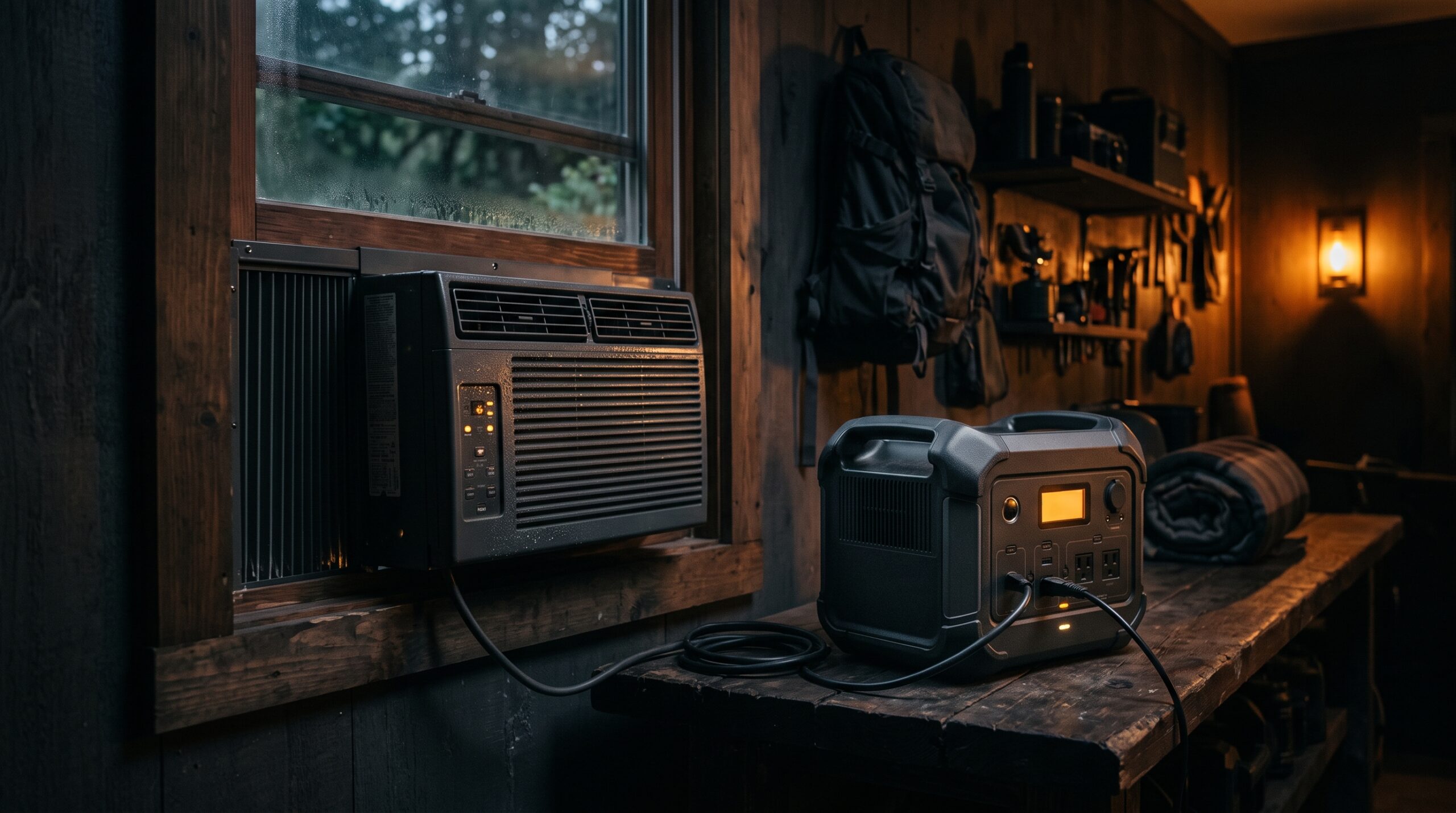
Yes, but with a big asterisk. A large power station can run a small window air conditioner for only a few hours, not all day, and it can trip the moment the compressor starts unless its surge rating clears the spike. A small window unit of about 5,000 to 8,000 BTU draws roughly 400 to 900 watts while running but jumps to around 1,200 to 2,000 watts for a split second at startup. A portable AC asks for more, and central air conditioning is out of reach for any portable station.
So the honest answer depends on which AC you mean and how long you need it. This guide breaks down what an air conditioner actually pulls, why the startup surge matters more than the running watts, how few hours a typical battery really lasts, and when a simple fan is the smarter move.
How much power an AC really uses
Air conditioners are some of the hungriest appliances in a home, and the gap between types is enormous. A small window unit is manageable; central air is not even close.
Small window AC (about 5,000 to 8,000 BTU). This is the only category a portable power station handles comfortably. A 5,000 BTU unit runs at roughly 400 to 500 watts, and an 8,000 BTU unit climbs to about 700 to 900 watts, depending on its efficiency rating. The U.S. Department of Energy notes that room units generally range from about 5,500 to 14,000 BTU, so the smaller end of that scale is what fits a battery.
Portable AC (about 10,000 to 14,000 BTU). These free-standing units with a window hose draw more, commonly 900 to 1,600 watts while the compressor runs, because they have to fight the heat they vent back into the room. A 2,000 W station can power one, but the battery drains quickly.
Central air conditioning. A whole-home system runs at roughly 3,000 to 5,000 watts and is wired for 240 volts. That is more than a 2,000 W portable station can deliver at all, before you even get to the startup surge. Central air needs a standby generator or a large 240-volt system, not a battery you can carry.
The startup surge problem
Running watts are only half the picture. Every air conditioner has a compressor, which is a motor, and motors briefly demand far more power at the instant they start than they do while running. That spike is the startup, or surge, draw, and it usually lasts only a fraction of a second.
For a small window AC, that surge typically lands somewhere around 1,200 to 2,000 watts, even though the unit settles down to 400 to 900 watts a moment later. A portable AC can surge to 1,800 to 3,200 watts, and a central system spikes well past 10,000 watts. The compressor needs that extra burst to overcome inertia and get the motor turning.
Here is why it matters: a power station has two output ratings, a continuous rating and a higher surge or peak rating. If the AC’s startup spike exceeds the surge rating, the station trips and shuts off the moment you turn the unit on, no matter how reasonable the running watts look. Most quality 2,000 W stations carry a surge rating near 4,000 watts, which is enough to absorb a small window unit’s spike but not a central system’s. Always check the AC’s startup wattage against the station’s surge number, not just the running watts against the continuous one.
How long a station lasts
This is where the reality check bites. A refrigerator sips power because its compressor cycles on and off, running maybe a third of the time. An air conditioner working against summer heat runs much more of the time, so its average draw stays close to its running wattage. That means a battery empties fast.
The table below assumes a battery near 2,000Wh, the size of a large portable station, and accounts for the 10 to 15 percent the inverter loses converting DC to AC, leaving about 1,700 to 1,800 usable watt-hours. Treat the hours as ranges, not promises. A milder day lets the AC cycle off and stretches runtime; a brutally hot day keeps it running and shortens it.
| AC type | Running watts | Surge watts | Approx. hours on ~2,000Wh |
|---|---|---|---|
| Small window AC (5,000 BTU) | 400–500 W | ~900–1,200 W | ~3–4 hr |
| Window AC (8,000 BTU) | 700–900 W | ~1,200–1,800 W | ~2–3 hr |
| Portable AC (10,000–14,000 BTU) | 900–1,600 W | ~1,800–3,200 W | ~1–2 hr |
| Central air conditioning | 3,000–5,000 W | past 10,000 W | Won’t run (exceeds output) |
| Box or ceiling fan (for comparison) | 35–100 W | minimal | ~18–50 hr |
The pattern is hard to miss. Even the smallest window AC pulls so much that a full 2,000Wh battery is gone in roughly the length of a movie or two, while that same battery runs a fan for a day or more. An AC is a short-term comfort tool on a power station, not an overnight solution.
The realistic option: small AC briefly, or a fan
Knowing the numbers, there are two sensible ways to use a power station for cooling during an outage, and they serve different goals.
Run a small window AC in short bursts. If you have a 5,000 to 8,000 BTU unit and a large station, use it to knock the temperature down in one room, a bedroom before sleep, for example, then switch it off and let the room hold. Cooling a small, closed-off space and not trying to run the unit continuously gets the most out of a few hours of battery. Close the door, draw the shades, and treat the AC as a burst tool.
Run a fan instead. For anything longer than a few hours, a fan is the smarter use of stored power by a wide margin. A box or ceiling fan draws only 35 to 100 watts, so a 2,000Wh battery runs it for the better part of a day or more, against the few hours an AC manages. A fan does not lower the air temperature, but moving air across your skin makes a real difference, and it costs a fraction of the energy. For most outages, a fan plus shade, hydration, and closed blinds keeps you safer for far longer than a battery-drained AC.
What size station you would need
If running an AC is the goal, size for two things at once: enough surge output to start it, and enough capacity to run it as long as you want.
Output. For a small window unit, pick a station with a continuous rating comfortably above the running watts, at least 1,000 watts, and a surge rating that clears the startup spike, ideally near 2,000 watts or more. A 2,000 W station with a surge rating around 4,000 watts starts and runs small and mid-size window units without drama. No portable station starts central air.
Capacity. This sets the hours. A 5,000 BTU window AC at about 450 watts uses roughly 450 watt-hours each hour it runs, so a few hours needs around 2,000Wh, and most of a night, say eight hours, needs closer to 4,000 to 5,000Wh once you account for inverter losses. An 8,000 BTU unit roughly doubles that. To run a window AC through a full night, you are realistically looking at a high-capacity station with one or more expansion batteries, which is a serious investment for cooling alone.
The ranges here are a starting point. Your AC has its own running watts, startup surge, and BTU rating, usually printed on the nameplate or in the manual. Run those exact figures through the Power-Station Sizing calculator to match both surge output and capacity to your unit, and use the Appliance Runtime calculator to see how many hours a given station will actually keep it running. Your real numbers will give you a far tighter answer than any general table.
What running AC actually takes, live prices


As an Amazon Associate we earn from qualifying purchases. Prices are pulled automatically from Amazon and may have changed.
Frequently asked questions
Can a power station run a window air conditioner all night?
Not from a typical 2,000Wh battery. A small 5,000 BTU window AC draws about 400 to 500 watts and empties a 2,000Wh station in roughly three to four hours of running, and a larger 8,000 BTU unit drains it even faster. To cover a full eight-hour night you would need a high-capacity station with expansion batteries in the 4,000 to 5,000Wh range or more, which is a major investment for cooling alone.
Will a power station run a portable AC?
A 2,000 W station can run a portable AC, but only briefly. Portable units of 10,000 to 14,000 BTU draw about 900 to 1,600 watts while running and surge to roughly 1,800 to 3,200 watts at startup, so a 2,000Wh battery lasts only about one to two hours. Confirm the unit’s startup surge stays under the station’s surge rating before counting on it.
Can a power station run central air conditioning?
No. Central air conditioning runs at roughly 3,000 to 5,000 watts, surges well past 10,000 watts, and is wired for 240 volts, all of which exceed what a portable power station can deliver. Backing up central air calls for a standby generator or a large 240-volt system, not a portable battery.
What size power station do I need to run a small AC?
For a small window unit, you want a continuous output of at least 1,000 watts, a surge rating that clears the startup spike of roughly 1,200 to 2,000 watts, and enough capacity for the hours you need. A 2,000Wh station with a surge near 4,000 watts starts the unit and runs it for a few hours; for most of a night, plan on 4,000 to 5,000Wh or more.
Is a fan a better choice than an AC on a power station?
For anything beyond a short burst, yes. A box or ceiling fan draws only 35 to 100 watts, so a 2,000Wh battery runs it for the better part of a day or more, compared with the few hours an AC manages. A fan does not cool the air, but moving air over your skin helps you feel cooler, and paired with shade and closed blinds it keeps stored power working far longer.
Sources
- U.S. Department of Energy, Estimating Appliance and Home Electronic Energy Use
- U.S. Department of Energy, Room Air Conditioners
- ENERGY STAR, Room Air Conditioners
- LearnMetrics, How Many Watts Do Air Conditioners Use? (Window, Portable, Mini-Split, RV)
- PICKHVAC, How Many Watts Does a Window Air Conditioner Use?