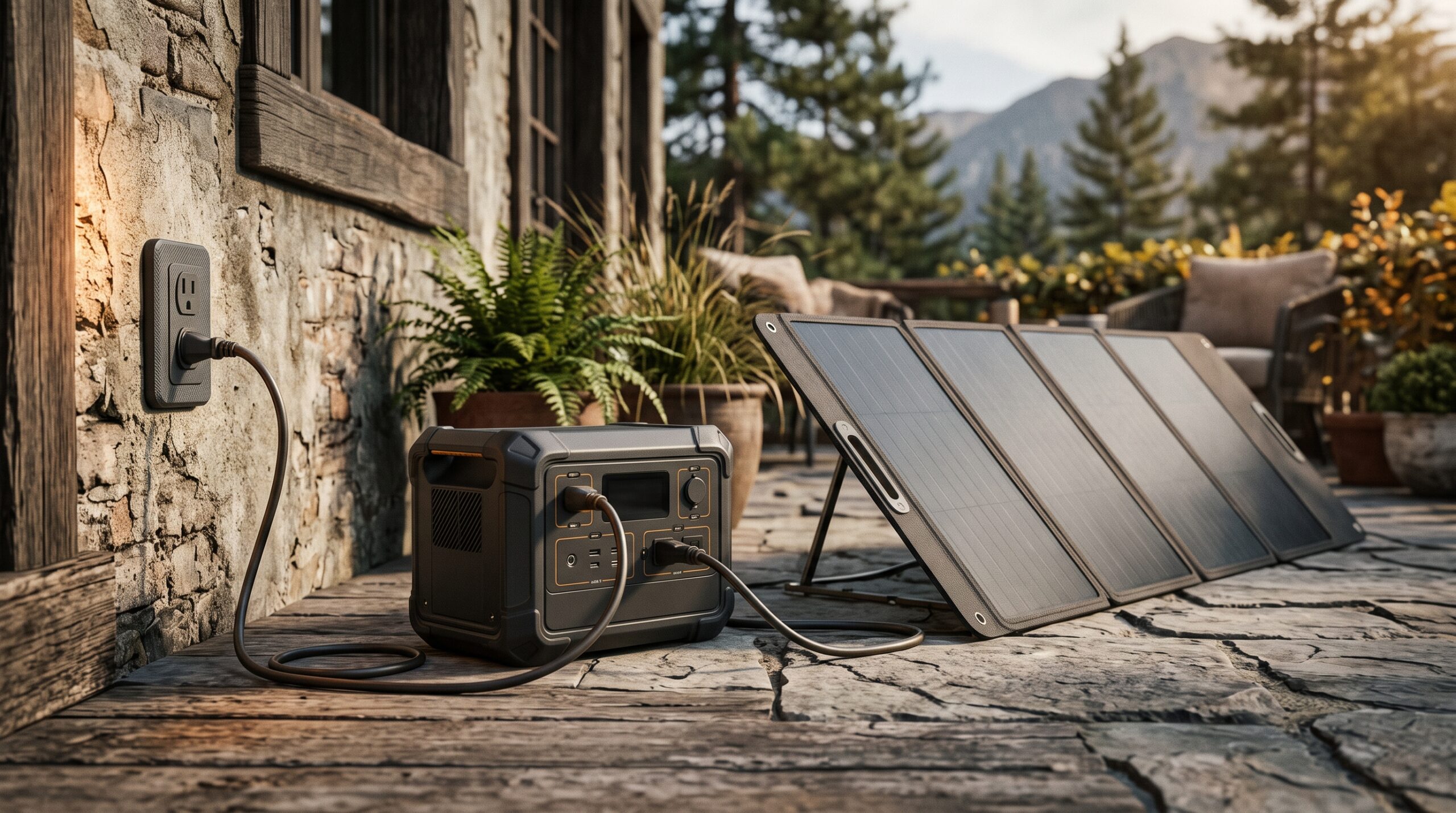
Every modern power station charges several ways, and they are not close in speed. A wall outlet is the fastest way to charge a power station, often refilling a mid-size unit in one to two hours; solar is the slower, quieter option for when there is no outlet to plug into. A car socket is slower still, and a gas generator works as a fallback for when an outage drags on and the sun will not cooperate.
Which method you reach for depends on where you are and how much time you have. Here is how each one works, the charging times to expect, the maximum solar input that quietly caps how fast panels can refill you, and how to treat the battery so it lasts.
Wall outlet (AC) charging, the fastest method
The AC wall charge is the headline number manufacturers advertise, and for good reason: it is the quickest way to fill the tank. Plug the included AC cord into a standard 120V household outlet and the station’s onboard charger does the rest. Most current units in the roughly 1,000Wh class reach full in about one to two hours, and several hit it faster in a boost mode.
- EcoFlow Delta 2 (1,024Wh): 0 to 80 percent in about 50 minutes and full in roughly 80 minutes, drawing up to around 1,200W from the wall.
- Anker SOLIX C1000 (1,056Wh): a full charge in about 58 minutes in its UltraFast mode.
- Bluetti AC180 (1,152Wh): 0 to 80 percent in about 45 minutes and full in roughly 1.3 to 1.8 hours with Turbo charging on.
- Jackery Explorer 1000 v2 (1,070Wh): full in under about 1.7 hours, or close to an hour using the app’s emergency boost.
Generation matters here. Older and budget units charge far slower than the headline numbers above; the first-generation Jackery Explorer 1000, for example, took around seven and a half hours on AC. The fast modes also draw a lot of current and spin the cooling fans loud, so they are not silent. The practical takeaway is simple: when a storm is in the forecast, an hour or two on the wall buys you a full battery to start the outage with.
Solar charging
Solar is the method for off-grid use and long outages, where there is no outlet to lean on. You connect compatible panels to the station’s solar (DC) input and the built-in MPPT charge controller optimizes the harvest. Two numbers on the spec sheet decide whether it works at all: the maximum solar input in watts, and the input voltage window.
- Maximum solar input. Every station caps how much solar it will accept. The Jackery Explorer 1000 v2 takes up to 400W, the EcoFlow Delta 2 up to 500W (11 to 60V), the Bluetti AC180 up to 500W (12 to 60V), and the Anker SOLIX C1000 up to 600W. The original Explorer 1000 capped at just 200W, so check your exact model rather than assuming.
- Real output trails the rating. Panels rarely make their nameplate wattage once you add heat, haze, dust, and an imperfect angle, so plan around roughly 70 percent of the rating. A 500W array in strong sun can refill a 1,000Wh unit in about 3 hours; clouds and a poor angle can stretch that to most of a day.
To match panels to your station and your local sun, work through how many solar panels it takes to recharge a power station, which lays out the simple formula and a sizing table. A unit that accepts solar at all is what marketers tend to call a solar generator; the difference between a solar generator and a plain battery power station is mostly whether panels come in the box, not the battery inside.
Car and 12V charging
Charging from a vehicle is for topping up on the road, and it is a slow trickle. You plug the included car cable into the 12V cigarette-lighter or accessory socket. That socket delivers only about 96 to 120W (roughly 8 to 10 amps at 12V), so a 1,000Wh station takes somewhere around 9 to 13 hours, which is realistically a full day of driving rather than a quick stop.
- Bluetti AC180: about 12 to 12.5 hours from a 12V socket, or 6.3 to 6.8 hours if the vehicle offers 24V.
- Jackery Explorer 1000 v2: roughly 12 hours from a 12V outlet.
- EcoFlow Delta 2: 8 amps at 12V or 24V, which means 20-plus hours from a running car and is best treated as a slow top-up, not a recharge.
Two practical notes. Only charge with the engine running, or you risk flattening the vehicle’s own starter battery, since the station can keep pulling after the engine is off. And the accessory socket is fused (often 10 to 15 amps), so the station deliberately limits its draw to stay under that ceiling. If you want genuinely fast vehicle charging, some brands sell a separate alternator charger that wires to the battery and pushes up to around 800W, refilling about 1kWh in roughly 1.3 hours, but that is extra hardware rather than the dashboard socket.
Generator charging
Any station that accepts AC charging can also be fed by a gas or inverter generator: you run the generator’s output into the station’s normal wall-charge input, exactly as if it were a household outlet. Bluetti lists a generator as one of four official recharge methods on the AC180, alongside AC, solar, and car. Not every brand documents it, but mechanically it is just AC charging from a different source.
The reason to bother is sequencing during a long outage with no sun. You run the noisy generator outdoors for an hour to refill the station, then bring the silent, emission-free battery inside to run sensitive electronics overnight, so the engine is not running all night. A pure sine wave inverter generator is the better match, because the station’s charger prefers clean, stable power. Size the generator so its continuous output comfortably exceeds the station’s AC input draw: a unit that pulls 1,200 to 1,440W on the wall needs a generator rated well above that, with headroom to spare.
⚠️ Run the generator outdoors only
A gas generator emits carbon monoxide and must run outdoors, at least 20 feet from windows, doors, and vents, with the exhaust aimed away from the house. Never run one in a garage, basement, shed, or on a porch, even with a door open. The station charging from it can be indoors; the generator cannot.
Can you use it while charging?
Yes. Almost all power stations support pass-through, meaning you can run devices from the outlets while the unit itself is charging, on any input. The catch is the arithmetic: the battery only banks the surplus between what is coming in and what your devices are pulling out. If your load exceeds the charge rate, the battery still drains, just more slowly than it would otherwise.
One caveat. Charging and discharging at the same time makes more heat and runs the fans harder, and some manufacturers suggest not leaving a station in constant pass-through as a permanent, always-plugged UPS unless the unit is built for that role. For getting through an outage it is fine; for a 24/7 standby setup, check what your manual recommends.
Battery care tips
Most current power stations use LiFePO4 cells, which are durable and forgiving, commonly rated for several thousand charge cycles (often in the 3,000 to 6,000 range, or roughly 8 to 15 years of typical use). A few habits keep them healthy.
- Keep it topped up if you might need it soon. For outage readiness, leaving the station on the charger or at a high state of charge is fine and means it is ready when the lights go out.
- Drop to a middle charge for long storage. If it will sit unused for months, store it around 50 to 60 percent and check it every few months. Sitting at a full 100 percent for a long time speeds calendar aging, and letting it drain to zero and sit there risks a deep discharge.
- Mind the temperature. Charge and use it in roughly 32 to 104°F, avoid charging below freezing without low-temperature protection, and store it somewhere cool and dry (about 50 to 77°F). Heat is the enemy of any lithium battery.
- Cycle it occasionally. A full charge and discharge now and then keeps the fuel gauge honest and the cells exercised.
If you are still deciding how much capacity to buy before worrying about how to keep it charged, the 1,000Wh versus 2,000Wh comparison walks through how runtime, recharge time, and weight trade off against each other.
Charging methods at a glance
| Method | Speed | Best for |
|---|---|---|
| AC wall outlet | Fastest: about 1 to 2 hours for a 1,000Wh unit, sometimes under 1 hour in a boost mode | Everyday top-ups and filling up before a forecast storm |
| Solar panels | Slow and weather-dependent: roughly 3 hours in strong sun at the station’s max input, longer under cloud | Off-grid use and multi-day outages with no outlet |
| Car / 12V socket | Slowest: about 9 to 13 hours from a standard accessory socket | Trickle-topping during a long drive |
| Generator (into AC input) | As fast as the wall, limited by the generator’s output | Prolonged outages when there is no sun |
| Pass-through (any input) | Charges and powers devices at once; battery gains only the surplus | Keeping loads running while you refill |
Want the numbers for your own gear instead of these ballparks? If solar is on your list, feed your station capacity, panel wattage, and local sun hours into the Solar Recharge calculator for a realistic refill estimate. And if you have not picked a station yet, start with the Power-Station Sizing calculator to turn your loads into the capacity and continuous-watt rating you actually need, then come back to plan how you will keep it charged.
Stations and panels, live prices


As an Amazon Associate we earn from qualifying purchases. Prices are pulled automatically from Amazon and may have changed.
Frequently asked questions
What is the fastest way to charge a power station?
A standard AC wall outlet, by a wide margin. Many current 1,000Wh-class units reach full in one to two hours on the wall, and some hit it in under an hour in a boost mode. Solar, car, and generator charging are all slower, with the car socket the slowest of the group. You can also combine AC and solar on many models to shave time off.
How long does it take to charge a power station?
It depends on the size, the method, and the model. As a rough guide for a 1,000Wh unit: about one to two hours from a wall outlet, around three hours on solar in strong sun at the panel cap, and roughly 9 to 13 hours from a 12V car socket. Bigger batteries and older or budget chargers take proportionally longer.
Can you charge a power station with a generator?
Yes, any station that accepts AC charging can be charged from a generator. You plug the station’s normal AC charge cable into the generator’s outlet, just as you would a wall socket. A pure sine wave inverter generator is best, and the generator’s continuous output should comfortably exceed the station’s AC input draw. Run the generator outdoors only.
Can you use a power station while it is charging?
Yes, most stations support pass-through, so you can power devices while the unit charges. The battery only stores the difference between what is coming in and what you are drawing out, so if your load is bigger than the charge rate, the battery still drains, just slower. Expect more heat and fan noise when doing both at once.
Should I keep my power station plugged in all the time?
For outage readiness it is fine to keep it at or near full so it is ready to go. If instead you are putting it away for months, store it around 50 to 60 percent and check it every few months, since sitting at a full charge for long stretches speeds aging and a slow self-discharge to empty can harm the cells.
Sources
- EcoFlow Delta 2 (1,024Wh; 0 to 80% in 50 min, full in ~80 min AC; up to 500W solar)
- Bluetti AC180 (1,152Wh; four recharge ways AC/Solar/Car/Generator; 500W max solar; car ~12 hr)
- Anker SOLIX C1000 (1,056Wh; full charge in ~58 min AC; up to 600W solar)
- Jackery Explorer 1000 v2 (1,070Wh; ~1.7 hr AC; up to 400W solar; ~12 hr car)
- Jackery Explorer 1000 original (200W max solar input, slower first-generation AC charging)
- EcoFlow: LiFePO4 voltage and state-of-charge guidance (storage and battery care)