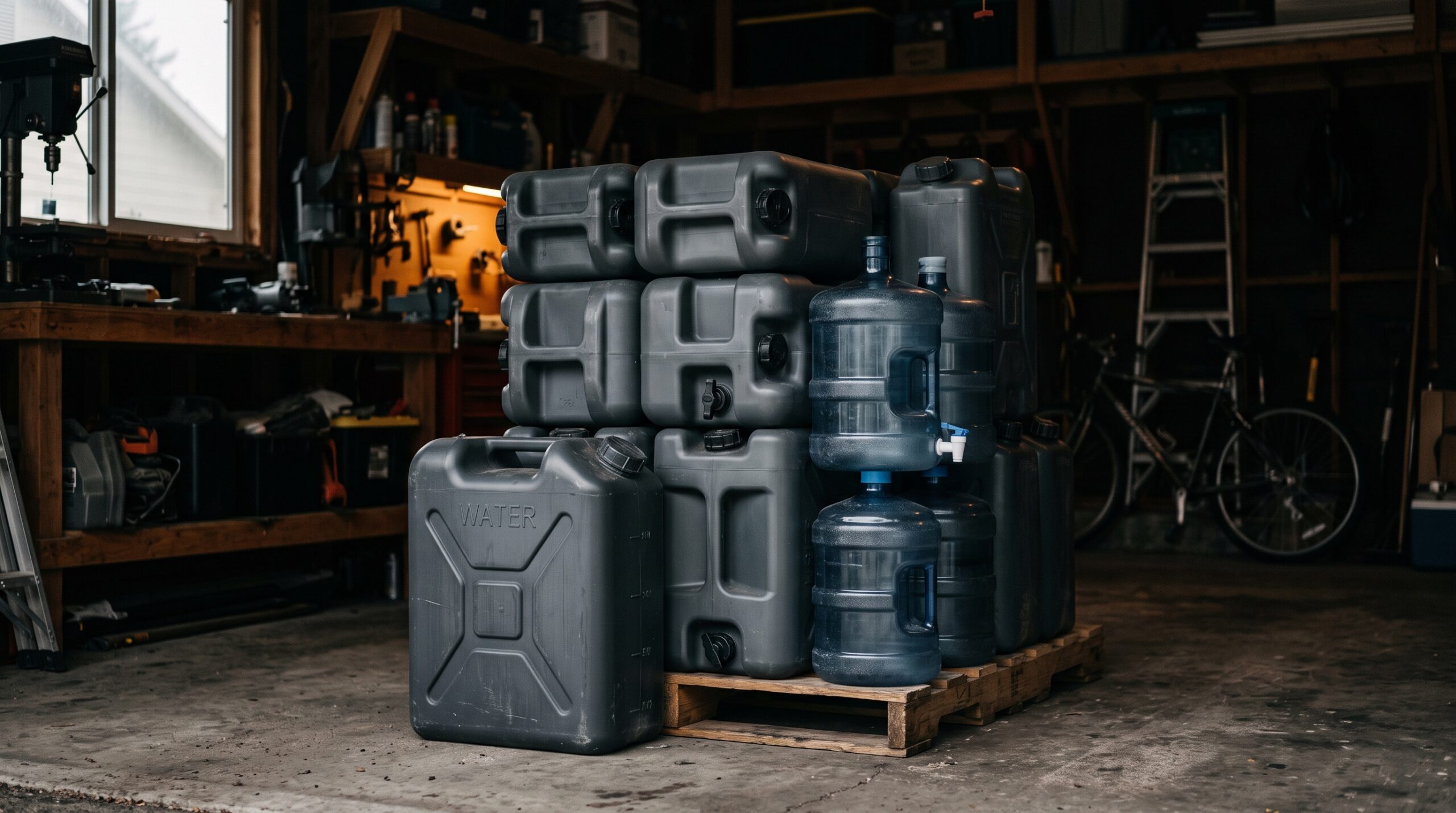
To store water for an emergency, the CDC’s advice is straightforward: keep it in clean, food-grade containers with tight-fitting lids, somewhere cool and out of direct sunlight, per the agency’s guide to creating and storing an emergency water supply. Commercially bottled water in its sealed container is the simplest option; if you fill your own, the container and how you clean it matter as much as the water inside.
This is the how-to companion to figuring out how much water to store. Below is how to choose containers, clean and fill them, store them so the water stays safe, rotate the supply, and make questionable water safe to drink if you run low before the power and the taps come back.
⚠️ Follow official disinfection guidance
If your utility issues a boil-water notice, follow it until officials lift it, and rely on stored or bottled water in the meantime. When you do disinfect water, use only the CDC-recommended ratios on this page and do not guess or eyeball them. The bleach used to sanitize a container is far stronger than the dose used to make drinking water safe, so keep the two steps separate and never mix them up.
Choosing containers
The easiest reliable supply is commercially bottled water. Ready.gov calls it the safest, most reliable choice, so keep it sealed in the original container, store it out of sunlight, and use it by the date printed on the label. If you’d rather store more than a case or two, filling your own containers is where most of the decisions live.
The CDC recommends FDA-approved, food-grade water storage containers, the kind sold at camping and surplus stores, because they won’t transfer toxic substances into the water. If you don’t have one, the CDC says a usable container has a top that closes tightly, is made of durable, unbreakable material rather than glass, and ideally has a narrow neck or opening. Wash and sanitize it before you fill it, using the steps in the next section.
Some containers are off the table no matter how well you clean them. The CDC says never reuse a container that held a toxic chemical such as bleach or pesticide. Milk and juice jugs are a poor choice too: their sugars and proteins are hard to rinse out completely and can let bacteria grow. When in doubt, buy a purpose-made container rather than improvising.
Cleaning and filling
Before you fill any container, clean it. The CDC’s steps are simple: wash the container with soap and rinse it completely with water, then sanitize it with a solution of 1 teaspoon of unscented liquid household chlorine bleach (5–9% sodium hypochlorite) in 1 quart (4 cups) of water. Cover the container tightly and shake it so the solution touches every inside surface, wait at least 30 seconds, then pour the solution out and let the container air-dry before use.
That sanitizing solution is much stronger than the dose used to disinfect drinking water further down this page. It is for the empty container only, not for the water you’ll drink, so don’t confuse the two ratios.
Fill the clean container with tap water if your water comes from a public system that treats it; that water is already disinfected and is ready to store. Close the lid without touching the inside of the cap, and label the container as drinking water with the date you filled it. If your water comes from a private well or a source you’re unsure about, treat it first using the methods below, then store it.
Where and how long to store
Where you keep the water decides how long it stays good. The CDC says to store it somewhere cool, around 50–70°F, and away from direct sunlight. Heat and light shorten its useful life and can encourage growth in the container, so a closet, basement, or interior pantry beats a sunny garage or a spot next to the water heater.
Keep containers away from toxic substances such as gasoline and pesticides, since some fumes can permeate plastic over time. It’s also worth not storing water directly on a bare concrete floor for long periods; a shelf or a sheet of cardboard underneath is a common, low-effort precaution. Spreading your supply across a few smaller containers rather than one large one makes it easier to tuck into cool spots and easier to carry.
How long it keeps depends on the source. Store-bought bottled water lasts until its labeled use-by date as long as the seal stays intact. Tap water you bottle yourself doesn’t carry a printed date, which is where rotation comes in.
Rotating your supply
For tap water you’ve stored yourself in food-grade containers, the CDC advises replacing it about every six months. That’s why the storage date on the label matters: it tells you when each container is due to be emptied, rinsed, and refilled. Pour the old water on the garden or down the drain rather than wasting it, and start the clock again.
A simple habit makes this stick. Tie the swap to something you already do twice a year, like changing smoke-detector batteries or the clocks, and check your other supplies at the same time. Stored water is one line item in a broader plan, so review it alongside your emergency kit while you’re at it. Commercially bottled water follows its own expiration date instead of the six-month rule, so rotate it as the labels come due.
Making water safe if you run low
If you run out of stored water before services return, the CDC describes two main ways to make questionable water safer to drink. Start with the cleanest water you can find, and if it’s cloudy, filter it through a clean cloth, paper towel, or coffee filter, or let it settle, before you treat it.
Boiling is the most reliable method. Bring clear water to a rolling boil for one minute, then let it cool; at elevations above 6,500 feet, boil for three minutes. Boiling needs a heat source that doesn’t depend on the grid, such as a propane camp stove used outdoors or in a well-ventilated space.
Disinfecting with unscented household bleach works when boiling isn’t an option. Use regular, unscented chlorine bleach labeled for disinfection. The CDC’s ratio is 8 drops of 5–9% sodium hypochlorite bleach per gallon of water (about 40 drops, or 1/2 teaspoon, for 5 gallons). The EPA gives the same dose by strength: 8 drops of 6% bleach, or 6 drops of 8.25% bleach, per gallon. Stir it in, let it stand for 30 minutes, and check for a slight chlorine smell; if there’s no smell, the EPA says repeat the dose and wait another 15 minutes. Double the bleach if the water is cloudy, colored, or very cold. One limit to keep in mind: chemical disinfection does not reliably kill parasites such as Cryptosporidium and Giardia, so boiling is the better choice when you can manage it.
| Method | How to | Notes |
|---|---|---|
| Filter or settle first | Pour cloudy water through a clean cloth, paper towel, or coffee filter, or let it settle, before treating. | Improves results; not a substitute for boiling or disinfecting. |
| Boiling (best) | Bring clear water to a rolling boil for 1 minute (3 minutes above 6,500 ft), then cool. | Most reliable; handles parasites like Cryptosporidium and Giardia that bleach may not. |
| Unscented household bleach | Add 8 drops of 5–9% sodium hypochlorite bleach per gallon (40 drops / 1/2 tsp per 5 gallons); stir, stand 30 minutes. | Use when you can’t boil; double for cloudy, colored, or very cold water; a slight chlorine smell is normal. |
During any boil-water or contamination advisory, follow your water utility and local authorities rather than these general rules, since the right response depends on what got into the supply.
Keeping water flowing during a longer outage
Stored water covers drinking and basic sanitation, but a longer outage adds two problems it can’t solve on its own. If your home runs on a well, the pump stops the moment the power does, so there’s no running water until it comes back; and a fridge or freezer full of food is on its own clock too. A portable power station can keep a well pump cycling or a refrigerator cold in the meantime. Our Power-Station Sizing calculator turns your devices and the hours you want to cover into a capacity target, and the Appliance Runtime calculator checks how long a given battery would hold a specific load like a pump or fridge. Enter your own wattages, and treat stored water and a sized power source as the two halves of the same plan.
Frequently asked questions
What containers are safe to store water in?
The CDC recommends FDA-approved, food-grade water storage containers. If you don’t have one, use a container with a tight-closing top made of durable, unbreakable material rather than glass, ideally with a narrow opening. Never reuse a container that held a toxic chemical like bleach or pesticide, and skip milk and juice jugs, which are hard to clean well enough.
How do I clean a container before storing water?
Wash it with soap and rinse completely. Then sanitize with a solution of 1 teaspoon of unscented liquid household chlorine bleach in 1 quart (4 cups) of water, per the CDC. Close it and shake so the solution coats every surface, wait at least 30 seconds, pour it out, and let the container air-dry before you fill it. This container-sanitizing dose is stronger than the one used to disinfect drinking water, so don’t confuse them.
How long can you store water before replacing it?
Commercial bottled water keeps until the use-by date on the label as long as the seal stays intact. For tap water you bottle yourself in food-grade containers, the CDC recommends replacing it about every six months. Storing it cool, ideally around 50–70°F, and out of direct sunlight helps it last.
How do I make water safe if I run out of stored water?
Boiling is best: bring clear water to a rolling boil for one minute, or three minutes above 6,500 feet, then cool. If you can’t boil, the CDC’s bleach method is 8 drops of unscented 5–9% sodium hypochlorite household bleach per gallon, stirred and left to stand 30 minutes; double it for cloudy or very cold water. During a contamination advisory, follow your local authorities.
Where is the best place to store emergency water?
Somewhere cool and dark. The CDC says to store water around 50–70°F, away from direct sunlight, and away from toxic substances such as gasoline and pesticides. An interior closet, basement, or pantry works well; a sunny garage or a spot beside the water heater does not. Spreading the supply across several smaller containers makes it easier to fit into those cooler spots.