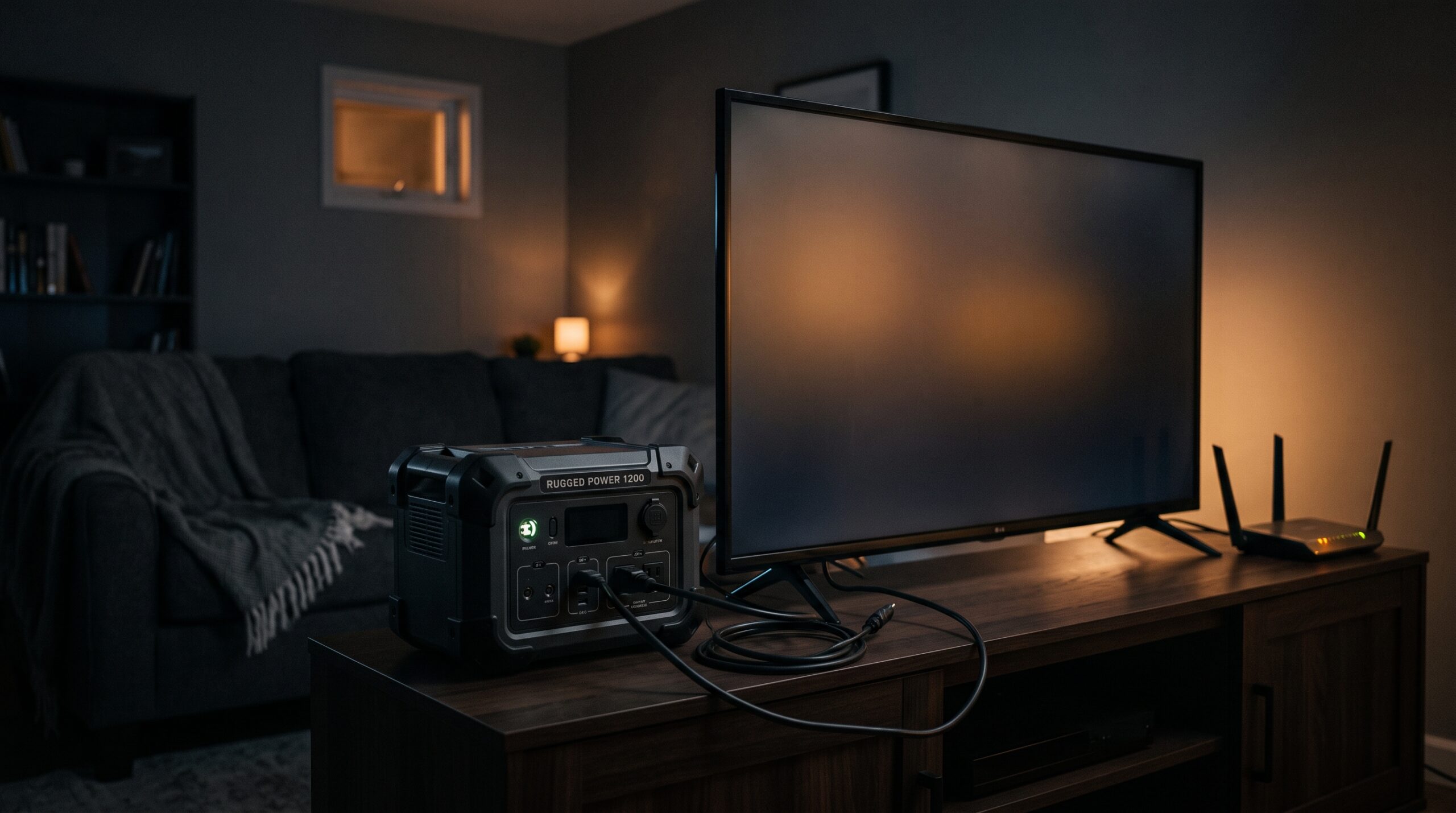
A small-to-mid power station will keep a TV and your home internet running for many hours, often most of a day on a 1,000 Wh battery, because a flat-screen TV plus a router and modem is a light load: usually well under 150 watts together, and frequently closer to 75.
TVs and internet gear sip power compared with anything that heats, cools, or has a motor. That is why staying informed or working from home through an outage is one of the easiest jobs to hand a portable power station. Here is the watt-hour math, a runtime table by battery size, and a few tricks to stretch it.
How much power a TV uses
Most modern flat-screen TVs draw somewhere between 50 and 120 watts. Size and panel type are the biggest factors. Independent testing at RTINGS puts a 55-inch LED TV around 57 watts on average and a 65-inch LED around 88 watts, while same-size OLED sets run a bit higher, roughly 98 and 116 watts, because they can spike on bright HDR scenes. Smaller sets are cheaper to run: a 32-inch LED is often near 28 watts.
Two things push the number up. Older technology is the big one, because plasma and older LCD sets can pull 150 to 300 watts or more for the same screen size. The other is settings: high brightness, vivid or HDR picture modes, and loud volume all add watts. For planning, a typical living-room LED TV at normal brightness is a 50 to 100 watt device, and the exact figure is printed on the label on the back or in the manual.
How much a router and modem use
This is the part that surprises people. A modern WiFi router uses roughly 5 to 20 watts, with about 10 watts being a fair average. A standalone cable, DSL, or fiber modem sits in a similar range, around 5 to 15 watts, and an all-in-one gateway that combines both usually stays under about 20 watts. Put a separate modem and router together and you are looking at roughly 10 to 30 watts for your whole internet setup.
That is a tiny load, about the same as a couple of LED bulbs. Your modem and router are the whole reason your home network works, so if you are wondering will your WiFi work once the power drops, the short answer is only if those two boxes stay powered. Keep them on a battery and you stay online for a long time on very little energy. Fiber is the one exception worth a flag: the optical box on the wall, the ONT, also needs power, so plan to back up both it and the router.
The runtime math
Runtime comes down to one simple equation: usable watt-hours divided by the watts your devices draw equals hours of runtime. A power station’s rated capacity is in watt-hours (Wh), but you do not get all of it, because the inverter that turns battery power into household AC loses some energy as heat. A reasonable rule is that about 85 percent of the rated capacity is usable, so a 1,000 Wh station gives you roughly 850 usable watt-hours.
Say you are running a 60-watt LED TV plus a 20-watt modem-and-router pair, for 80 watts total. On that 1,000 Wh station with about 850 usable watt-hours, 850 divided by 80 is a little under 11 hours. Drop the TV and keep only the WiFi, and the same battery runs for well over a day. The lighter your load, the longer the battery lasts, which is why TV and internet stretch so far compared with a fridge or a heater.
How long by power-station size
The table below runs that math for common setups across three popular battery sizes. The watt figures are representative; your own TV and gear may draw more or less, so treat these as planning estimates rather than promises. If you want to power more than the TV corner, see what a 2000W station runs across a wider list of household devices.
| Setup | Typical watts | Hours on 500 Wh | Hours on 1,000 Wh | Hours on 2,000 Wh |
|---|---|---|---|---|
| WiFi only (modem + router) | ~20 W | ~21 hrs | ~43 hrs | ~85 hrs |
| Mid-size LED TV alone | ~60 W | ~7 hrs | ~14 hrs | ~28 hrs |
| LED TV + WiFi | ~80 W | ~5 hrs | ~11 hrs | ~21 hrs |
| 65-inch or OLED TV + WiFi | ~135 W | ~3 hrs | ~6 hrs | ~13 hrs |
| Older big LCD or plasma TV + WiFi | ~220 W | ~2 hrs | ~4 hrs | ~8 hrs |
The pattern is clear. Keeping just your internet alive is almost free in battery terms, so even a small 500 Wh unit covers an entire outage and then some. Adding a TV is where size starts to matter: a 500 Wh station gives you an evening of viewing, a 1,000 Wh station gets you through most of a day, and a 2,000 Wh station can run a TV and WiFi off and on across a long weekend.
Tips to stretch it
A few easy moves can add hours. The biggest is the TV itself: a newer, smaller LED set sips a fraction of what an old plasma or a giant OLED at full brightness pulls, so if you have a spare bedroom TV, run that during an outage. Within whatever set you use, lower the backlight or brightness, switch off vivid or HDR picture modes, and turn the volume down, since the speakers draw power too.
Conserve when you are not actively watching. Leave the modem and router running so the household stays connected, but switch the TV off rather than leaving it idle, because it keeps drawing power on standby. For quick news and outage maps you often do not need the TV at all; lean on your phone instead, and our guide to keeping your phone charged pairs well with this if screens are your main concern. Finally, recharge the station from a car outlet or a solar panel during daylight so you start each evening with a full battery.
Want to see exactly how long your own setup will last? Plug your TV and internet wattage into our Appliance Runtime calculator to estimate hours from any battery, or use the Power-Station Sizing calculator to find the right capacity for keeping a TV, WiFi, and a few other essentials running through an outage.
Sizes that keep the TV and router up


As an Amazon Associate we earn from qualifying purchases. Prices are pulled automatically from Amazon and may have changed.
Frequently asked questions
How long will a power station run a TV and WiFi?
A 1,000 Wh station running a typical LED TV plus a modem and router, about 80 watts total, lasts roughly 10 to 11 hours. A 500 Wh unit gives you about 5 hours of TV plus internet, while keeping only the WiFi alive runs for well over a day on either battery. Bigger or brighter TVs shorten these figures.
How many watts does a TV use?
Most modern flat-screen LED TVs use 50 to 120 watts, depending on size and brightness. Testing puts a 55-inch LED near 57 watts and a 65-inch LED near 88 watts, with OLED sets a bit higher. Older plasma and LCD TVs can draw 150 to 300 watts or more, so the safest figure is the one on the label on the back of your set.
Can a small power station run a TV?
Yes. Even a 300 to 500 Wh station can run a modern LED TV for several hours, and adding the modem and router barely changes that. Just check that the station’s continuous output rating in watts is higher than your TV’s draw, which is rarely a problem since most TVs stay well under 150 watts.
Do a router and modem use much power?
No. A router and modem together use only about 10 to 30 watts, roughly the same as a couple of LED bulbs. That makes home internet one of the cheapest things to keep running during an outage, and a small power station or even a router-sized UPS can hold it up for many hours.
How can I make my power station last longer while watching TV?
Use the smallest, newest LED TV you have, lower the brightness, turn off vivid or HDR modes, and keep the volume down. Switch the TV off when you are not watching rather than leaving it idle, lean on your phone for quick updates, and recharge the station from a car or solar panel during the day so you start each evening full.
Sources
- RTINGS — OLED and LED TV power consumption and electricity cost
- Aurora Solar — How many watts does a TV use (by size, type and cost)
- EnergySage — How many watts does a WiFi router use?
- Jackery — How many watts does a modem use?
- EcoFlow — How many watts does a WiFi router use?
- Energy Use Calculator — Electricity usage of a Wi-Fi router