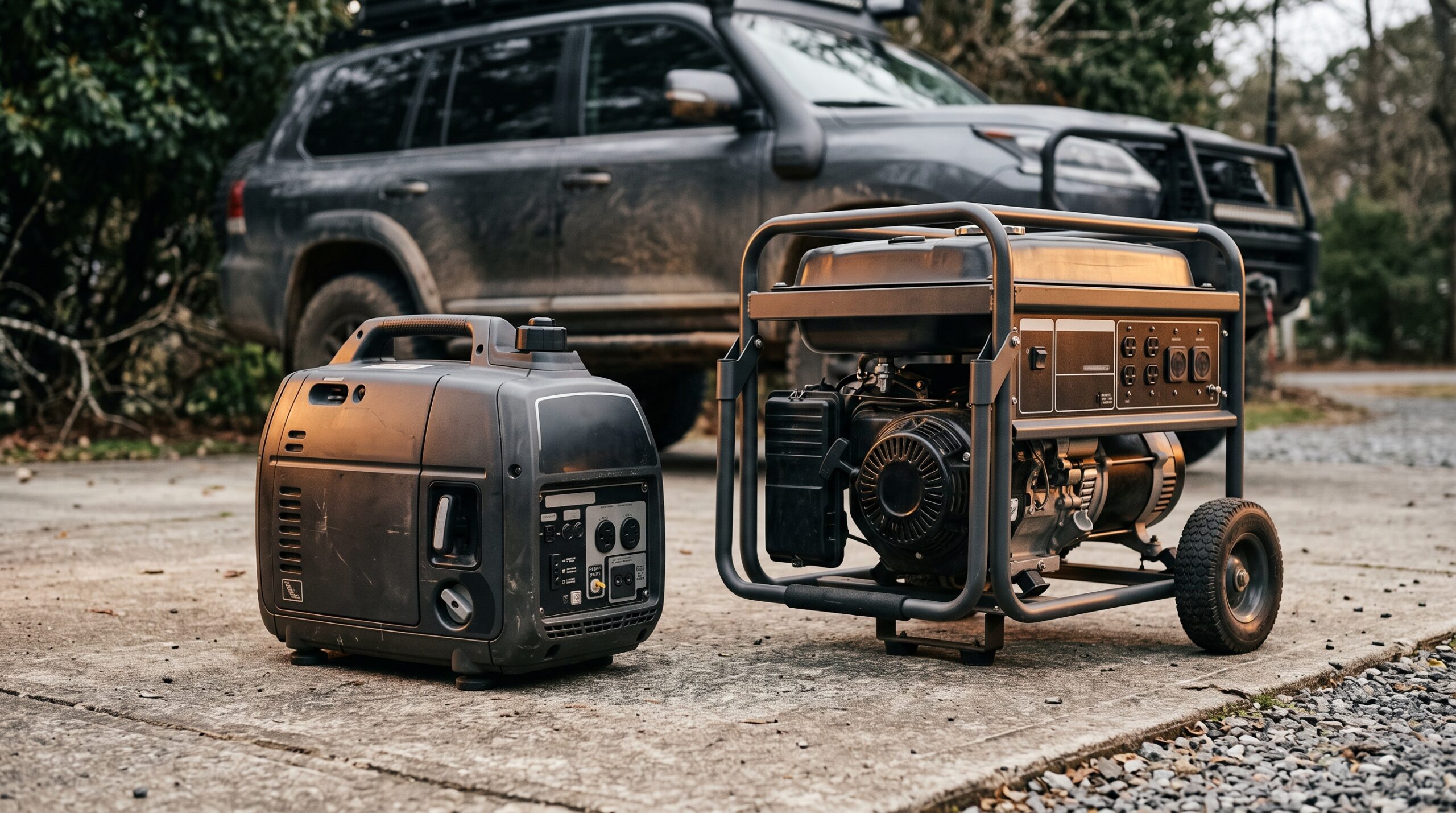
If you are shopping for a portable generator for outages, the choice usually comes down to two designs: an inverter generator or a conventional open-frame one. Pick an inverter generator when you care most about clean power for electronics, low noise, and fuel economy; pick a conventional generator when you need the most watts per dollar to run big loads. Both burn fuel and both produce carbon monoxide, so the safety rules below apply no matter which one you buy.
⚠️ Either way, run it outdoors only
Both types give off carbon monoxide. Run any generator outdoors only, more than 20 ft from windows, doors, and vents, with the exhaust pointing away from the house. Never run one indoors or in a garage, even with the doors open, and use a battery-powered CO alarm inside.
What each one is
A conventional generator, often called an open-frame generator, is the classic design: an engine spins an alternator at a fixed speed (usually around 3,600 rpm) to make 60 Hz alternating current directly. The engine runs at that speed whenever it is on, regardless of how much you are actually drawing. The hardware sits in an open metal frame, which is cheap to build and easy to service.
An inverter generator adds a layer of electronics. The engine still turns an alternator, but the raw output is converted to DC and then “inverted” back into a tightly regulated AC sine wave. Because the electronics handle the final waveform, the engine speed can vary with the load, and the whole unit is usually wrapped in a sound-dampening enclosure. That extra circuitry is the reason inverter models cost more and weigh less for a given size, and it is also the reason they behave differently in the areas below.
Power quality and sensitive electronics
This is the biggest practical difference. Power quality is usually described with total harmonic distortion (THD), which measures how far the output strays from a perfect sine wave. Inverter generators typically deliver under 3% THD, which manufacturers like Champion and Honda describe as clean, pure sine wave power that is safe for delicate electronics. Conventional generators run higher; Champion, for example, puts its standard open-frame units at roughly 12% to 20% THD depending on load.
For simple resistive loads, such as incandescent lights, a kettle, or a basic space heater, the higher distortion rarely matters. The concern is gear with sensitive control electronics: laptops, phones, networking equipment, modern refrigerators with inverter compressors, variable-speed furnace blowers, and medical devices. Cleaner power lowers the risk of those devices misbehaving or being stressed over time. This is the same reason battery power stations, which are inverter-based by design, are popular for electronics; if you are weighing that route too, see our breakdown of a generator vs power station. When in doubt, check the appliance manual for any THD requirement before connecting it.
Noise
Inverter generators are noticeably quieter. Because the engine speed drops when the load is light, and because the unit is enclosed, inverter models commonly run in the range of about 48 to 65 dB(A) depending on load and distance, roughly the level of normal conversation at the low end. Conventional open-frame generators hold a fixed engine speed and have no sound enclosure, so they often measure around 65 to 85 dB(A) under load, closer to a vacuum cleaner or street traffic.
Decibels are logarithmic, so a 10 dB gap sounds roughly twice as loud to most people. Noise also drops with distance, which lines up with the safety rule of keeping any generator well away from the house; our guide on using a generator safely covers placement in more detail. If you will run the generator overnight, near neighbors, or while camping, the quieter inverter design is a real advantage.
Weight and portability
For a given wattage, inverter generators tend to be lighter and more compact, which is why small “suitcase” models are common for camping and tailgating. Consumer Reports puts small inverter units at roughly 50 to 60 pounds, midsized models at 80 pounds and up, and large inverter generators at 150 to 300 pounds (those usually ship with wheels and a handle).
Conventional generators are often heavier for the same output because of the larger engine and open frame, though many include a wheel kit so you can roll them into position. If you need something one person can lift into a car, a small inverter wins; if the generator will live in one spot and just needs to roll out of the shed, weight matters less.
Fuel efficiency
Variable engine speed also saves fuel. An inverter generator only revs as high as the current load demands, so at partial loads it sips fuel; Honda says its Eco Throttle feature can cut fuel use by up to about 40% compared with running at full speed. A conventional generator runs at the same fixed rpm whether it is powering one phone charger or a fridge plus lights, so it burns fuel at a steadier, often higher rate.
Over a multi-day outage that difference adds up in both refueling trips and runtime per tank, especially if your real load is modest most of the time. The catch is that the savings shrink as you approach full load, where both designs work their engines hard.
Cost
Conventional generators give you more raw watts per dollar. As one illustration, Consumer Reports has compared a recommended conventional unit at around $850 for 7,500 watts with a recommended inverter at around $4,000 for 5,000 watts. Prices vary widely by brand, capacity, and fuel type, so treat those as examples rather than fixed figures, but the pattern holds: inverters cost more per watt for the cleaner power, lower noise, and lighter build.
Small inverter generators are still affordable in absolute terms, since they are low-wattage. The price gap widens most at the high-output end, where a large inverter can cost several times what a similarly powerful open-frame generator does.
Which to choose by use case
Lean toward an inverter generator if your priorities are clean power for electronics, quiet operation, light weight, and good fuel economy on modest loads. Typical fits: running a fridge, lights, Wi-Fi, and phones during an outage; an apartment, RV, or campsite where size and noise matter; or anyone backing up sensitive equipment.
Lean toward a conventional open-frame generator if you need the most output for your budget or have to start heavy loads, such as a well pump, central air conditioner, or several large appliances at once. If your goal is broad backup, work out the real total first; our guide to what size generator you need walks through running versus starting watts. High-output inverter models exist for whole-home use, but they carry the price premium noted above. Whichever you choose, the outdoor-only carbon monoxide rules are identical.
Inverter vs conventional generator: head to head
| Factor | Inverter generator | Conventional (open-frame) |
|---|---|---|
| Power quality | Cleaner; typically under 3% THD (pure sine wave) | Higher distortion; often ~12–20% THD |
| Noise | Quieter; ~48–65 dB(A) depending on load | Louder; often ~65–85 dB(A) under load |
| Weight | Lighter for the wattage; small units ~50–60 lb | Heavier for the same output; usually has a wheel kit |
| Fuel use | Throttles to the load; more efficient at partial loads | Fixed engine speed; steadier, often higher burn |
| Typical wattage | Commonly small to mid; high-output models exist but cost more | Easier to find in high-wattage sizes at lower cost |
| Cost | More per watt | More watts per dollar |
Put real numbers on your decision
The right design depends on the load you actually need to cover. Add up your essentials, then mind the surge: motors in fridges, pumps, and AC units can draw two to three times their running watts at startup. Use the Power-Station Sizing calculator to find the wattage you need, then the Appliance Runtime calculator to estimate how long a given setup keeps your devices going. Those numbers make the inverter-versus-conventional trade-off concrete instead of abstract.
Inverter and conventional, live prices


Champion 4500W Dual Fuel Inverter
Gas or propane, electric start, RV ready
$988.62Check price on Amazon →

Generac GP8000E
8,000 running / 10,000 starting watts, electric start
$1,299.00Check price on Amazon →

Champion 9375W Dual Fuel
Home-backup open frame, electric start, gas or propane
$874.99Check price on Amazon →
As an Amazon Associate we earn from qualifying purchases. Prices are pulled automatically from Amazon and may have changed.
Frequently asked questions
Is an inverter generator safe for a CPAP or medical device?
Inverter generators produce cleaner, more consistent power, which is generally gentler on sensitive electronics than a higher-distortion conventional unit. That said, this is not medical advice. For a CPAP, oxygen concentrator, or any equipment you cannot safely go without, confirm the power and backup requirements with the device maker and your clinician, and check the manual for any THD or pure sine wave requirement before relying on any generator.
Can a conventional generator damage electronics?
It can stress devices with sensitive control electronics, because the higher total harmonic distortion is further from the clean sine wave they expect. Many simpler appliances run fine on conventional power, and some open-frame units have lower distortion than others. If you plan to power laptops, networking gear, or appliances with electronic boards, either choose an inverter source or check each device manual for its power-quality requirement first.
Are inverter generators powerful enough for a whole house?
Most inverter generators are sized for essentials rather than a full house, though high-output and parallel-capable models can cover larger loads. Conventional generators are easier to find in high-wattage sizes at a lower price, which is why they are common for broad backup. Size the load before deciding, since the answer depends on what you actually need to run at the same time.
Why are inverter generators so much quieter?
Two reasons. The engine speed varies with the load instead of holding a fixed high rpm, so it slows down when you are drawing less, and the components sit inside a sound-dampening enclosure. Conventional open-frame units run at a constant speed with no enclosure, which is why they tend to be louder.
Which is more fuel efficient?
Inverter generators are usually more fuel efficient, especially at light to moderate loads, because they throttle the engine to match demand. A conventional generator runs at a fixed speed regardless of load, so it tends to use more fuel when you are only drawing a little. The gap narrows as both approach full load.
Sources
- CDC, Carbon Monoxide Poisoning: https://www.cdc.gov/carbon-monoxide/about/index.html
- U.S. Consumer Product Safety Commission, What to Know About Portable Generators and Carbon Monoxide (PDF): https://www.cpsc.gov/s3fs-public/468-WhattoKnowGenerators_2022.pdf
- Champion Power Equipment, Total Harmonic Distortion: https://help.championpowerequipment.com/article/dgn7qk3fzz-total-harmonic-distortion
- Honda Power Equipment, Inverter Generator Advantages: https://powerequipment.honda.com/generators/inverter-generator-advantages
- Consumer Reports, Pros and Cons of Inverter Generators: https://www.consumerreports.org/home-garden/generators/pros-and-cons-of-inverter-generators-a1104840654/