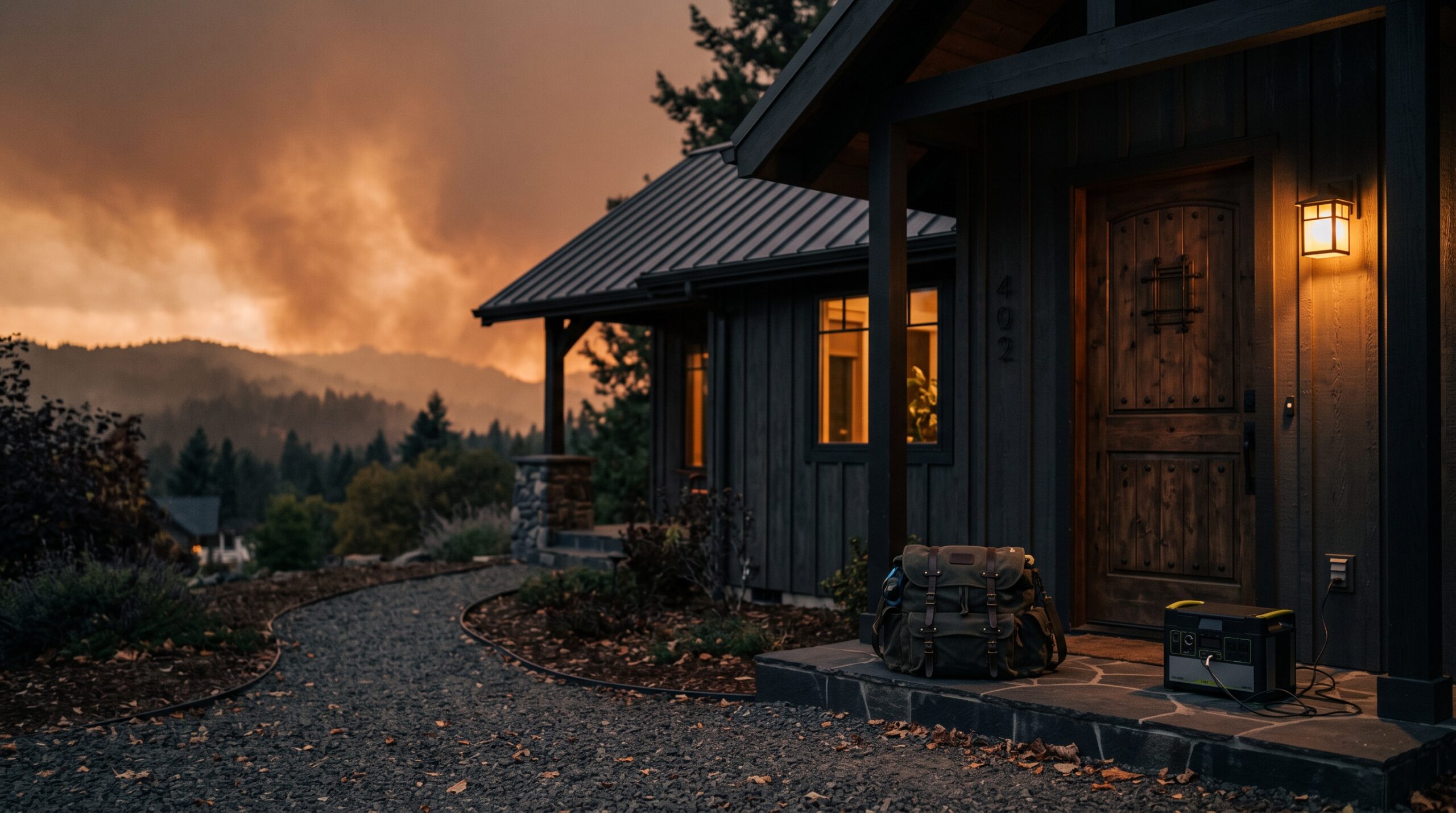
A wildfire can take your power two different ways, and a real plan has to cover both. Wildfire prep means being ready to leave at a moment’s notice while also being ready to shelter from smoke if you stay, so the core of it is a packed go bag, backup power for your essentials, and a way to keep smoky air out of one room. According to Ready.gov, the rule that overrides everything else is simple: evacuate immediately if authorities tell you to, and pay attention to emergency alerts for instructions.
Two kinds of outages come with fire weather. Utilities cut power on purpose during dangerous conditions in what is called a Public Safety Power Shutoff, and the fire and wind also knock out lines with no warning at all. This guide is about riding out either one safely, and it pairs with our PSPS shutoff prep for the planned side. The most important rule comes first, because it is the one that decides whether the rest of the plan ever matters.
⚠️ When officials say evacuate, go
Never wait out an evacuation order to save backup power, pack more, or watch the fire; leave early, and leave on your own if a fire is near and you feel unsafe even before an order arrives. No power station, generator, or air purifier is worth staying for. Run generators outdoors only, at least 20 feet from any window, door, or vent, because they give off carbon monoxide, an odorless gas that kills (Ready.gov, CDC). Keep a battery-powered CO alarm in the home, and follow local air-quality guidance during smoke.
Be evacuation-ready: your go bag
CAL FIRE organizes wildfire readiness around a “Ready, Set, Go!” model: get your home and supplies ready, set yourself up to leave at the first sign of trouble, and go early when told. The piece you can act on today is the go bag, a packed kit you can grab in seconds and throw in the car. Build it before fire season and keep it where you can reach it in the dark, because once an order comes you may have only minutes.
A wildfire go bag overlaps heavily with a general power outage emergency kit, so build one and the other comes most of the way for free. CAL FIRE and Ready.gov suggest packing the items below, sized for at least three days.
- Water, at least one gallon per person per day, plus three days of non-perishable food and a manual can opener
- N95 masks for smoke, a flashlight with spare batteries, and a battery-powered or hand-crank radio
- A first-aid kit, a week of any prescription medications, and copies of important documents in a waterproof bag
- Phone chargers and a charged battery bank or portable power station, plus some cash in small bills
- Sturdy shoes and clothing that covers your skin, ideally cotton, plus supplies for children, seniors, and pets
Two habits make the difference on a bad day. Keep at least half a tank of gas in your vehicle through fire season, since stations may lose power or close, and keep the go bag in the car or by the door rather than buried in a closet. When you leave, take your bag, your medications, your pets, and your phone, and do not turn back for anything else.
Prep before fire season
The work that makes a fire-season outage survivable happens weeks earlier. CAL FIRE recommends hardening the home and clearing defensible space around it, but the part that keeps the lights and the air manageable is your power and supplies. Charge everything you would lean on, top off phones, laptops, battery banks, and any portable power station, and keep them topped off whenever fire weather is in the forecast, because a Public Safety Power Shutoff can be called with only a day or two of notice.
Sign up for your county and utility alerts now, while you can, and ask your utility whether it offers advance notice of planned shutoffs. Test your smoke and carbon monoxide alarms and replace the batteries. If you rely on well water or an electric garage door, learn the manual override before you need it. Fire weather often rides in on the same heat waves that strain the grid, so if a shutoff lands during a hot stretch, our guide on staying cool during a power outage covers how to get through it without air conditioning.
Backup power for essentials and an air purifier
During a PSPS the whole neighborhood can be dark for hours or days, so backup power is about covering a short list of essentials rather than running the house. Prioritize the things that protect health and keep you informed: phones, any powered medical device, a fridge holding medication, and a portable air purifier to keep one room breathable. A battery power station is the safest choice indoors because it produces no fumes, while a gas generator must stay outside, well away from windows and doors, for the carbon monoxide reasons in the warning above.
The good news on smoke is that an air purifier sips power. Most portable HEPA air purifiers draw only about 30 to 100 watts on common settings, far less than an air conditioner or a space heater, so even a modest battery can run one for many hours or recharge during the day from solar. That makes a purifier one of the highest-value loads you can put on backup power during a fire, since clean air in a single room matters more than running everything at once.
Keeping smoke out
If you are not under an evacuation order and the air outside is smoky, the goal is to create one clean room and spend your time in it. The CDC advises choosing a room you can close off from outside air and setting up a portable air cleaner or filter to keep that room cleaner even when it is smoky outdoors. Pick an interior room with few windows, keep the doors and windows shut, and let everyone gather there, pets included.
If your home has central heating or air conditioning and the power is on, the EPA’s AirNow program recommends fitting a high-efficiency filter rated MERV-13 or higher and running the system on “Recirculate” and “On” rather than “Auto” so it keeps cleaning the air instead of pulling in smoke. Run a portable air cleaner continuously with the doors and windows closed, since that is when it works best. Just as important, avoid adding particles indoors: AirNow says to skip frying foods, sweeping, vacuuming, candles, and any gas, propane, or wood-burning stove while smoke is in the air.
| To keep smoke out | What to do | Source |
|---|---|---|
| Make a clean room | Close off one interior room; run a portable air cleaner with doors and windows shut | CDC, AirNow |
| Use your HVAC well | Fit a MERV-13 or higher filter; set the system to Recirculate and On | AirNow |
| Stop adding particles | No frying, sweeping, vacuuming, candles, or gas, propane, or wood stoves | AirNow |
| Protect yourself outside | Wear an N95 respirator; take it easier to breathe in less smoke | AirNow, Ready.gov |
If you have to go outside while it is smoky, an N95 respirator that seals to your face filters out the fine particles in smoke; an ordinary cloth or surgical mask does not. Keep outdoor time short and exertion low, because hard breathing pulls more smoke into your lungs.
Medical and vulnerable people
Wildfire smoke hits some people much harder than others. The CDC flags children, older adults, people who are pregnant, and anyone with a heart or lung condition such as asthma, COPD, or heart disease, along with people with diabetes, as the most at risk. These are the household members to settle in the clean room first and to watch for trouble breathing, chest tightness, or unusual fatigue. If symptoms are severe, do not wait it out; call for medical help.
If anyone in the home depends on powered equipment, plan the power before the outage, not during it. A CPAP, oxygen concentrator, nebulizer, or medication that needs refrigeration all need a backup plan, whether that is a battery power station sized for the device, a place to go that has power, or both. Contact your utility now to ask about a medical baseline or priority-notification program, which can give you advance warning of a planned shutoff. For masks, the CDC notes that children ages two and older can wear respirators, but NIOSH-approved respirators are not made in sizes that fit very young children, so a clean room matters even more for the youngest.
Stay informed
In a fast-moving fire, information is safety. Ready.gov recommends paying attention to emergency alerts and signing up for your community’s alert system, and reminds people that Wireless Emergency Alerts reach any enabled phone in a targeted area with no sign-up needed. Keep a battery-powered or hand-crank radio in your kit so you can still get official updates if the cell network goes down with the power.
For smoke specifically, the EPA’s AirNow Fire and Smoke Map shows current air quality and nearby fire smoke, and the numbers can swing sharply through the day. AirNow’s Air Quality Index runs from 0 to 500; once it climbs past 100, sensitive groups should start limiting time outdoors, and above 150 the air is considered unhealthy for everyone. Check it before you decide whether to open windows, run errands, or let kids play outside, and let the current reading, not the look of the sky, drive the call.
If you plan to lean on a battery during fire season, do the math before the smoke rolls in. Our Power-Station Sizing calculator helps you match a station to the essentials you actually need to keep running, such as a phone, a medical device, and an air purifier, and the Appliance Runtime calculator shows how long each load will last on a given battery before it runs flat.
Frequently asked questions
What is the difference between a PSPS and a wildfire power outage?
A Public Safety Power Shutoff (PSPS) is a planned outage a utility triggers on purpose during dangerous fire weather to keep its own lines from sparking a fire, and you usually get a day or two of notice. A wildfire outage is unplanned, caused when an active fire or high wind damages the grid, and it comes with no warning. Fire-season prep should cover both, since a single event can bring one and then the other.
Can a portable power station run an air purifier during a smoke event?
Yes, and it is one of the best uses for a battery during a fire. Most portable HEPA air purifiers draw only about 30 to 100 watts on common settings, far less than a fridge or an air conditioner, so even a modest power station can run one in a clean room for many hours and recharge from solar during the day. Run it with the doors and windows closed for the most benefit.
Do N95 masks protect against wildfire smoke?
An N95 respirator that seals well to your face filters out the fine particles in wildfire smoke, while an ordinary cloth or surgical mask does not. The CDC says children ages two and older can wear respirators, but NIOSH-approved respirators are not made small enough for very young children, so keeping the youngest in a clean room is the better protection for them.
How do I keep wildfire smoke out of my house during an outage?
Choose one interior room you can close off, keep the doors and windows shut, and run a portable air cleaner in it continuously, which the CDC and AirNow call a clean room. If your HVAC has power, fit a MERV-13 or higher filter and set it to Recirculate and On. Avoid frying, vacuuming, candles, and gas or wood stoves, since they add particles to the air you are trying to keep clean.
When should I evacuate during a wildfire?
Leave as soon as authorities issue an evacuation order, and do not wait to pack more or watch the fire. If a fire is close and you feel unsafe even before an official order, the Red Cross advises leaving anyway. Grab your go bag, medications, and pets, keep at least half a tank of gas through fire season, and know more than one route out in case your usual road is blocked.