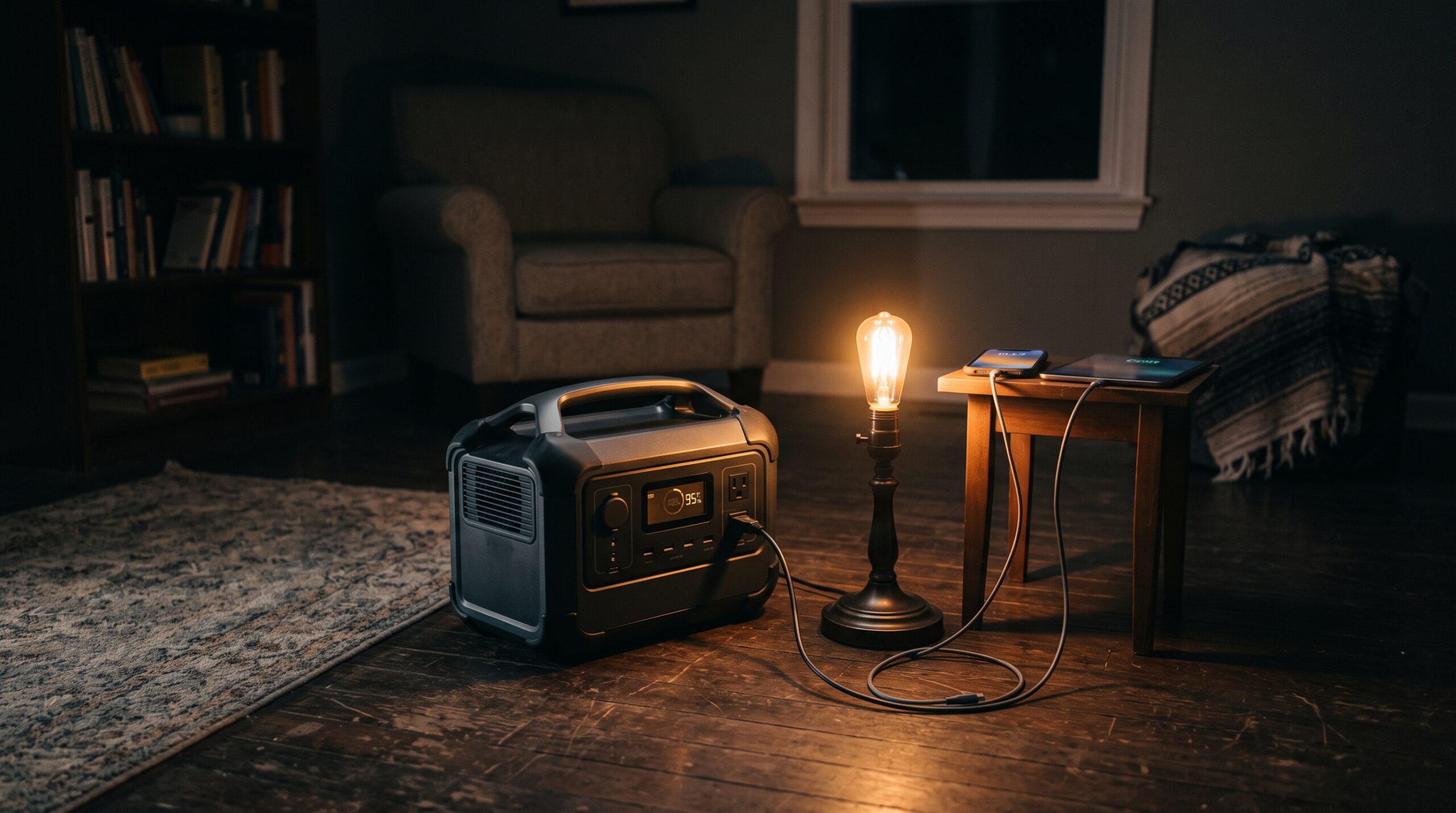
There is no single best portable power station for home backup, because the right one depends entirely on what you need to keep running and for how long. Size the load first, then match it to a tier: a few hundred watt-hours for phones, Wi-Fi, and a CPAP; around 1,000 watt-hours to hold a fridge overnight; roughly 2,000 watt-hours for most of a day of essentials; and an expandable system in the multi-kilowatt-hour range for multi-day or whole-home backup.
This guide skips the single-winner ranking and sorts stations by need instead. It shows how to add up your loads first, what capacity each tier actually covers, the specs that separate a reliable backup unit from a camping toy, and where a portable station simply cannot do the job.
Size it first: add up what you want to keep running
Before you look at any model, make a short list of what you want powered during an outage and write down two numbers for each item: its running watts (how much it draws while on) and its surge or startup watts (the brief spike when a motor or compressor kicks in). A phone charger draws a handful of watts; a Wi-Fi router 10 to 20; a CPAP without a heated humidifier roughly 30 to 60; a modern refrigerator about 100 to 250 running, but with a startup surge that can momentarily hit 600 to 2,000 watts.
Two specs on the power station have to clear those numbers. Continuous and surge output (in watts) must be high enough to start and run everything you plug in at once, including that compressor spike. Capacity (in watt-hours) sets how long it all runs before the battery is empty. They are independent: a unit can have plenty of output and still die in a few hours if its capacity is small, or hold a big charge but trip the instant a fridge tries to start. Plan around usable capacity, too, since inverter and battery losses mean only about 85 to 90 percent of the rated watt-hours actually reach your devices.
Once you know your total running watts, your worst-case surge, and a rough daily watt-hour budget, the tier you need usually becomes obvious. The table below maps the four tiers to the loads they typically cover.
| Tier | Capacity | What it typically runs | Best for |
|---|---|---|---|
| Small | ~250–600 Wh | Phones, tablets, Wi-Fi router, lights, a CPAP without humidifier for a night | Short outages, staying connected, small medical loads, apartments |
| Medium | ~800–1,200 Wh | An efficient fridge for most of a day, or fridge plus phones and Wi-Fi overnight in cycles | Keeping the refrigerator cold through an overnight outage |
| Large | ~1,800–2,400 Wh | Fridge plus several essentials for most of a day; brief use of a microwave or coffee maker | A full day of household essentials |
| Expandable | ~3,000–4,000+ Wh base, stackable to ~25–48 kWh | Essentials for multiple days; with 240V models, some larger circuits | Multi-day outages and whole-home essentials |
Small: phones, Wi-Fi, and a CPAP
A small station in the roughly 250 to 600 watt-hour range is built to keep you connected and to run low-draw medical gear, not to power the kitchen. That is enough to recharge phones and tablets many times over, keep a Wi-Fi router and modem alive, run LED lighting, and carry a CPAP through a night as long as you skip the heated humidifier, which is the part that eats most of the power. Units like the Jackery Explorer 300 and 500 V2 (about 293 and 512 watt-hours), the EcoFlow River 3 series, and the Anker SOLIX C300 sit in this class.
For a CPAP specifically, a 300 watt-hour unit running a machine at 30 to 60 watts generally covers a single night, and a 500 watt-hour unit gives you a comfortable margin or a second night of light use. Confirm the station outputs a pure sine wave, since CPAPs are sensitive electronics, and check that it can run with any low-power auto-shutoff disabled so it does not switch off under a small load. These units are light, often 7 to 15 pounds, and easy to keep on a shelf ready to go.
Medium: a fridge plus essentials overnight
The medium tier, around 800 to 1,200 watt-hours, is the most popular choice for home backup because it is the smallest size that reliably keeps a refrigerator cold through an overnight outage. A modern, efficient fridge averages somewhere around 1 to 2 kilowatt-hours per day once you account for the compressor cycling on and off, so a 1,000 watt-hour station delivering roughly 850 to 900 usable watt-hours tends to cover most of a day, with margin to also top up phones and run the Wi-Fi. For the full breakdown on matching a station to your fridge, see our guide on running a refrigerator.
Common 2026 units here include the EcoFlow Delta 3 and Delta 3 Plus (around 1,024 watt-hours with 2,400 watts of output), the Anker SOLIX C1000 (1,056 watt-hours, 1,800 watts continuous), the Jackery Explorer 1000 V2, and Bluetti’s Elite 100 class. What matters at this size is surge headroom: an 1,800 watt or higher inverter clears most refrigerator startup spikes comfortably. If you are weighing this size against the next one up, our comparison of 1000Wh vs 2000Wh walks through where the extra capacity earns its cost.
Large: most of a day for several loads
A large station in the 1,800 to 2,400 watt-hour range steps up from holding one critical appliance to running several essentials at once for most of a day. With roughly 1,700 to 2,100 usable watt-hours and inverters commonly rated 2,000 to 3,000 watts, this tier can keep a fridge cold while also powering lights, internet, and device charging, and handle brief, higher-draw jobs like a microwave or coffee maker one at a time. Examples include the EcoFlow Delta 3 Plus and Delta 2 Max, the Anker SOLIX C2000, the Jackery Explorer 2000 V2, and the Bluetti AC200L and Elite 200 V2 (around 2,000 watt-hours).
This is the practical ceiling for a single, still-portable box you can carry or wheel between rooms. Many of these models also accept high solar input, so on a sunny day you can recharge while you draw power and stretch a single unit across a longer outage. If your needs are mostly a fridge plus the basics, you may not need this much; if you want a buffer for a warm climate or an older fridge, it is the safer pick.
Expandable: multi-day and whole-home essentials
When you need to cover several days or back up essential circuits in your panel, you move from a single battery to an expandable system. These start at roughly 3,000 to 4,000 watt-hours in the base unit and accept add-on battery packs that push total capacity well into the tens of kilowatt-hours. The EcoFlow Delta Pro 3 carries 4,096 watt-hours with a 4,000 watt output and scales to around 48 kilowatt-hours with extra batteries, and offers 120V/240V split-phase output. The Anker SOLIX F3800 holds 3,840 watt-hours with a 6,000 watt inverter and expands to about 26.9 kilowatt-hours on its own, or roughly 53.8 kilowatt-hours when two units are paired.
Because these support 240V output and can tie into a transfer switch or smart panel, they can back up selected household circuits rather than just whatever you plug into the front. Paired with solar, an expandable system is the closest a battery setup gets to riding out a multi-day outage without a fuel generator. The trade-off is weight and cost: these are wheeled units in the premium and high-end price tiers, and a full multi-battery setup is a significant investment.
What to look for on the spec sheet
Once you know your tier, a handful of specs separate a dependable backup unit from one that will frustrate you:
- LiFePO4 (LFP) battery chemistry. Most reputable 2026 models use it, and for good reason: LFP cells are typically rated for about 3,000 to 6,000 charge cycles, several times the life of older lithium chemistries, and they handle heat more safely. For a unit that sits in reserve for years, this is the single most important spec.
- Pure sine wave output. Motors and sensitive electronics, from fridge compressors to CPAPs, run cooler and more reliably on a clean pure sine wave. Most quality stations already provide it, but confirm it on budget units.
- Surge (peak) headroom. The surge rating has to beat the worst startup spike among your loads, not just the running total. A fridge that draws 150 watts running can spike past 1,000 for a moment.
- Solar input and MPPT. A high solar input rating lets you recharge during a long outage. For multi-day planning, the ability to take 400 watts or more of panels turns a battery into a renewable buffer.
- Recharge speed and UPS switchover. Fast AC recharge (many 2026 units hit 80 percent in under an hour) means you can top up in a brief window of grid power, and a fast UPS or EPS switchover keeps sensitive gear from blinking off when the grid drops.
Brand also affects app quality, support, and the expansion ecosystem you can grow into later. Our brand comparison breaks down how the major makers differ on those points.
Where a power station can’t help
A portable station is excellent for essentials, but it is not a whole-house generator, and a few jobs are out of reach for all but the largest expandable systems. High-draw resistive loads, electric water heaters, electric ranges, and most space heaters, can swamp a mid-size unit’s output and drain even a large battery in a couple of hours. Central air conditioning and electric furnaces usually need 240V and more sustained power than a single portable box provides.
Well pumps and other hard-wired 240V equipment generally require an expandable, split-phase system tied into a transfer switch, not a station you plug appliances into. And for genuinely long grid-down events, a battery only lasts as long as its charge unless you can recharge it, which means pairing it with enough solar or accepting that it is a bridge, not an indefinite supply. If your goal is to run the entire house through a long outage, a standby generator or a large solar-plus-battery installation is the right tool, and a portable station is the backup to that backup.
Size it for your own home
The tiers above are a starting point, but your house has its own list of must-run loads, each with its own watts and surge. To turn that list into a specific capacity and output target, run your appliances through the Power-Station Sizing calculator, which matches both surge output and watt-hours to what you want to keep on. If you have a station in mind already and want to know how many hours it will carry a given load, the Appliance Runtime calculator does that math directly. Working from your own numbers will give you a far tighter answer than any general tier.
Home-backup picks, live prices


EcoFlow DELTA 2 Max
2,048Wh, 2,400W — fast solar, runs most of a kitchen
$1,049.00Check price on Amazon →

Jackery Explorer 2000 v2
2,042Wh, 2,200W — big capacity, not expandable
$899.00Check price on Amazon →
As an Amazon Associate we earn from qualifying purchases. Prices are pulled automatically from Amazon and may have changed.
Frequently asked questions
What size power station do I need for home backup?
It depends on what you want to run. For phones, Wi-Fi, and a CPAP, a few hundred watt-hours is enough. To hold a refrigerator overnight, plan on around 1,000 watt-hours. For most of a day across several essentials, roughly 2,000 watt-hours. For multi-day or whole-home essentials, an expandable system in the multi-kilowatt-hour range. Add up your loads’ running and surge watts first, then match them to the tier that covers them.
Can a portable power station run my whole house?
Generally no, not in the way a standby generator does. A single portable unit runs the loads you plug into it, which is great for essentials like a fridge, lights, and internet. Backing up entire household circuits, including 240V equipment like central AC, electric furnaces, or a well pump, requires a large expandable, split-phase system wired through a transfer switch, and even then it is sized for essentials rather than unlimited use.
How long will a power station last during an outage?
Runtime equals usable capacity divided by your average draw, so it varies with the load. A 1,000 watt-hour unit delivering about 850 to 900 usable watt-hours might run a CPAP for many nights, an efficient fridge for most of a day, or a 700 watt load for a bit over an hour. The heavier and more continuous the draw, the shorter the runtime. Solar recharging during the day can extend any of these.
Is LiFePO4 better for home backup?
For backup that may sit unused for long stretches, yes. LiFePO4 (LFP) cells are typically rated for about 3,000 to 6,000 charge cycles, far more than older lithium chemistries, and they tolerate heat more safely. That longer service life and stability is why most reputable 2026 home-backup stations use LFP, and it is worth prioritizing over a slightly cheaper non-LFP unit.
Do I need solar panels with a home backup power station?
Not for short outages. For a few hours or a single night, a charged battery is enough on its own. Solar matters when an outage stretches past a day, because it lets you recharge without grid power and turns the station into a renewable buffer rather than a one-time charge. If multi-day resilience is your goal, choose a unit with a high solar input rating and size your panels to your daily watt-hour budget.
Sources
- U.S. Department of Energy – Estimating Appliance and Home Electronic Energy Use
- TechRadar – Best Portable Power Stations of 2026
- EcoFlow – DELTA Pro 3 Specifications
- Anker SOLIX – F3800 Portable Power Station
- Jackery – Explorer 300 Portable Power Station