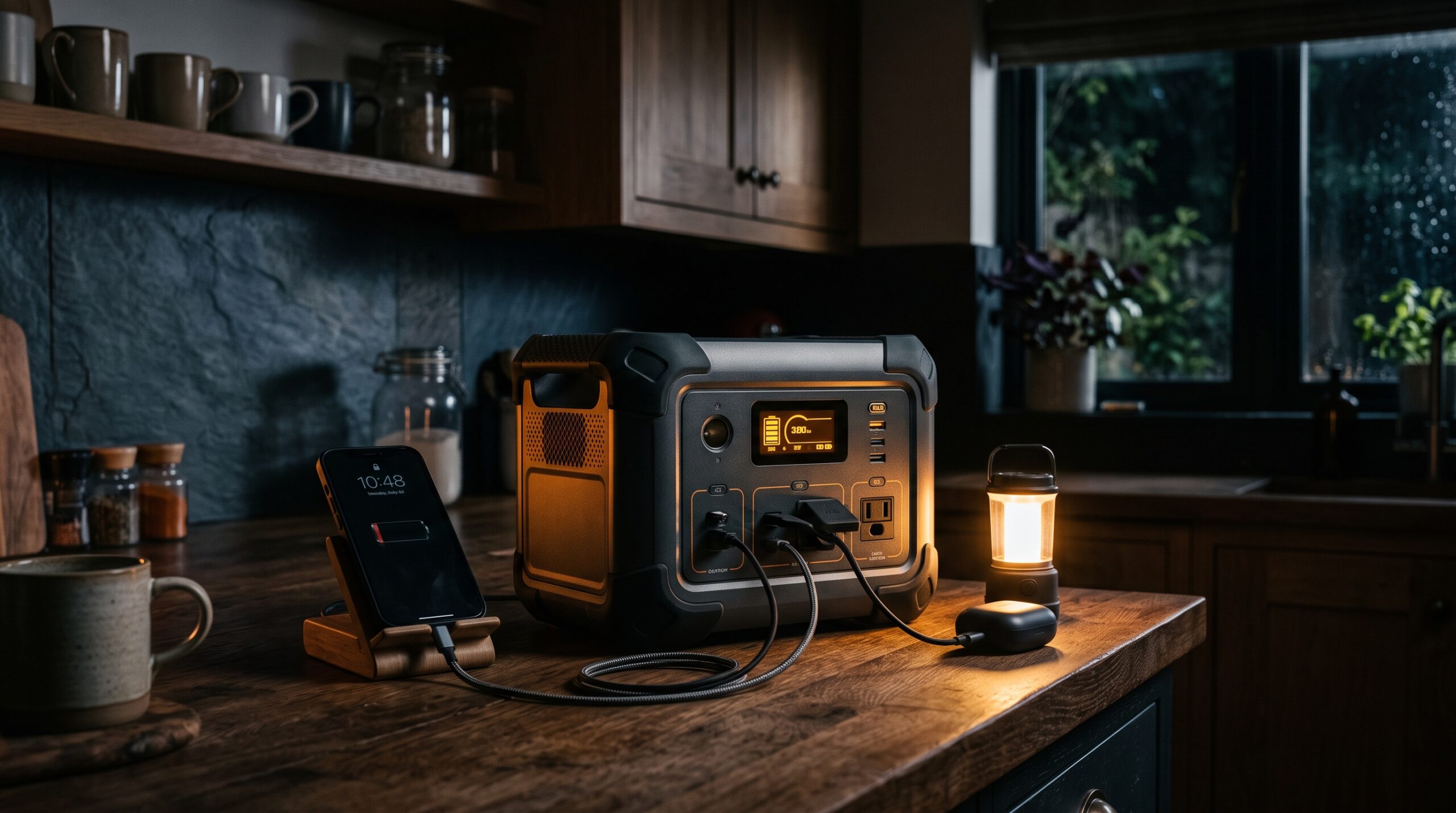
A 1,000-watt power station comfortably runs your essentials, one at a time or several at once, a refrigerator, lights, WiFi, phones, a laptop, and a CPAP, and a roughly 1,000Wh battery keeps that mix going for hours, often most of a day for the low-draw loads. What it will not handle is the heavy stuff: a full 1,500 W space heater, any air conditioning beyond the smallest window unit, electric kettles and dryers, and large motors whose startup surge climbs past the inverter’s limit.
Two numbers do the work here, and they answer different questions. The 1,000 W output rating is the load, how much you can pull at any one instant before the inverter overloads. The watt-hour capacity, about 1,000Wh on this class of unit, is the fuel tank, how long that load can run. A 50 W draw on a 1,000Wh battery lasts close to a full day; a 500 W draw lasts under two hours. So you add up the running watts of everything plugged in to stay under 1,000 W, then divide the capacity by that draw to get hours. (Many units sold as 1,000Wh actually push 1,500 to 1,800 W of output, which lifts the ceiling but does not change the runtime math.)
What a 1,000-watt power station can power at once
The 1,000 W ceiling covers a surprising amount of a home backup setup, as long as you stick to the low-draw electronics that make up most of daily life. A full-size refrigerator runs at about 100 to 200 watts, a 50- to 55-inch LED TV at 70 to 200 watts, a WiFi router and modem together at 10 to 35 watts, a laptop at 30 to 100 watts, and a room of LED bulbs at 10 to 60 watts. Add a box or ceiling fan at 35 to 100 watts and you can still run all of it at the same time and stay a few hundred watts under your 1,000 W budget, with room to charge phones and a tablet on top.
You can also run one larger appliance on its own. A microwave pulls 600 to 1,200 watts while cooking and a coffee maker 800 to 1,200 watts, so either sits right near the top of what a 1,000 W unit can sustain, fine in short bursts but not alongside other loads. The rule is simple: run those heavier items one at a time, and keep the small steady loads going around them. If you want the same mix to last longer or absorb a bigger appliance, that is where the jump to what a 2000W station runs starts to matter.
What it cannot run
A 1,000 W station is not whole-home backup, and the line falls right at the high-wattage heating, cooling, and motor loads:
- A full 1,500 W space heater, which sits above a true 1,000 W output rating and will overload the inverter (a model with surge-boost may run it briefly, but it empties a 1,000Wh battery in well under an hour).
- Central air conditioning, which runs at 3,500 to 5,000 watts and surges past 10,000 watts on startup, and most window AC units, whose startup surge alone trips a 1,000 W unit.
- High-wattage kitchen and laundry loads, electric kettles, hair dryers, toasters, and clothes dryers, most of which draw 1,200 to 5,000 watts.
- Electric water heaters, ranges, and ovens, all of them 240-volt loads a portable cannot supply at all.
- Large well pumps and other big motors, whose starting surge climbs past the unit’s limit even when the running watts look manageable.
If keeping any of those running is the priority, you are looking at a larger station with a higher output rating, a 240-volt unit, or a standby generator, not a 1,000 W portable. The 1000Wh vs 2000Wh comparison lays out exactly where that extra capacity and output change what you can keep on.
Runtime by device on a ~1,000Wh battery
The hours below assume a battery near 1,000Wh and account for the 10 to 15 percent the inverter loses turning DC into AC, so usable energy is closer to 850 to 900Wh. Treat these as ranges, not exact promises. Real runtime shifts with the specific model, the temperature, and how hard each appliance is working.
| Device | Running watts | Approx. hours on ~1,000Wh |
|---|---|---|
| Full-size refrigerator | 100–200 W (cycles on/off) | ~12–20 hr because the compressor cycles (raw draw alone is ~5–8 hr) |
| Chest or upright freezer | 100–400 W (cycles) | ~6–12 hr, longer with cycling |
| CPAP (no humidifier) | 30–60 W | ~15–25 hr |
| WiFi router + modem | 10–35 W | ~30–80+ hr |
| Laptop | 30–100 W | ~10–25 hr |
| LED TV (50–55 in) | 70–200 W | ~5–12 hr |
| LED lights (a room) | 10–60 W | ~15–80+ hr |
| Box or ceiling fan | 35–100 W | ~9–25 hr |
| Phone (full charges) | ~5–12 Wh per charge | ~80–150 full charges |
One pattern stands out. Fridges and freezers look like 150-watt loads on paper, but their compressors only run about a third of the time, so a 1,000Wh battery often carries a fridge most of a day rather than the five or six hours the raw math suggests. The steady electronics, router, lights, CPAP, phone charging, barely register against the battery, which is why a 1,000Wh unit shines at keeping the lights, internet, and medical gear on through an outage even though it cannot touch a heater.
These are ballpark figures. To pin down your own gear, run the numbers through the Appliance Runtime calculator. And if you are still deciding which unit to buy, the Power-Station Sizing calculator adds up your loads plus their startup surge and tells you whether 1,000 W is actually enough.
What about starting surge?
Running watts are only half the story for anything with a motor. Compressor-driven appliances, fridges, freezers, well pumps, sump pumps, and air conditioners, pull 2 to 4 times their running wattage for a fraction of a second when the motor kicks on. That spike is the starting, or surge, draw.
Most 1,000 W stations carry a surge rating roughly 1.5 to 2 times their continuous output, around 2,000 watts, to absorb those brief spikes. That is why a fridge running at 150 watts is no problem even though it may jump to 600 to 1,200 watts at the instant it starts. The trouble comes when the surge exceeds the limit: a window AC compressor or a big well pump can trip the inverter no matter how reasonable the running watts look. When you size a load, check both the running watts and the startup surge against the unit’s two ratings, and remember that on a 1,000 W class unit the surge headroom is tighter than on the bigger models.
How to recharge a 1,000Wh power station
The fastest path back to full is a standard wall outlet. Most current 1,000Wh units reach about 80 percent in under an hour and a full charge in roughly 1 to 1.7 hours on AC, and many will pass power through to your devices while they charge.
Solar is the option that matters in a prolonged outage. With around 400 to 500 watts of panels and good sun, a 1,000Wh battery can refill in roughly 2.5 to 4 hours, though cloud cover and panel angle stretch that out. A 12-volt car socket works too, but it is slow, think most of a day for a full charge, so treat it as a top-up rather than a primary method. Because the battery is smaller than the bigger units, a modest solar setup can keep a 1,000Wh station essentially topped off through a sunny multi-day outage.
The 1,000Wh class, live prices


As an Amazon Associate we earn from qualifying purchases. Prices are pulled automatically from Amazon and may have changed.
Frequently asked questions
Can a 1,000W power station run a refrigerator?
Yes. A full-size refrigerator runs at about 100 to 200 watts and surges briefly to several hundred watts when the compressor starts, both within a 1,000 W unit’s continuous and surge ratings. Because the compressor cycles on and off, a roughly 1,000Wh battery typically keeps a fridge cold for around 12 to 20 hours, often most of a day.
How long will a 1,000Wh power station run a CPAP?
A CPAP without a heated humidifier draws about 30 to 60 watts, so a 1,000Wh battery runs it for roughly 15 to 25 hours, two or three nights of sleep. Turning on the heated humidifier or heated hose pushes the draw to 60 to 100 watts and cuts that runtime by about half, so leave humidification off to stretch the battery during an outage.
Can a 1,000W power station run a space heater?
Not a typical 1,500 W space heater, which sits above a true 1,000 W output rating and will overload the inverter. Some units with a surge-boost feature can run one on a lower setting, but even then a 1,500 W heater empties a 1,000Wh battery in well under an hour, so a power station this size is not a practical way to heat a room.
Will it run a window air conditioner?
Only the smallest units, and only if the startup surge stays under the limit. A compact window AC runs at about 400 to 1,200 watts but can surge two to three times that when the compressor starts, which often trips a 1,000 W station. Central air conditioning is out of the question, as it draws 3,500 to 5,000 watts and surges well past 10,000.
How long can it keep a TV and internet running?
A long time. A WiFi router and modem draw only 10 to 35 watts and an LED TV 70 to 200 watts, so the two together pull well under 250 watts and a 1,000Wh battery can run them for several hours, often an evening or more. The router alone can stay up for a couple of days. For the full breakdown, see running a TV and internet.
Sources
- U.S. Department of Energy, Estimating Appliance and Home Electronic Energy Use
- EcoFlow, Appliance Wattage Chart and Energy Usage Calculator
- Jackery Explorer 1000 v2 Portable Power Station (1,070Wh, 1,500W / 3,000W surge specifications)
- EcoFlow DELTA 2 Portable Power Station (1,024Wh, 1,800W / 2,700W surge, X-Boost specifications)
- Jackery, CPAP Power Supply: Can a Solar Generator Power a CPAP (CPAP wattage)