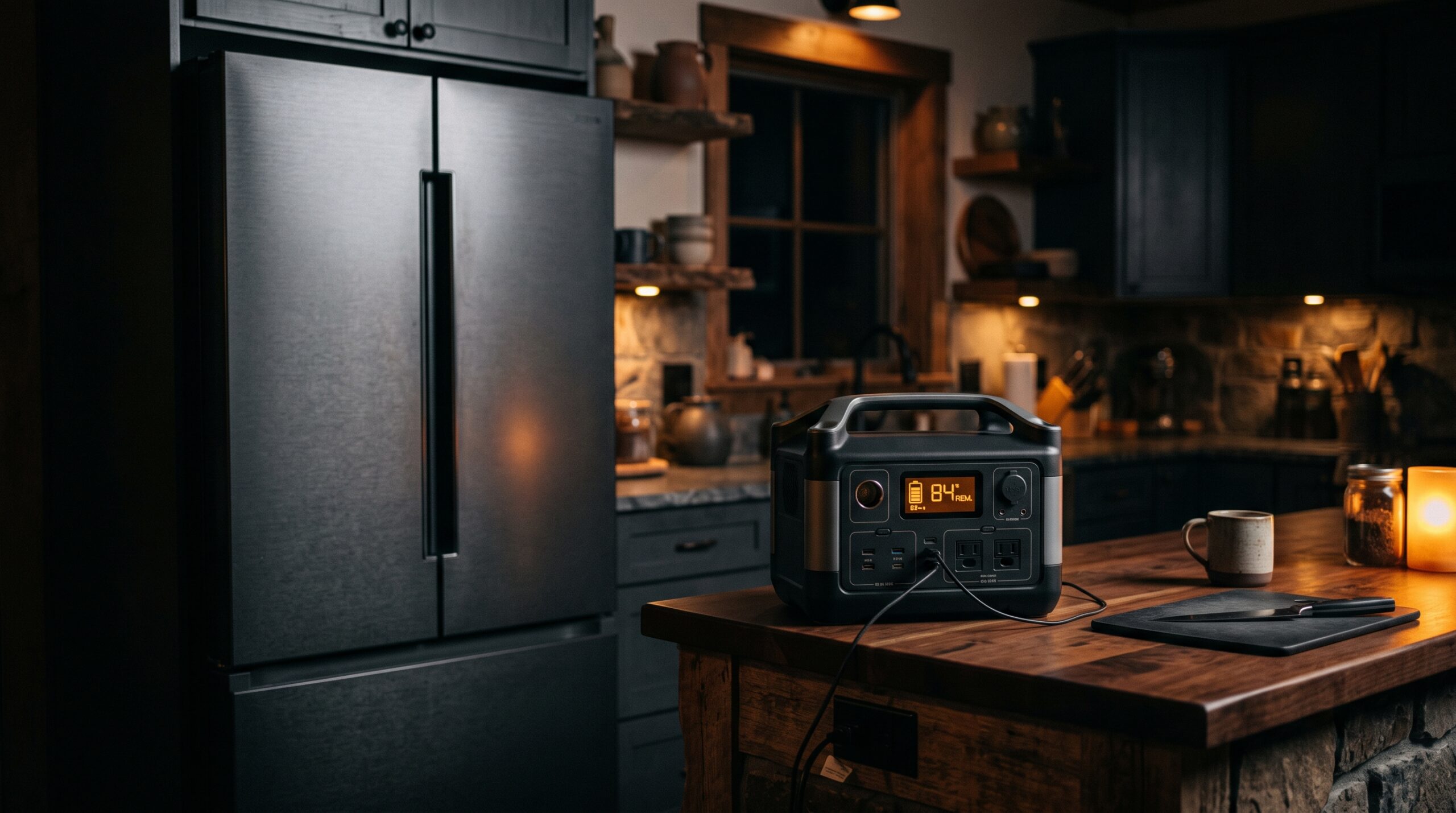
A refrigerator uses about 100 to 400 watts while the compressor is running, and it briefly pulls 600 to 2,000 watts at startup when the compressor first kicks on. Because the compressor cycles on and off, the U.S. Department of Energy suggests estimating that a fridge runs about one-third of the time, so its real daily energy use is far lower than its rated watts multiplied by 24 hours.
This guide breaks down running watts versus startup surge watts by fridge type, explains the duty cycle that makes the daily math look confusing, shows how to read the yellow EnergyGuide label, and turns all of it into how much backup power you actually need during an outage.
Running watts vs. starting watts
A refrigerator has two wattage numbers that matter, and they are very different. The first is the running watt draw, the steady power the compressor pulls once it is up and spinning. For most full-size models that lands between 100 and 400 watts. The second is the starting or surge wattage, a short spike that happens the instant the compressor motor starts. That inrush is typically two to three times the running figure and lasts only a fraction of a second.
For your electricity bill, running watts and total energy are what count. For sizing a generator, inverter, or power station, the surge is usually the deciding number. A backup unit has to survive that startup spike or the fridge will trip it and refuse to start, even if the unit could easily handle the steady running load afterward.
How many watts each type of refrigerator uses
Wattage scales with size and design. A compact dorm fridge sips power, while a 28 cubic foot French-door model with an ice maker draws several times more. The ranges below cover typical modern units. Use them as planning figures, and confirm against your own appliance label before you buy backup power.
| Refrigerator type | Running watts | Starting / surge watts | Est. daily energy |
|---|---|---|---|
| Mini / compact (1.7–4.5 cu ft) | 50–100 W | 200–400 W | 300–900 Wh (0.3–0.9 kWh) |
| Standard top- or bottom-freezer (18–22 cu ft) | 100–250 W | 600–1,200 W | 1,000–1,700 Wh (1.0–1.7 kWh) |
| Large side-by-side / French-door (22–28+ cu ft) | 150–400 W | 1,000–2,000 W | 1,500–2,500 Wh (1.5–2.5 kWh) |
Why duty cycle makes the daily number much lower
A fridge does not run its compressor all day. It cycles on to pull the temperature down, then shuts off and coasts until it warms back to the setpoint. The share of time the compressor actually runs is the duty cycle, and for a refrigerator it usually sits somewhere around a third to half of the day depending on how full it is, how often the door opens, and the room temperature.
This is why you cannot just multiply running watts by 24. The Department of Energy spells out the shortcut: divide the total time the refrigerator is plugged in by three to estimate the hours it operates at its rated wattage. A 150-watt fridge running roughly 8 of every 24 hours uses about 1,200 watt-hours a day, not the 3,600 watt-hours you would get assuming it never shuts off. That gap is the duty cycle at work, and it is the single biggest reason fridge power math trips people up.
How to read the EnergyGuide label
You do not have to guess your fridge’s energy use. The yellow EnergyGuide label, required by the Federal Trade Commission, gives you the official number. According to the FTC, the label shows the model’s estimated yearly energy use in kilowatt-hours, an estimated yearly operating cost based on a national average electricity rate, and a range showing how the model compares with similar units. The kWh figure is the most useful part because it already bakes in the duty cycle from a standard test.
To turn that label into watts, do two quick divisions. A label reading 630 kWh per year works out to about 1.7 kWh per day (630 divided by 365). Divide again by 24 hours and you get an average draw of roughly 72 watts. Notice that average sits well below the 150 watts or so the compressor pulls while actually running, which is the duty cycle showing up in real numbers. Most modern ENERGY STAR refrigerators land between about 350 and 600 kWh per year, and the U.S. Energy Information Administration reported that the most-used refrigerator in a home cost about $87 a year to operate in 2020.
How fridge watts translate to backup power sizing
When the power goes out, two numbers decide whether your fridge stays cold. The first is the startup surge, which sets the minimum peak output your generator, inverter, or power station must deliver. If your fridge surges to 1,500 watts, a unit rated for 1,000 watts continuous can still fail to start it unless it has enough extra surge headroom built in. The second is daily energy in watt-hours, which sets how much battery capacity or fuel you need to keep the fridge running for the hours you want to cover.
A rough example: a standard fridge using about 1.5 kWh a day needs roughly that much usable battery capacity to run for 24 hours, and a 1 kWh portable power station might cover a standard fridge for somewhere around 8 to 12 hours once you factor in the duty cycle. To do the power math for your own fridge instead of a generic average, run your running watts, surge watts, and battery size through the Power-Station Sizing calculator, then check how long a given battery will last with the Appliance Runtime calculator.
Frequently asked questions
How many watts does a refrigerator use per day?
A standard full-size refrigerator uses roughly 1,000 to 2,000 watt-hours (1 to 2 kWh) of energy per day after accounting for the compressor cycling on and off. A mini fridge uses far less, about 300 to 900 watt-hours a day. Your exact figure depends on size, age, and how often the door opens.
What size power station or generator do I need to run a refrigerator?
Pick a unit whose surge rating clears your fridge’s startup spike, which is often 1,000 to 2,000 watts for a full-size model. A power station or inverter generator rated around 1,500 to 2,000 watts continuous with a higher surge ceiling comfortably handles most home refrigerators. For runtime, match the battery’s usable watt-hours to the daily energy you want to cover.
How many watts does a mini fridge use?
A mini or compact refrigerator typically draws 50 to 100 watts while running and surges to roughly 200 to 400 watts at startup. Over a year that often adds up to around 100 to 470 kWh, depending on the model and how cold you keep it.
Will a 1,000-watt inverter run a refrigerator?
It can run many compact and smaller standard fridges whose startup surge stays under 1,000 watts, but it may trip on a large side-by-side or French-door model that surges past 1,500 watts. Check your fridge’s surge rating, not just its running watts, and leave headroom above the spike.
How do I find my refrigerator’s exact wattage?
Check the nameplate inside the door or on the back for watts, or for volts and amps that you multiply together (most U.S. fridges run on 120 volts). You can also take the kWh per year from the yellow EnergyGuide label, divide by 365 and then by 24 for the average watts, and remember the compressor pulls two to three times that while actually running.
Sources
- U.S. Department of Energy – Estimating Appliance and Home Electronic Energy Use
- Federal Trade Commission – How to Use the EnergyGuide Label to Shop for Home Appliances
- ENERGY STAR – Certified Residential Refrigerators
- U.S. Energy Information Administration – Electricity Use in Homes