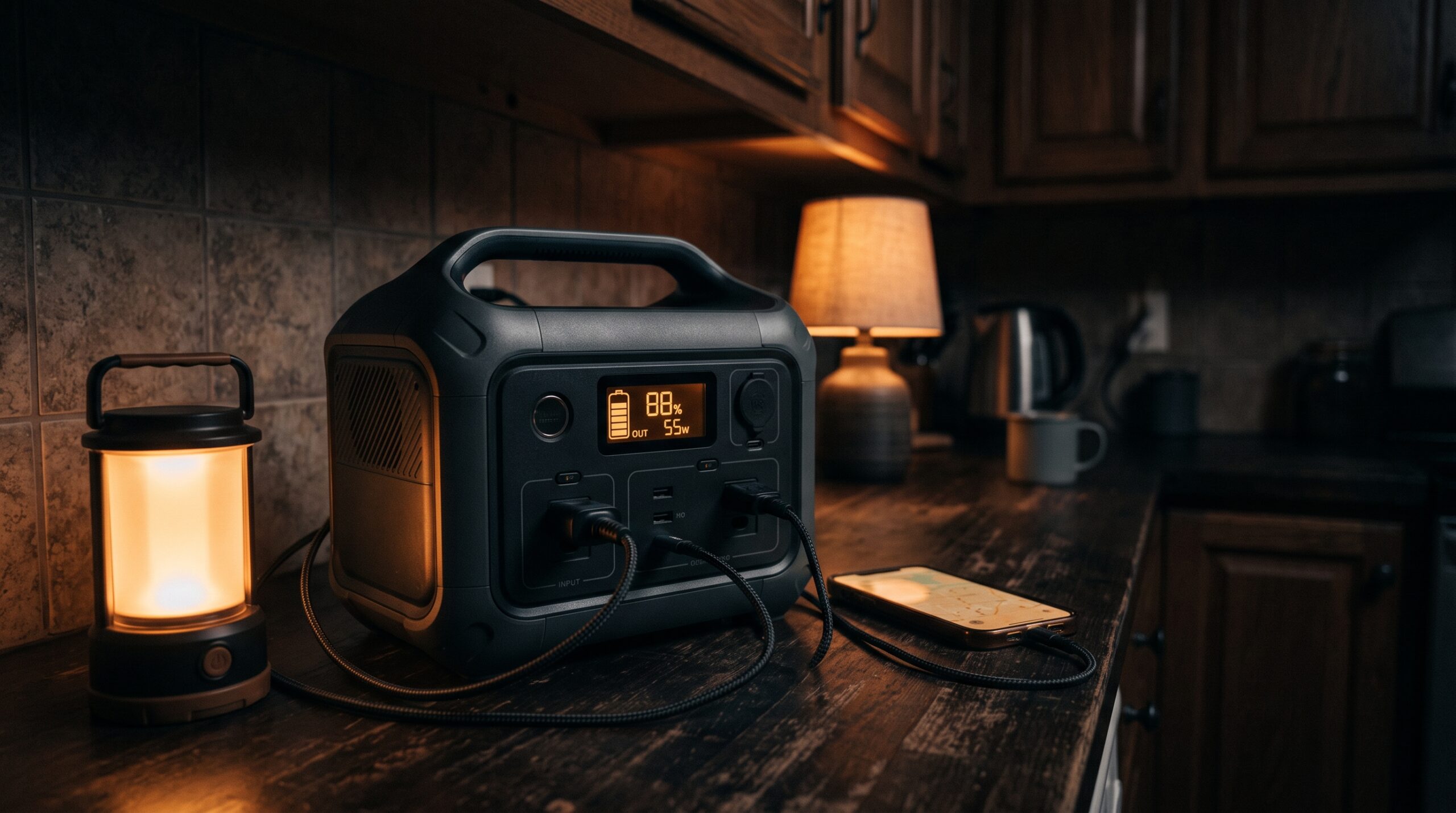
Honest answer: it depends on what you actually want it to do. A portable power station is genuinely worth it if you face regular short outages, need to protect something that can’t lose power (a fridge, a CPAP, a home office), or want clean indoor power for camping and apartment life. If your outages are rare and brief, a power bank and good flashlights may be all you need, and if you want to run your whole house for days, a generator or a home battery is the better tool.
This page lays out a simple decision framework: who it pays off for, who should probably skip it, and how the cost stacks up against the two alternatives people usually weigh it against. The honest test at the end is whether you can name the specific things you’d plug in. If you can, sizing your real need takes about two minutes with the runtime calculator.
The short version: worth it for some, overkill for others
A portable power station is a big rechargeable battery with normal household outlets, USB ports, and usually a 12V car socket built in. It stores energy quietly, makes no fumes, and you charge it from a wall outlet, your car, or solar panels. What it is not is a whole-home solution. Even a large unit covers a handful of important loads, not your central air, electric range, and well pump all at once.
So the question isn’t really “are these any good” (they are). It’s “does my situation match what one is good at.” The strongest case is a clear, recurring need: an outage-prone area, a medical device, a freezer full of food, or work that can’t go dark. The weakest case is buying one “just in case” when nothing in your life actually depends on it.
Who it’s genuinely worth it for
If one or more of these describes you, a power station tends to earn its keep:
- You get frequent short outages. If the lights flicker out for a few minutes to a few hours several times a year, a power station keeps your fridge, lights, internet, and phones running with zero setup. You flip a switch instead of dragging a generator outside in the rain.
- You depend on a medical device. A CPAP, BiPAP, oxygen concentrator, or a fridge holding temperature-sensitive medicine is the clearest case there is. A power station runs silently at the bedside with clean power. See the best power station for CPAP and our medical equipment backup guide for sizing.
- You want to protect a fridge or freezer. A full freezer of food is worth more than a mid-size station, and a station can cycle the fridge through a multi-hour outage so nothing spoils.
- You work from home or need internet uptime. Keeping a laptop, monitor, modem, and router alive through an outage can be the difference between a normal workday and a lost one.
- You camp, RV, or spend time off-grid. Clean power for a fridge, fans, lights, and devices without a noisy gas generator at the campsite. Our camping and RV sizing guide covers the typical loads.
- You need indoor, no-fumes power. Generators can never run inside or in a garage because of carbon monoxide. A power station can sit on your kitchen counter safely, which matters most exactly when the weather is too bad to be outside.
- You live in an apartment or condo. Most renters can’t legally or safely run a generator on a balcony. A battery is often the only realistic backup option, and it stores in a closet.
Who should probably skip it (or buy something else)
Being honest cuts both ways. A power station is the wrong purchase in a couple of common situations.
- Your outages are rare and brief. If the power goes out once every couple of years for twenty minutes, you don’t need a battery the size of a microwave. A good power bank to keep phones alive, a few rechargeable lanterns, and a cooler with ice will cover you for far less money. We compare these directly in power bank vs. power station.
- You want to run the whole house for days. Powering central AC, electric heat, a water heater, and every circuit through a multi-day outage is a job for a standby generator or a permanent home battery system, not a portable unit. Start with portable power station vs. home battery backup and home battery backup cost.
- You need to run high-heat appliances for long stretches. Space heaters, electric ranges, hair dryers, and window AC units draw enormous power and will drain even a large station in under an hour. If that’s your main goal, a generator with fuel is the more practical answer.
If you’re squarely choosing between battery and gas for outages, gas generator vs. power station walks through the trade-offs side by side, and our generator-or-power-station tool helps you decide.
Cost vs. benefit: what each price tier really covers
Prices move with sales, but the tiers are stable enough to plan around. The rough landscape in 2026 looks like this:
- Small (roughly 300–600Wh, about $200–$350): Phones, laptops, a router, lights, a CPAP for a night, a fan. Great for travel, short outages, and keeping communication alive. Won’t carry a fridge for long.
- Mid (roughly 1,000Wh, about $400–$800 depending on sale): The sweet spot for most homes. Cycles a fridge through a multi-hour outage, runs internet and devices, handles a CPAP for several nights, and covers most camping loads.
- Large (roughly 2,000Wh and up, about $800–$2,000+): Multi-day off-grid trips and longer outages, often expandable with extra batteries. Heavier and pricier, but closer to true home backup for essential circuits.
For context on the two alternatives: a basic gas generator can deliver more raw watts per dollar up front, but you keep paying for fuel, oil, and maintenance, and you can’t run it indoors. A whole-home standby generator typically runs several thousand dollars or more once installed. At the other end, a power bank is a tenth of the price of a small station but only really keeps phones and small USB devices alive. The 1000Wh vs. 2000Wh comparison helps you avoid both over- and under-buying.
Lifespan and long-term value
This is where a quality power station quietly makes its case. Most current units use LiFePO4 (lithium iron phosphate) batteries, which are typically rated for somewhere around 3,000 to 4,000+ charge cycles before settling to about 80% of original capacity. Reaching that number isn’t a failure point; it just means the battery holds a bit less than when it was new.
In practical terms, if you use one weekly for camping or pull it out for occasional outages, that’s commonly 10-plus years of service. Spreading the cost of a mid-range unit across thousands of cycles works out to pennies per use, which is why paying more up front for LiFePO4 usually beats replacing a cheap unit every few years. We dig into this in how long power stations last and the chemistry behind it in LiFePO4 vs. lithium-ion.
Worth-it scenarios at a glance
Match your situation to a starting point, then size it against your actual devices before you buy.
| If this is you… | Worth it? | Recommended size or alternative |
|---|---|---|
| Frequent short outages, want fridge + lights + internet | Yes | Mid (~1,000Wh) |
| CPAP / oxygen / refrigerated medicine to protect | Yes, high priority | Small–mid (600–1,000Wh, pure sine wave) |
| Work from home, can’t lose internet | Yes | Small–mid (500–1,000Wh) |
| Camping, RV, off-grid weekends | Yes | Mid–large (1,000–2,000Wh), add solar |
| Apartment or condo, can’t run a generator | Yes | Small–mid (500–1,000Wh) |
| Rare, brief outages, mostly want phones alive | Often no | Power bank + lanterns + cooler |
| Want whole house powered for days | No | Standby generator or home battery |
| Need to run heat/AC/electric range for hours | No | Fuel generator (used outdoors) |
How to buy without overspending
The single biggest mistake is buying by gut feel instead of by load. Write down the specific things you want to power and how long, add up the watts, and let the math pick the size. Underbuy and it dies mid-outage; overbuy and you’ve paid for capacity you’ll never cycle.
- List your must-run devices and rough wattage, then check runtime with the runtime calculator.
- Get a recommended capacity from the sizing calculator so you’re buying to a number, not a hunch.
- Favor LiFePO4 chemistry and pure sine wave output, especially for anything medical or with a motor.
- Watch for sales: the same unit can swing by hundreds of dollars across the year. If you’re starting from scratch, how to choose a power station and our home-backup picks point you to solid options.
We don’t post prices we can’t keep current or “we tested it” claims we can’t stand behind. Buy from a reputable retailer, check the warranty and cycle rating, and size to your real load rather than the biggest number on the box.
What each tier actually costs today


As an Amazon Associate we earn from qualifying purchases. Prices are pulled automatically from Amazon and may have changed.
Frequently asked questions
Is a portable power station worth it for just a couple of outages a year?
If those outages are short and nothing critical is at stake, probably not. A power bank for phones, a few rechargeable lights, and a cooler with ice will get you through for a fraction of the cost. A station starts to pay off when outages are frequent, long enough to threaten food in the fridge, or you have a device that genuinely can’t lose power.
Can a power station replace a generator?
For essential loads during shorter outages, indoor use, and camping, yes, and with no fumes or noise. For running a whole house, high-heat appliances, or multi-day outages, a generator (or a permanent home battery) still does the job better. Many people who face long outages end up using both. The full comparison breaks down where each wins.
How long will a power station actually run my stuff?
It depends entirely on the device. A CPAP without a humidifier might run all night on a small unit, while a fridge cycles on and off and stretches a mid-size station across many hours, and a space heater can flatten even a big battery in under an hour. Plug your real devices into the runtime calculator for a concrete estimate.
Do power stations lose capacity over time?
Yes, but slowly with LiFePO4. After roughly 3,000 to 4,000 cycles a quality battery typically still holds about 80% of its original capacity, which for most households is many years of use. Storing it around half charge in a cool place and avoiding constant full drains helps it last even longer.
What size should I buy?
Buy to your load, not to a feeling. List what you must run and for how long, then use the sizing calculator for a recommended capacity. As a rough guide, around 1,000Wh suits most home-backup and camping needs, smaller units cover phones and a CPAP, and 2,000Wh-plus is for multi-day or higher-draw use.
Sources
- Consumer Reports — Best Portable Power Stations
- OutdoorGearLab — The Best Power Stations (lab tested)
- TechRadar — Best Portable Power Stations
- EcoFlow — Choosing a Battery-Powered CPAP Option
- LiFePO4 Cycle Life Explained