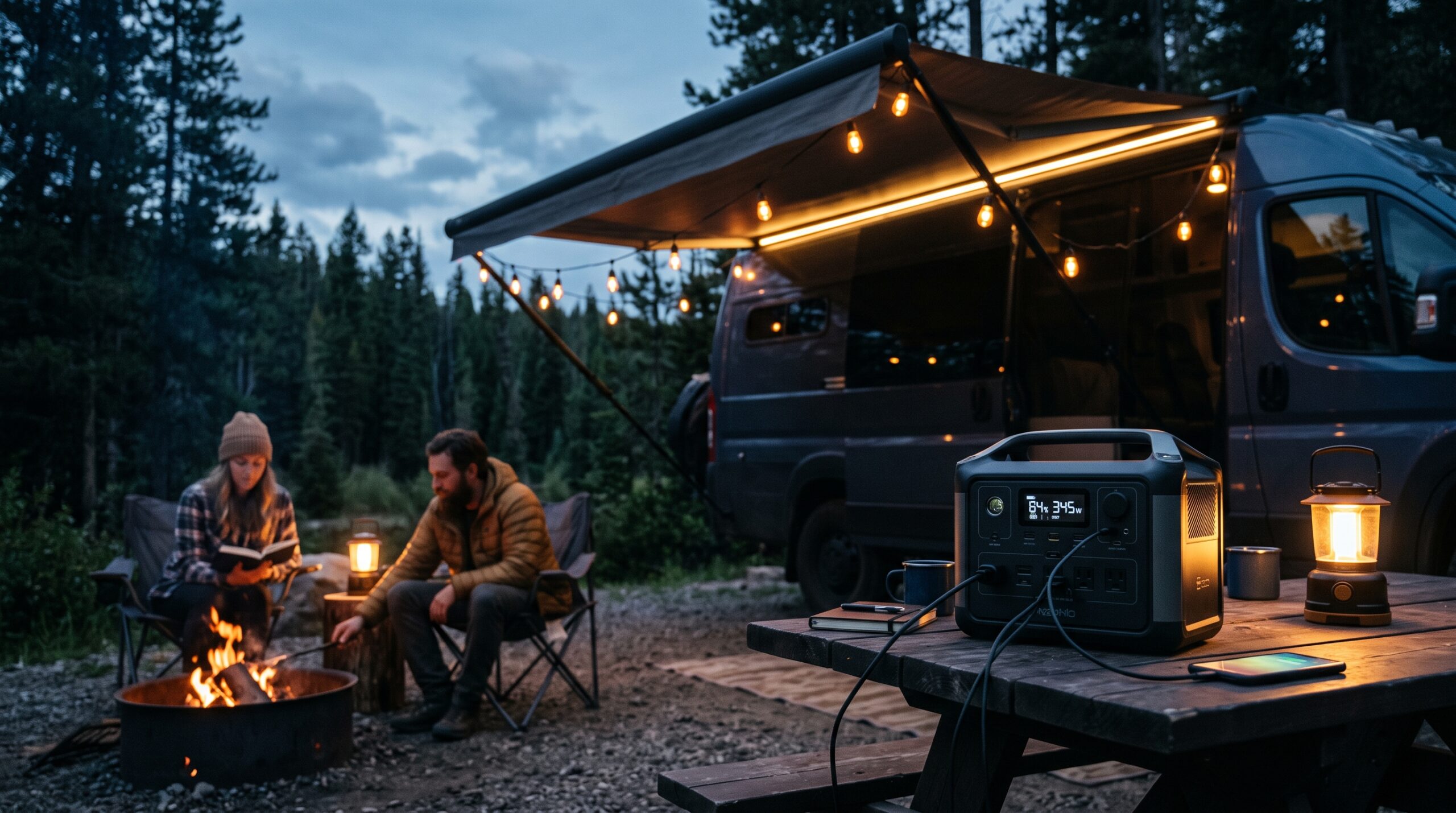
The best power station for RV and camping is the one sized to your actual trip, not the one with the biggest number on the box. For weekend tent or car camping, a 250 to 600 Wh unit keeps phones, lights, and a fan going. For van life and longer off-grid stays, step up to 1,000 to 2,000 Wh with solar input. And if you want to run an RV air conditioner, plan for 2,000 Wh or more and accept that runtime will be short. Below are strong options by category with their published specs, plus an honest look at what each tier can and cannot do.
What actually matters for RV and camping power
A few specs decide whether a power station fits the way you camp. Capacity (watt-hours) sets how long it runs your gear. Output watts and surge rating decide what it can turn on at all. After that, the camping-specific details matter more than marketing slogans.
- Capacity vs weight. More watt-hours means more runtime and more pounds. A 1,000 Wh unit usually lands in the 24 to 35 lb range, which one person can still carry. Push past 2,000 Wh and you are into 60 lb territory that mostly lives in the rig.
- Solar input. Off-grid, the battery is only half the system. A unit that accepts 400 to 600 W of solar can top up during a sunny afternoon instead of forcing you to drive somewhere to charge.
- The right ports. Look for a 12V car/cigarette output for fridges and fans, USB-C Power Delivery (ideally 100W) for laptops and phones, and enough AC outlets for the few things you actually plug in.
- Pure sine wave. Nearly all current name-brand stations output pure sine wave, which sensitive electronics and CPAP machines need. If you are comparing chemistry and waveform tradeoffs, see pure sine wave vs modified sine wave.
- LiFePO4 longevity. Most 2024 to 2026 models use LiFePO4 (LFP) cells rated for 3,000 to 6,000 cycles, far more than older lithium-ion. For the full breakdown, see LiFePO4 vs lithium-ion power stations.
- Silent and emissions-free. Unlike a gas generator, a power station makes no noise and no fumes, so it is legal and welcome in campgrounds with quiet hours.
Before you buy anything, add up the watts and hours of the gear you actually bring. The sizing calculator turns your fridge, fan, lights, and laptop into a target capacity so you are not guessing.
Weekend tent and car camping: 250 to 600 Wh
If you camp a couple nights at a time and mostly charge phones, run LED lights, power a small fan, and maybe a CPAP, you do not need a big unit. A compact 250 to 600 Wh station is light enough to carry one-handed and cheap enough to be a first purchase.
- Jackery Explorer 300 Plus — 288 Wh LiFePO4, around 7 lbs, with USB-C PD and a 12V output. Book-sized and easy to toss in a trunk.
- EcoFlow River 2 — 256 Wh, roughly 8 lbs, known for fast recharging (full in about an hour from AC). Good for short trips where you can top up at home.
- Bluetti EB3A — 268 Wh with a long 2,500-cycle rating and a 600W inverter that handles small appliances better than its size suggests.
- Step up to ~500 Wh (such as the Jackery Explorer 500 v2 at 518 Wh) if you want a second night of runtime or a small cooler in the mix.
The honest tradeoff at this tier: these units cannot run anything that heats or cools with a compressor for long. A coffee maker or kettle will drain a 300 Wh unit in minutes. Keep them for electronics and lighting and they are excellent.
Van life and longer off-grid trips: 1,000 to 2,000 Wh with solar
This is the sweet spot for most RV and van users. A 1,000 to 1,200 Wh unit with solar input can keep a 12V fridge running, charge laptops and cameras, run lights and a fan overnight, and recharge from panels the next day. It is the tier where a power station starts to feel like a real off-grid system rather than a backup battery.
- EcoFlow Delta 2 — 1,024 Wh LiFePO4, 1,800W output, up to 500W solar input, around 27 lbs. A popular all-rounder that recharges quickly and has plenty of outlets.
- Jackery Explorer 1000 v2 — about 1,070 Wh and 1,500W output. A common pick for solo travelers and couples in smaller trailers.
- Bluetti AC180 — 1,152 Wh LiFePO4, 1,800W, with fast AC charging (manufacturer cites a full charge in roughly an hour at 1,440W). Compact for its capacity, which suits tight van builds.
- Anker SOLIX C1000 — 1,056 Wh, 1,800W, around 26 lbs, with up to 600W solar input. Anker rates the cells for a long service life.
If you are between two capacities, err larger here. The difference between a one-night and a two-night buffer is the difference between relaxing and rationing. For a deeper look at sizing for this exact use, see what size power station for camping and RV. To plan the solar side, how many solar panels to recharge a power station walks through realistic panel counts and charge times.
Running an RV air conditioner: the honest limits
This is where buyers get burned by optimistic marketing. A typical 13,500 BTU RV air conditioner draws roughly 1,500 to 1,700 running watts, but its startup surge can spike to 3,000 watts or more. So the unit needs both a big enough inverter and surge headroom just to turn the AC on, and then a large battery to keep it running.
Even when a station can handle it, runtime is short. A roughly 2,000 Wh unit like the Jackery Explorer 2000 Plus (2,042 Wh, 3,000W) will run a mid-size RV AC for only an hour or so on its own battery. A 4,000 Wh class unit such as the EcoFlow Delta Pro series stretches that to a few hours. For all-day cooling you really need a large battery paired with heavy solar input or shore power, or an AC unit with a soft-start kit to tame the surge.
- Jackery Explorer 2000 Plus — 2,042 Wh, 3,000W (6,000W surge), expandable, with a true 30A output for RV connections. About 62 lbs.
- Bluetti AC200L — 2,048 Wh, 2,400W, with a 30A NEMA TT-30 RV port and up to 1,200W solar input.
- EcoFlow Delta Pro series — roughly 3,600 to 4,000+ Wh and expandable, for users who want meaningful AC runtime and can handle the weight and price.
The realistic takeaway: a power station is great for the RV’s fridge, lights, fans, electronics, and a short burst of AC. Treating it as an all-day air conditioner replacement is where expectations and physics collide. For the full math, see can a power station run an air conditioner.
How the popular options compare
This is a comparison of widely available, well-reviewed models grouped by tier, not a tested ranking. Specs are manufacturer-published; prices are approximate street ranges that move often with sales.
| Model (class) | Capacity | Key ports | Approx weight | Approx price |
|---|---|---|---|---|
| Jackery Explorer 300 Plus (weekend) | 288 Wh | AC, USB-C PD, USB-A, 12V car | ~7 lbs | ~$200–300 |
| EcoFlow River 2 (weekend) | 256 Wh | AC, USB-C, USB-A, 12V | ~8 lbs | ~$180–250 |
| EcoFlow Delta 2 (van life) | 1,024 Wh | 4x AC, USB-C 100W, 12V, 500W solar | ~27 lbs | ~$600–900 |
| Jackery Explorer 1000 v2 (van life) | 1,070 Wh | AC, USB-C 100W, USB-A, 12V | ~24 lbs | ~$700–900 |
| Bluetti AC180 (van life) | 1,152 Wh | AC, USB-C 100W, USB-A, 12V, wireless pad | ~35 lbs | ~$700–1,000 |
| Anker SOLIX C1000 (van life) | 1,056 Wh | AC, USB-C 100W, USB-A, 12V, 600W solar | ~26 lbs | ~$600–1,000 |
| Jackery Explorer 2000 Plus (big rig) | 2,042 Wh | 3,000W AC, USB-C 100W, 30A, expandable | ~62 lbs | ~$1,400–2,000 |
| Bluetti AC200L (big rig) | 2,048 Wh | AC, USB-C 100W, 30A TT-30, 12V | ~62 lbs | ~$1,300–1,700 |
Solar, ports, and the specs that matter off-grid
If you stay off-grid more than a night or two, the recharge path matters as much as the battery. A 1,000 Wh unit with 400 to 600W of solar can realistically replace a chunk of its capacity on a clear day, while a unit that caps solar input at 200W will lag behind your usage. Match panel wattage to the station’s maximum input so you are not leaving sun on the table.
On ports, the 12V output is the unsung hero for RV and van users because most camping fridges run on it efficiently. USB-C PD at 100W charges laptops without an AC adapter, which saves inverter losses. And if you are deciding between a camping unit and one that doubles as house backup, the priorities differ; see best portable power station for home backup for that angle.
How to buy without overpaying
These models are widely available directly from the manufacturers (Jackery, EcoFlow, Bluetti, Anker) and from major retailers like Amazon, Home Depot, and Lowe’s. A few honest notes before you check out:
- Prices swing a lot. These units go on sale around major holidays and festival season, sometimes 30% or more off list. If you are not in a rush, wait for a sale.
- Always confirm current capacity, output, and solar input on the product page before buying, since brands revise models (v1 vs v2) and bundle different solar kits.
- Solar panels are often sold separately. A “solar generator” bundle can be cheaper than buying the station and panels apart, but compare the panel wattage, not just the price.
- Size to your own gear, not to a reviewer’s setup. Run your real load list through a sizing tool first so you buy enough capacity without overpaying for weight you will not use.
RV and camping picks, live prices


Jackery Explorer 1000 v2
1,070Wh, 1,500W — light and simple for outages
$499.00Check price on Amazon →
As an Amazon Associate we earn from qualifying purchases. Prices are pulled automatically from Amazon and may have changed.
Frequently asked questions
What size power station do I need for camping?
For weekend tent or car camping with phones, lights, and a fan, 250 to 600 Wh is plenty. For van life or multi-day off-grid trips with a fridge and laptops, aim for 1,000 to 2,000 Wh and add solar. Total your gear’s watts and hours to get an exact number rather than guessing.
Can a power station run an RV air conditioner?
It can start and run a mid-size RV AC if the inverter handles the surge (often 3,000W+ for a 13,500 BTU unit), but runtime is short. A 2,000 Wh station may give about an hour, and a 4,000 Wh class unit a few hours. All-day cooling needs a large battery plus heavy solar or shore power.
Is LiFePO4 worth it for camping?
Yes. LiFePO4 cells last roughly 3,000 to 6,000 cycles versus around 500 for older lithium-ion, so a LiFePO4 unit can outlast many years of weekend trips. They also tolerate heat better, which matters in a hot rig. Nearly all current name-brand stations now use LiFePO4.
How long does it take to recharge from solar?
It depends on panel wattage, sun, and the station’s input limit. As a rough guide, a 1,000 Wh unit with 400W of panels in good sun can refill a large part of its capacity in a single day. Cloud cover and panel angle change this a lot, so size panels toward the station’s maximum solar input.
Power station or gas generator for an RV?
A power station is silent, fume-free, and campground-legal during quiet hours, and it pairs with solar for off-grid recharging. A gas generator gives more sustained high wattage for running AC all day, at the cost of noise, fuel, and fumes. Many RVers carry a power station for everyday use and rely on shore power or a generator only when they need the air conditioner running for hours.