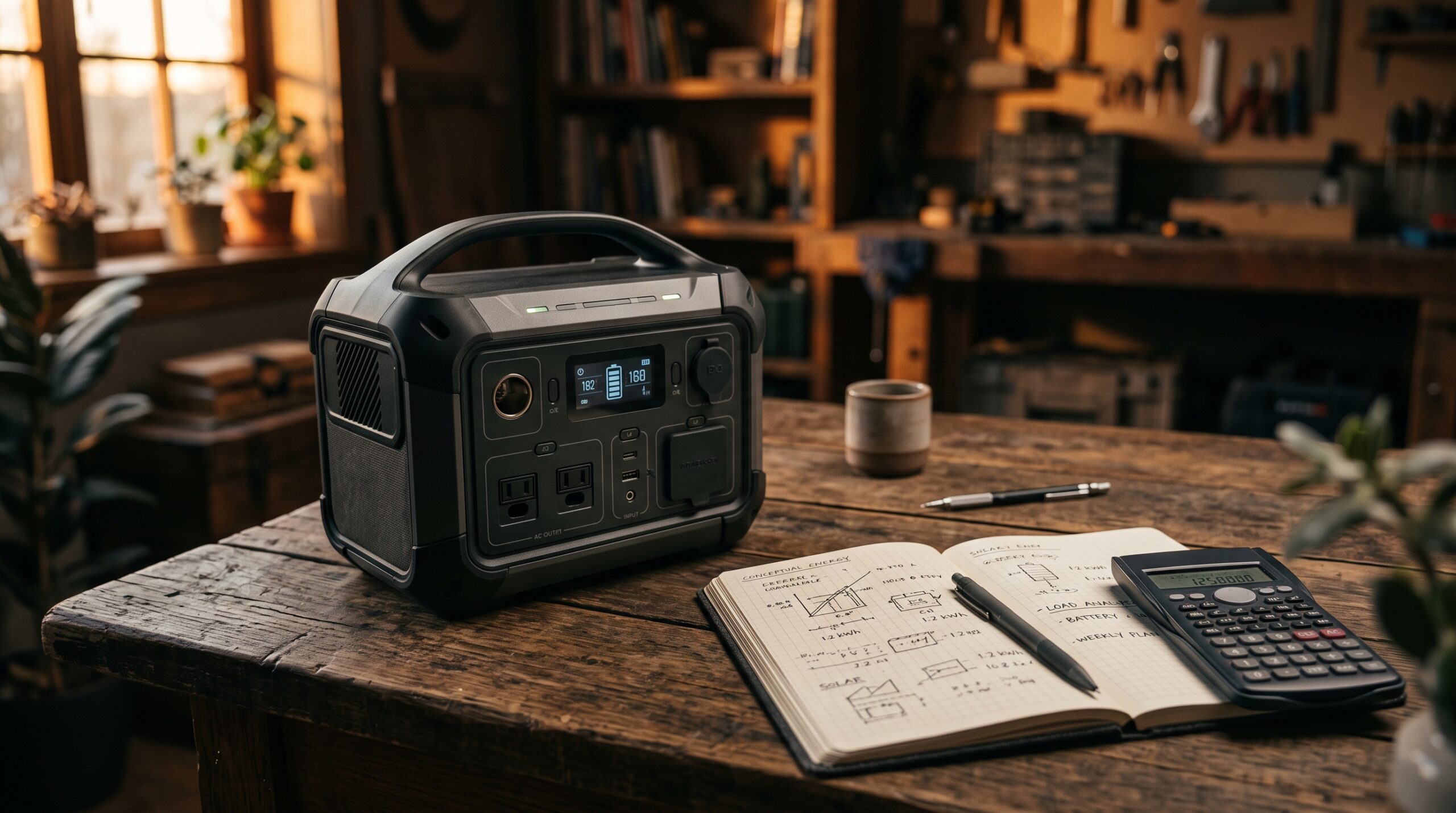
A watt-hour is energy: watts multiplied by hours. It is the number that tells you how long a battery or power station can run something. Watts measure how fast a device pulls power right now. Watt-hours measure how much energy gets used over time. A 60-watt device left on for one hour uses 60 watt-hours, and a power station rated at 1,000Wh holds about that much energy to give away.
If you only remember one thing, make it this: when you shop for backup power, the watt-hour number is the size of the fuel tank. It is what decides whether your fridge stays cold for 6 hours or 16. Below is the plain-English version of what a watt-hour is, the one formula you need, and why it is the spec that matters most.
Watts vs watt-hours
Watts and watt-hours sound almost identical, and that is exactly why people mix them up. They measure two different things.
A watt is a rate. It tells you how fast a device draws power at any given moment, the same way miles per hour tells you how fast a car is moving. A microwave might pull 1,000 watts while it runs. An LED bulb might pull 9 watts. The U.S. Energy Information Administration puts it simply: a watt is a unit of power, and one watt is a very small amount of power.
A watt-hour is a total. It is power used over time. The EIA defines one watt-hour as the energy of one watt used for one hour. So watts tell you the speed of the draw, and watt-hours tell you how much got used once you account for how long it ran. That is the whole difference: watts are how fast, watt-hours are how much.
The reason this matters for backup power is that a device’s watt rating alone never tells you how long your battery lasts. A 9-watt bulb and a 900-watt heater are worlds apart, but you can only compare them once you bring time into it, and that is what watt-hours do.
The simple formula
The math is genuinely just multiplication. The Department of Energy uses this same formula to estimate appliance energy use:
Watts × hours = watt-hours.
A 60-watt fan running for 5 hours uses 60 × 5 = 300 watt-hours. A 1,200-watt space heater running for 2 hours uses 1,200 × 2 = 2,400 watt-hours. A 5-watt phone charger running for 3 hours uses just 15 watt-hours. Same formula every time. The big draw over a short time and the small draw over a long time both land in the same unit, which is what makes watt-hours so useful for planning.
You can run it backward too. If you know how much energy you have and how many watts a device pulls, you can solve for hours, and that is exactly how runtime works.
Watt-hours and your power station’s runtime
Portable power stations are rated in watt-hours because that rating is their whole point: it is how much energy they store. A 1,000Wh station holds roughly 1,000 watt-hours. To estimate how long it runs a device, you flip the formula around:
Runtime (hours) = usable watt-hours ÷ device watts.
On paper, a 1,000Wh station running a 100-watt device gives you 1,000 ÷ 100 = 10 hours. In the real world it is a little less, and the word doing the work above is “usable.” No power station hands over 100 percent of its rated watt-hours. Some energy is lost as the inverter converts the battery’s DC power into the AC power your appliances expect, and the battery’s management system usually holds a little in reserve to protect the cells. As a rough planning rule, expect somewhere around 85 percent of the label to reach your device, so that 1,000Wh station behaves more like 850Wh in practice. That is a range, not a guarantee, and it shifts with the load, the temperature, and the specific unit.
So a more realistic estimate for that 100-watt device is closer to 850 ÷ 100, or about 8 to 9 hours. The bigger the watt-hour number on the label, the longer the runtime for the same device, which is the heart of comparisons like 1000Wh vs 2000Wh: double the watt-hours, and you roughly double the time. If you want the numbers worked out for your own gear, the Appliance Runtime calculator does the division and the efficiency haircut for you.
Watt-hours vs kWh
A kilowatt-hour is just a bigger watt-hour. One kilowatt-hour (kWh) equals 1,000 watt-hours, the same way one kilometer equals 1,000 meters. To convert, you divide watt-hours by 1,000: a 2,000Wh power station holds 2 kWh, and a 1,000Wh station holds 1 kWh.
You see kWh on your electricity bill because it is the tidy unit for household-scale energy. The EIA notes that utilities measure and bill electricity in kilowatt-hours, and the Department of Energy’s appliance formula divides watt-hours by 1,000 to land on the kWh figure your utility charges for. Power stations stick with watt-hours because the numbers are friendlier at that size; 1,000Wh reads more naturally than 1 kWh when you are comparing a shelf of portable units. They are the same kind of measurement, just scaled differently, so a 1,024Wh station and a “1 kWh” station are describing the same tank.
Why it matters for backup power
When the power goes out, the question is never “how many watts does my fridge use.” It is “how long can I keep it running.” Watts alone cannot answer that. Watt-hours can, because they fold in the only thing you actually care about during an outage: time.
Here is how it plays out. A refrigerator might pull around 100 to 200 watts while the compressor runs, though it cycles on and off rather than running flat out, so its real draw averages lower (the breakdown is in how many watts a fridge uses). Feed that average into a 1,000Wh station and you are looking at well over half a day of cold food on a single charge. Swap in a 1,000-watt appliance like a microwave and that same battery is gone in under an hour. The watt-hour tank did not change; the speed you drained it did.
That is why watt-hours are the spec to anchor on. The watt rating tells you whether a device will even turn on, which is a real limit worth checking against what a 1000W station runs. But the watt-hour rating tells you how long the lights, the fridge, the CPAP, and the phones keep going before you need sun or a generator. Size your backup power by the watt-hours, and you are planning around the number that actually decides how your outage goes.
| Term | What it measures | Example |
|---|---|---|
| Watt (W) | Power: how fast a device uses energy right now | A microwave pulls about 1,000W while running |
| Watt-hour (Wh) | Energy: power used over time (watts × hours) | A 60W fan for 5 hours uses 300Wh |
| Kilowatt-hour (kWh) | Energy in larger units: 1,000 watt-hours | A 2,000Wh power station holds 2 kWh |
| Usable watt-hours | The energy that actually reaches your device after losses | A 1,000Wh station delivers roughly 850Wh |
Want this applied to your own situation? The Appliance Runtime calculator turns a power station’s watt-hours into hours for any device, and the Power-Station Sizing calculator works the other way, telling you how many watt-hours you need to cover the things you want to keep running.
Frequently asked questions
Is a watt-hour the same as a watt?
No. A watt measures power, which is how fast a device uses energy at a given moment. A watt-hour measures energy, which is power used over time. One watt running for one hour equals one watt-hour, so the watt-hour is what tells you how much energy was actually used, not just how fast.
How do I calculate watt-hours?
Multiply the device’s wattage by the number of hours it runs: watts × hours = watt-hours. A 500-watt device running for 2 hours uses 500 × 2 = 1,000 watt-hours. To convert that to kilowatt-hours, divide by 1,000, which gives you 1 kWh.
How many watt-hours do I need for a power outage?
It depends on what you want to run and for how long. Add up each device’s watts times the hours you need it, then add some headroom because you only get around 85 percent of a station’s rated watt-hours in practice. For just a fridge and phones overnight, many people find 1,000Wh enough; for longer outages or several appliances at once, 2,000Wh or more buys breathing room. The Sizing calculator does this math for you.
Why does a power station not give its full rated watt-hours?
Two reasons. The inverter loses some energy as heat when it converts the battery’s DC power into the AC power your appliances use, and the battery management system usually keeps a small reserve to protect the cells. Together that means roughly 10 to 15 percent of the rated capacity does not reach your device, so a 1,000Wh station typically delivers somewhere around 850Wh of usable energy. The exact figure varies by unit, load, and temperature.
Is Wh or kWh the better number to shop by?
They are the same measurement at different scales, so use whichever is easier to compare. Portable power stations are almost always labeled in watt-hours, so Wh is the practical number for comparing units. Your home electricity bill uses kWh because it is the tidier unit for household-scale energy. Just remember 1,000Wh equals 1 kWh when you switch between them.
Sources
- U.S. Energy Information Administration — Electricity explained: Measuring electricity (watt, watt-hour, kilowatt-hour definitions)
- U.S. Department of Energy — Estimating appliance and home electronic energy use (wattage × hours ÷ 1,000 formula)
- U.S. Energy Information Administration — Glossary: kilowatthour