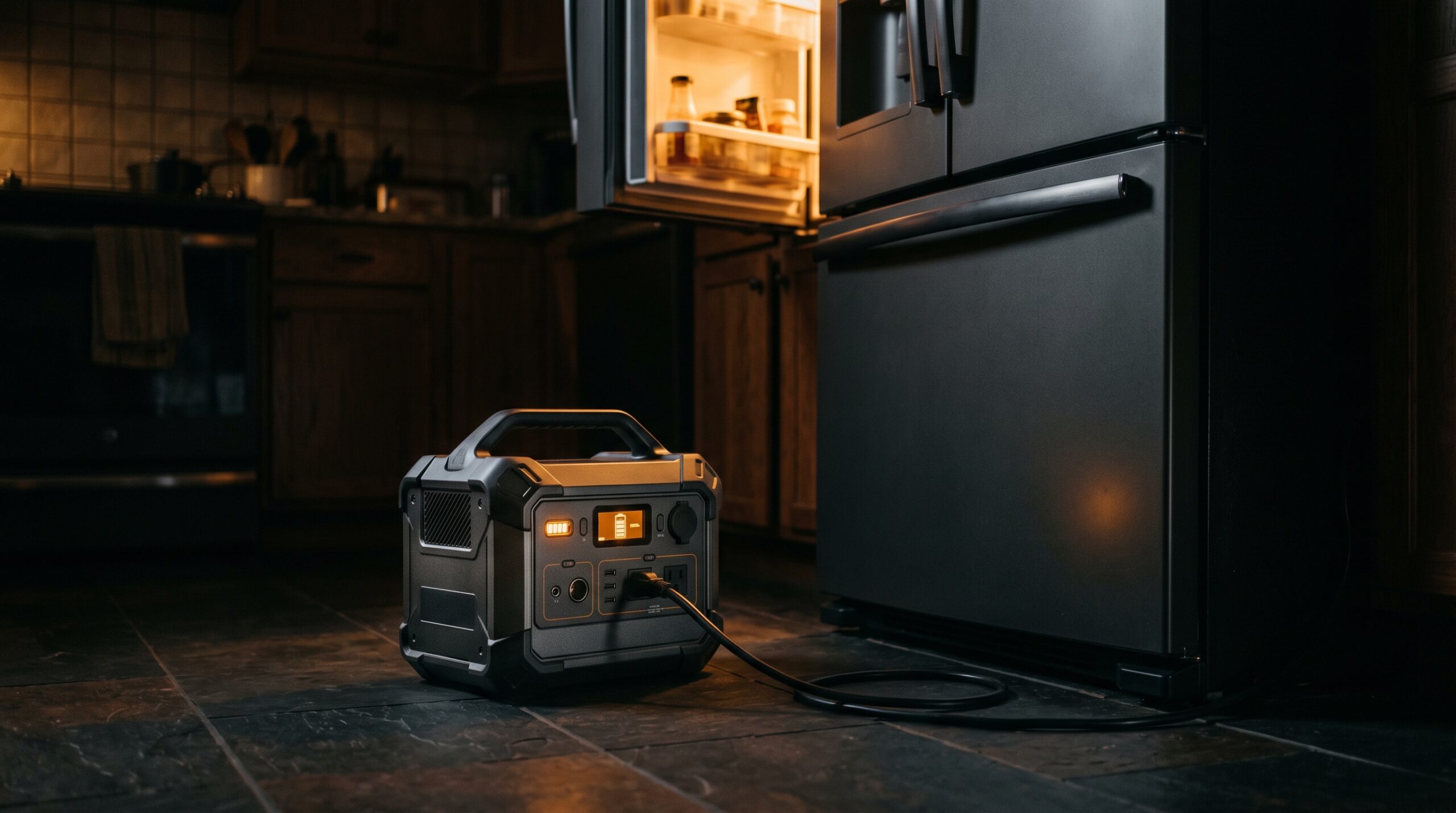
The right power station for a refrigerator has to do two things: survive the compressor’s startup surge (a brief spike of roughly 600–1,200 watts, well above the 100–200 watts the fridge draws while running) and hold enough watt-hours to cover your target hours, since a typical fridge pulls about 1,000–2,000 watt-hours over a full day. As a quick pick: a 1,000Wh LiFePO4 unit covers a short outage (roughly 10–18 hours), a 2,000Wh unit covers about a day, and a 2,000Wh unit paired with solar can keep the fridge cold for days. The rest of this guide maps real, current models to each runtime target.
What your refrigerator actually needs from a power station
A fridge is a deceptively simple load. Most of the time the compressor isn’t even running. It cycles on and off, so the running draw of a modern full-size refrigerator is only about 100–200 watts, and across 24 hours the average works out to roughly 1,000–2,000 watt-hours because the compressor is active only 30–50% of the time. That duty cycle is what makes a fairly small battery last surprisingly long.
The catch is the moment the compressor kicks on. For a fraction of a second it demands far more than its running wattage, often 600–1,200 watts and sometimes higher on older units. If the inverter can’t deliver that surge, it shuts off and the fridge never starts. So you’re sizing for two numbers at once: a peak output high enough to start the compressor, and enough capacity (watt-hours) to run it for the hours you care about. If those terms are fuzzy, our explainer on running watts vs. starting watts and the breakdown of how many watts a refrigerator uses are worth a quick read first.
Pick your station by runtime target
The cleanest way to choose is to decide how long you need the fridge to stay cold, then buy the capacity tier that matches. Here’s how the three common targets map to battery size.
- About 12 hours (short outage): A 1,000Wh-class LiFePO4 station is enough. It will start the compressor and carry a modern fridge through roughly 10–18 hours, which covers most run-of-the-mill blackouts.
- About 24 hours (overnight and then some): Step up to a 2,000Wh-class unit. It comfortably handles the surge and runs a typical fridge for roughly a day, sometimes longer if the fridge is efficient and the door stays shut.
- Multi-day (storm or extended outage): Pair a 2,000Wh-class station with solar panels. Sun during the day replaces the watt-hours the fridge drains, so the battery effectively resets each afternoon and the fridge can stay cold indefinitely.
To size it precisely for your own fridge instead of a generic estimate, run your numbers through our sizing calculator and then check the hours with the runtime calculator. Those two tools will tell you whether you’re on the 1,000Wh or 2,000Wh side of the line. For the deeper math on duty cycle and hours, see power station refrigerator runtime and our guide to what size power station to run a refrigerator.
Strong options that fit each tier
These are genuinely popular, current models from the four brands most people end up comparing. This is not a tested ranking, and we haven’t bench-tested any of them. Treat it as a shortlist of solid choices in each capacity tier, all of which use LiFePO4 cells (the chemistry you want for a battery that gets cycled often) and all of which have enough peak output to start a household refrigerator. Prices move constantly, so the figures below are ballpark street prices, not quotes.
| Model / class | Capacity | Continuous / peak output | Max solar input | Approx. price | Est. fridge runtime |
|---|---|---|---|---|---|
| EcoFlow Delta 2 (1kWh class) | 1,024 Wh | 1,800 W / 2,200 W boost | 500 W | ~$700–900 | ~10–18 hrs |
| Jackery Explorer 1000 v2 (1kWh class) | 1,070 Wh | 1,500 W / 3,000 W peak | 400 W | ~$600–800 | ~10–18 hrs |
| Anker SOLIX C1000 (1kWh class) | 1,024–1,056 Wh | 1,800–2,000 W / 2,400–3,000 W | 600 W | ~$700–900 | ~10–18 hrs |
| Bluetti AC180 (1kWh class) | 1,152 Wh | 1,800 W / 2,700 W lift | 500 W | ~$600–900 | ~12–20 hrs |
| EcoFlow Delta 2 Max (2kWh class) | 2,048 Wh | 2,400 W / 3,400 W surge | 1,000 W | ~$1,100–1,500 | ~20–36 hrs |
| Jackery Explorer 2000 Plus (2kWh class) | 2,042 Wh | 3,000 W / 6,000 W peak | 1,400 W | ~$1,000–1,400 | ~20–36 hrs |
Any of the 1,000Wh units will start and run a standard refrigerator. The 2,000Wh units do the same with more headroom and, importantly, far more solar input, which is what makes them the better pick if a multi-day outage is on your mind. If you want a wider field of options across price points, our roundups of the best power stations and the Jackery vs. EcoFlow vs. Bluetti comparison go broader.
Features that actually matter for a fridge
- Peak/surge output: Confirm the unit’s surge rating clears your fridge’s startup spike. Every model above does for a typical household fridge, but a second large appliance on the same station eats into that headroom.
- Capacity in watt-hours: This sets your hours. Match it to the runtime target above, not to the running wattage.
- LiFePO4 chemistry: For something you’ll cycle daily during an outage (and maybe top up for years), LiFePO4 lasts far longer than older lithium-ion. See LiFePO4 vs. lithium-ion for why.
- Pure sine wave inverter: A fridge compressor is a motor; it runs cleaner and cooler on pure sine wave power. All the models above are pure sine wave, but it’s worth verifying on any unit you consider.
- Solar input: The bigger the solar input ceiling, the faster you can replace what the fridge drains. This is the single feature that turns a one-day battery into a multi-day one.
If you want a full walkthrough of reading these numbers off a spec sheet, our guide on how to choose a power station covers the rest.
How to stretch your runtime during an outage
The single biggest lever is free: keep the door shut. Every time you open a refrigerator, warm air rushes in and the compressor has to run longer to recover, which drains the battery faster. A closed fridge holds its cold for hours on its own, so the station mostly tops up the loss rather than cooling from scratch.
- Open the door as little as possible, and decide what you need before you open it. Pair this with the basics in how to keep food cold without power.
- Turn off or unplug anything else on the station so all the watt-hours go to the fridge.
- Use the station’s eco or power-saving mode if it has one, so it isn’t burning idle watts.
- If the outage may run long, add solar early in the day rather than waiting until the battery is low.
It also helps to know how long your food is safe regardless of the battery; our note on how long food lasts in a fridge without power sets realistic expectations.
How to buy without overpaying
We don’t sell these and there are no affiliate links here, so a few honest pointers. Power station prices swing hard around sale events; the same unit that lists at $999 routinely drops to $700 during Black Friday, Prime Day, or seasonal promotions, so it’s worth waiting for a sale if your timeline allows. Buy the capacity tier your runtime target calls for rather than the biggest battery you can afford, since an oversized unit is heavier and pricier for hours you’ll rarely use. If a multi-day outage is realistic where you live, budget for panels at the same time and confirm the station’s solar input ceiling matches them. Check the warranty and cycle rating, and buy from the manufacturer or an authorized seller so the warranty actually holds.
Fridge-capable picks, live prices


Jackery Explorer 1000 v2
1,070Wh, 1,500W — light and simple for outages
$499.00Check price on Amazon →

As an Amazon Associate we earn from qualifying purchases. Prices are pulled automatically from Amazon and may have changed.
Frequently asked questions
What size power station do I need to run a refrigerator?
For most modern full-size fridges, a 1,000Wh LiFePO4 station with at least 1,500–1,800W continuous output is the practical minimum, and it will run the fridge for roughly 10–18 hours. Step up to 2,000Wh if you want a full day or more. Run your specific fridge through the sizing calculator to confirm the tier.
Will a power station handle the fridge’s startup surge?
It will if the unit’s peak or surge rating clears the compressor’s spike, which is usually 600–1,200 watts for a few seconds. Every model in the table above has peak output well above that, so the surge isn’t a problem for a single household fridge. The thing to watch is stacking a second big appliance on the same station, which cuts into the available headroom.
How long will a power station run a refrigerator?
Roughly capacity divided by the fridge’s average hourly draw, after inverter losses. A 1,000Wh unit lasts about 10–18 hours and a 2,000Wh unit about a day, because the compressor only runs part of the time. Keeping the door shut pushes you toward the high end. The runtime calculator gives you a number for your exact setup.
Do I need a pure sine wave power station for a fridge?
Yes, it’s strongly recommended. A compressor is a motor, and it runs cooler and more reliably on clean pure sine wave power than on a modified sine wave. All the stations listed here are pure sine wave; if you’re looking at something else, verify it before buying. Our pure sine vs. modified sine guide explains the difference.
Can solar panels keep my fridge running for days?
Yes, that’s the multi-day strategy. A fridge drains roughly 1,000–2,000 watt-hours a day, and a 2,000Wh station with 1,000W or more of solar input can usually replace that during daylight, so the battery resets each afternoon. The bigger the solar input ceiling, the more margin you have on cloudy days.