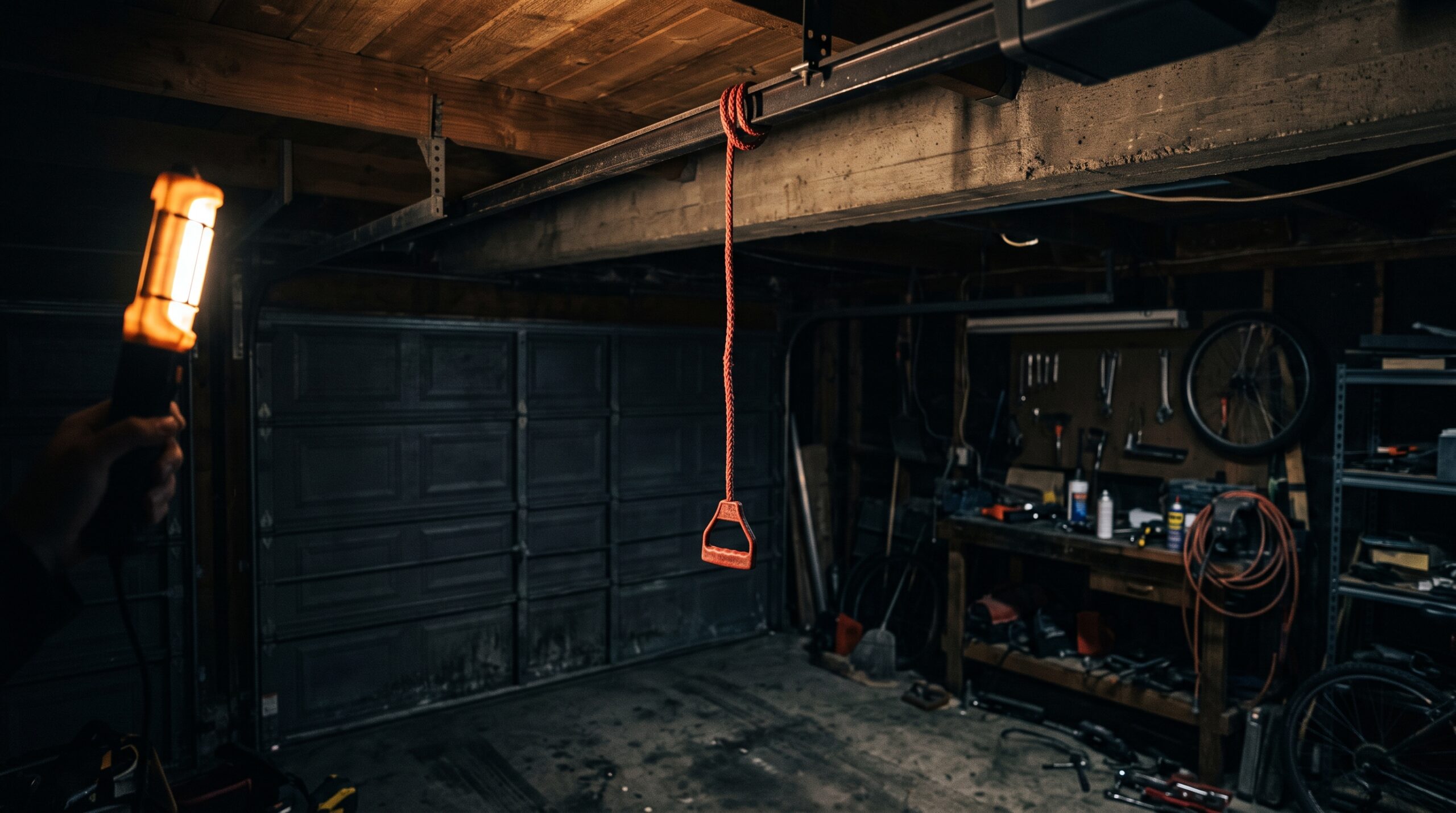
When the power goes out, your electric garage door opener stops too, because the motor has no electricity to run on, so the wall button and remote do nothing. The door itself is not locked, though. Use the manual release, the red cord hanging from the opener rail, to disengage the door from the motor so you can open it by hand. It takes a few seconds once you know where the cord is, and re-engaging the opener after power returns is just as quick. The one rule that matters most: only pull that cord when the door is fully closed.
⚠️ Only release the door when it is fully closed
Pull the manual release only with the door down. A closed door is held up almost entirely by its springs, and the opener carriage helps hold it in place. If you disconnect the opener while the door is open, or if a spring is broken or weak, the full weight of the door can slam shut and cause serious injury. If the door feels heavy, jams, or moves unevenly when you lift it, stop and call a professional.
Why the opener stops
A standard automatic garage door opener is a mains-powered electric motor. It plugs into a wall outlet, and that is its only source of power. When the grid goes down, the motor cannot run the wall button, the remotes, or the keypad, so the door will not move on its own.
The door is not jammed or locked. It is simply still connected to a motor that has nothing to drive it. To move the door, you need to separate it from the motor using the manual release, then lift it yourself. This is exactly what the red cord is for, and it is a normal part of owning an opener. Knowing where it is before an outage is part of preparing your home for a power outage so you are not searching for it in the dark.
How to use the manual release – step by step
The manual release is a cord with a red handle that hangs down from the trolley (the carriage that rides along the opener rail). Pulling it disconnects the door from the motor so the door can move freely by hand.
- Make sure the door is all the way down. Never pull the release with the door open or partway up. If it is open and you have power for a moment, lower it first; if not, leave it and wait until you can safely bring it down.
- Unplug the opener (if you safely can). Cutting power to the unit removes any chance of the motor engaging while you work. If power is already out, the unit is already dead.
- Release any manual lock or deadbolt. Some doors have a separate slide lock on the side. Disengage it so the door is free to move.
- Pull the red cord straight down. Pull until you hear a click. That click is the trolley disconnecting from the opener carriage. Pulling the handle toward the door (away from the motor) helps make sure it is fully released.
- Lift the door by hand using the handle or bottom edge. Lift with your legs, not your back, and keep your fingers clear of the panel seams. The door should feel balanced and stay where you leave it. If it is hard to lift, drops, or moves unevenly, stop. That points to a broken spring or cable, and the door needs a professional.
- To close it, lower the door by hand and re-secure any manual lock. A disconnected door is not locked by the opener, so use the manual lock if you want it secured while the power is out.
While the opener is disengaged you can raise and lower the door manually as many times as you need. If you are managing a longer outage, it helps to know what to do during a power outage so a stuck garage is one less thing to worry about.
Re-engaging the opener after power returns
Once the power is back, you reconnect the trolley to the opener so the remote and wall button work again. There are two common ways openers re-engage, and most models do it automatically the next time you run them.
- Put the door back in the closed position. Lower it by hand first.
- Pull the red cord back toward the door. On many openers this resets the release lever so it is ready to re-latch.
- Press the remote or wall button once. The trolley moves until it snaps back onto the carriage. You will usually hear it click into place.
- Test the door. Open and close it once with the remote to confirm it is reconnected and moving smoothly.
Steps vary slightly by brand, so check the sticker on your opener or the owner’s manual for your exact model if the trolley does not re-latch on the first try.
Battery-backup openers
Many newer openers include a built-in battery backup, which keeps the opener working through a short outage so you may not need the manual release at all. The door opens normally from the remote or wall button, drawing on the battery instead of the grid until power returns.
In California this is now the law. Under Senate Bill 969, since July 1, 2019 a residential automatic garage door opener that is manufactured for sale, sold, or installed in the state must include a battery backup function that is “operational without interruption during an electrical outage.” Violations carry a civil penalty of $1,000 per opener. The law was passed after wildfires in which people could not open their garage doors to escape during outages. It does not require homeowners to replace an existing opener, but any new or replacement unit sold in California has to include the feature.
A few practical notes on backup batteries:
- The battery is sized to run the door a limited number of times, not indefinitely. Use it to get in and out, not as a long-term power source.
- Backup batteries wear out. Chamberlain notes a backup battery typically lasts about one to two years with normal use, and most openers show a light or beep when the battery needs replacing.
- Even with battery backup, learn where your manual release is. The battery can be dead or depleted exactly when you need it.
Can you power an opener with a battery station?
Yes, in most cases a portable power station can run a garage door opener, as long as the station can handle the motor’s brief startup surge. A garage door opener is a motor, so it draws a short spike of power the instant it starts moving, then settles to a lower running draw.
Most residential openers draw roughly 350 to 600 watts while running, but the startup surge when the motor kicks in can briefly exceed 1,000 watts, and it runs higher on heavy-duty chain or screw-drive units. The running watts are modest; it is the surge you need to size for. As a conservative rule of thumb, a station rated for around 1,500 watts of surge (or more) handles a typical opener comfortably. Always check your opener’s label and your power station’s surge rating before relying on it.
| What to check | Typical figure | Why it matters |
|---|---|---|
| Running power | ~350–600 W | Low and brief; easy for most stations to sustain. |
| Startup surge | Can exceed 1,000 W | The momentary spike your station must be able to deliver. |
| Suggested station surge rating | ~1,500 W or higher | Headroom so the opener starts cleanly without tripping the station. |
| Outlet type | Standard 120 V AC | Most openers plug into a normal wall outlet near the unit. |
Practically, a power station big enough to start the opener has far more than enough stored energy for the few seconds the door actually runs. Because the door cycles in seconds, energy use per open/close is tiny. The deciding factor is almost always the surge rating, not the battery size. For most outages, the manual release is faster and simpler than dragging out a power station; the station makes more sense if you are already running it for other gear and want the opener on it too.
Size your backup power
If you are planning backup power for the opener alongside other essentials, match the station to both the startup surge and everything else you want to run. Use our Power-Station Sizing calculator to find a station with enough surge headroom for a motor like a garage door opener, and the Appliance Runtime calculator to estimate how long a given station will keep your other essentials going during an outage.
Frequently asked questions
Where is the garage door manual release cord?
It is the cord with a red handle that hangs down from the trolley on the opener rail, usually somewhere between the motor unit and the door. On most doors it sits a few feet inside the garage. Find it in daylight before an outage so you are not hunting for it in the dark.
Is it safe to pull the red release cord?
It is safe when the door is fully closed. Pulling it with the door open, or when a spring is broken, can let the door drop with its full weight and cause serious injury. Only release a closed door, keep clear of the panel, and stop if the door feels heavy or off-balance when you lift it.
How do I reconnect the opener after the power comes back?
Lower the door so it is closed, pull the red cord back toward the door to reset the release lever, then press the remote or wall button once. The trolley moves until it clicks back onto the carriage. Open and close the door once to confirm it is reconnected. Check your opener’s manual if it does not re-latch.
Will a battery-backup opener still work in a power outage?
Yes, as long as the backup battery is charged. The opener runs on the battery during a short outage, so the door works normally from the remote or wall button. Backup batteries are sized for a limited number of cycles and last roughly one to two years, so replace them when the opener signals a low battery, and still learn where the manual release is.
Can I run my garage door opener from a portable power station?
Usually yes. Most openers run on about 350 to 600 watts but spike above 1,000 watts at startup, so choose a station with enough surge capacity, around 1,500 watts or more, as a safe target. Check your opener’s label and your station’s surge rating first. For a quick in-and-out, the manual release is simpler than setting up a power station.
Sources
- California Legislature, Senate Bill 969 (2018), Automatic garage door openers: backup batteries. leginfo.legislature.ca.gov
- Chamberlain Group, California SB 969 FAQs. support.chamberlaingroup.com
- Overhead Door, How to Open a Garage Door Manually. overheaddoorcompanyofhuntsville.com
- Overhead Door, When to Use and Not Use the Garage Door Emergency Release. overheaddoorcompanyofhuntsville.com
- EcoFlow, How Many Watts Is a Garage Door Opener? ecoflow.com
- Ready.gov, Power Outages. ready.gov