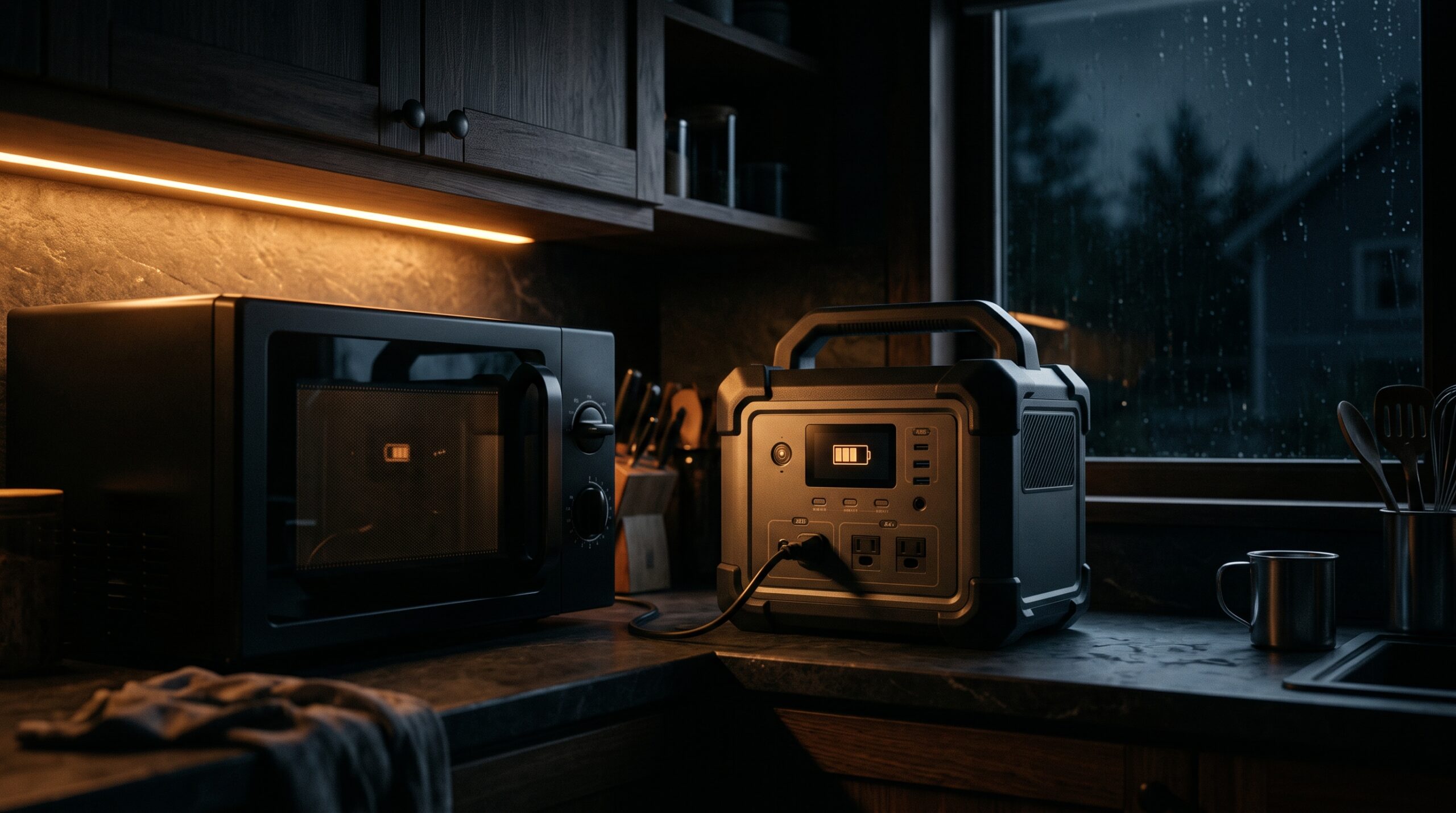
Yes, a power station can run a microwave, as long as its output rating clears the oven’s real wall draw of about 1,200 to 1,700 watts, and what you get is many short uses rather than continuous running. A microwave only runs in bursts of one to five minutes, so the energy per use is small, but the instantaneous pull is high. The catch is almost never the battery size. It is whether the inverter can deliver that draw without tripping.
The number on the front of the oven is cooking power, not the load on your station. A microwave sold as “1,000W” is rated for how much heat it puts into the food, and the magnetron is only around 60 to 70 percent efficient, so the wall draw is much higher. Across a study of 203 countertop models, the average “1,000W” microwave actually pulled 1,402 watts of input power. Treat the rated figure as the smaller number, and size your station to the bigger one.
How much a microwave really draws
The cooking watts printed on the door describe output. The figure that matters for breakers, extension cords, and power stations is input watts, which is what the oven pulls from the outlet while running. Two real spec sheets show the gap clearly: a Toshiba EM131A5C-SS rated at 1,100W cooking output draws 1,550W input, and a Farberware FMO11AHTBKB rated at 1,000W output draws 1,500W input. As a rough rule, a 1,000W to 1,100W microwave pulls somewhere around 1,500 to 1,550 watts while it cooks.
Smaller compact ovens draw less, often 1,000 to 1,200 watts of input, while full-size 1,200W models can climb past 1,700. This is the same trap behind a lot of appliance surprises, and it is worth understanding the difference between running versus starting watts before you trust any label. The cooking number tells you how fast your food heats. The input number tells you whether your station can keep up.
The output your station needs
Output is the load ceiling, the most a station can deliver at any instant before the inverter overloads. To run a microwave continuously, that ceiling has to sit comfortably above the oven’s real input draw. A 1,000W microwave pulling 1,500W input needs a station rated above 1,500W continuous, which is why a 1,000W-class unit usually cannot do the job and a 2,000W-class unit can. If you are mapping appliances generally, our breakdown of what a 2,000W station runs is a useful reference point for where a microwave lands.
Some stations stretch this with a boost mode. EcoFlow’s DELTA 2 is rated 1,800W continuous but can drive resistive loads up to 2,200W through its X-Boost feature, and a Jackery Explorer 1000 lists 1,000W continuous with a 2,000W surge ceiling. Boost helps a marginal microwave start, but for steady cooking you still want headroom in the continuous number, not just the peak. By contrast, a strict 1,000W inverter will refuse most full-size ovens outright, which is the same reason our list of what a 1,000W station runs leaves microwaves off.
How many minutes of use per charge
Capacity in watt-hours decides total cooking time, not whether the oven runs. A reasonable estimate is battery capacity times about 0.85 for inverter losses, divided by the microwave’s input watts. A 1,500W microwave on a 1,000Wh station works out to roughly 1,000 times 0.85 divided by 1,500, or about 34 minutes of actual cooking. On a 2,000Wh station that doubles to around 68 minutes.
Put that next to how a microwave is really used. A cup of coffee is 90 seconds, a frozen meal is 4 to 5 minutes, leftovers are 2 to 3. So 34 minutes of cooking is not “half an hour and done,” it is something like ten to twenty separate uses, and twice that on a larger battery. The high draw is real, but the energy each use costs you is small.
| Microwave size (rated cooking W) | Real wall draw (input W) | Min. station output | Approx. minutes of use on ~1,000–2,000Wh |
|---|---|---|---|
| Compact, ~700W | ~1,000–1,200 W | ~1,500 W | ~40–50 min / ~80–100 min |
| Mid, ~900–1,000W | ~1,400–1,500 W | ~1,800 W | ~30–35 min / ~65–70 min |
| Full-size, ~1,100–1,200W | ~1,550–1,700 W | ~2,000 W | Won’t start on most 1,000W units / ~55–65 min |
The surge to watch
A microwave is not a motor, so it does not have a giant startup spike the way a fridge compressor does. But it does have a brief inrush as the high-voltage transformer energizes and the filter capacitor charges, which can push the instantaneous demand above the steady running draw for a fraction of a second. A common guideline is to pick a station whose continuous rating is at least 1.5 times the microwave’s running watts, which builds in margin for that moment.
The bigger surge risk is stacking. If a fridge compressor kicks on, or a kettle is already drawing, while the microwave starts, the combined instantaneous load can trip the inverter even though the microwave alone would be fine. On a power station you usually only have one oven running anyway, but if you are sharing the unit with other loads during an outage, give the microwave its own headroom and avoid starting two heavy appliances at the same moment.
The smarter option for cooking
A microwave is one of the more battery-friendly ways to heat food, precisely because it works in short bursts. Reheating a plate for three minutes might cost 60 to 80 watt-hours, a tiny slice of a 1,000Wh battery. The expensive habit is anything that runs hot for a long time. A toaster oven or an electric kettle held on for ten or fifteen minutes will burn through far more of your reserve than a few microwave cycles ever will.
So the smart play during an outage is to lean on quick high-power bursts and skip sustained heating. Microwave, don’t slow-cook. Boil only what you need. And keep the station’s output rating, not just its size, in mind when you shop, because a big battery wired to a small inverter still will not run the oven at all.
Size it for your own microwave
Numbers here are ranges, not guarantees, because your exact draw depends on the model. Find the input watts on the back-panel label or in the manual, then run it through the tools below. The Appliance Runtime calculator turns your battery’s watt-hours and the oven’s input draw into real minutes of cooking, and the Power-Station Sizing calculator checks whether a given station’s output clears the load before you buy.
Sizes whose inverter handles a microwave


As an Amazon Associate we earn from qualifying purchases. Prices are pulled automatically from Amazon and may have changed.
FAQ
Can a 1,000W power station run a microwave?
Usually not a full-size one. A typical “1,000W” microwave pulls around 1,500 watts from the wall, which is above a 1,000W inverter’s continuous ceiling. A boost mode might start a compact oven briefly, but for reliable cooking you want a station rated above the oven’s real input draw, which generally means a 2,000W-class unit.
How long will a 2,000Wh power station run a microwave?
For a microwave drawing about 1,500 watts input, expect roughly 65 to 70 minutes of total cooking time from a full 2,000Wh battery, after inverter losses. Since each use is only a minute or two, that is many separate meals, not one long run. A higher-draw 1,700W oven trims that toward 55 minutes.
Why does my 1,000W microwave need so much more than 1,000 watts?
Because the 1,000W rating is cooking output, not electrical input. The magnetron is only around 60 to 70 percent efficient, so the oven draws roughly 1,400 to 1,550 watts from the outlet to deliver 1,000 watts into your food. Always size a power station to the input figure, not the number on the door.
Does a microwave have a big startup surge like a fridge?
No. A microwave has no large motor, so its startup spike is small and brief, just the transformer inrush and capacitor charge. The real overload risk is stacking it with another heavy load, like a fridge compressor or kettle starting at the same instant. As a margin, pick a station rated at least 1.5 times the oven’s running watts.
Is a microwave an efficient way to cook on battery power?
Yes, relatively, because it heats in short bursts. A three-minute reheat costs only about 60 to 80 watt-hours, a small fraction of a 1,000Wh battery. What drains a station is sustained heat, so a toaster oven or kettle held on for many minutes will cost far more than a few microwave cycles.
Sources
- EcoCostSavings, microwave wattage study of 203 countertop models (1,000W average input 1,402.7W; ~71% efficiency)
- UDPOWER, common microwave wattages and station sizing (Toshiba and Farberware input examples)
- EcoFlow, DELTA 2 specifications (1,800W continuous, 2,200W with X-Boost)
- Jackery, can a power station run a microwave (runtime formula and model output ratings)
- Ampace, how many amps and surge watts a microwave uses