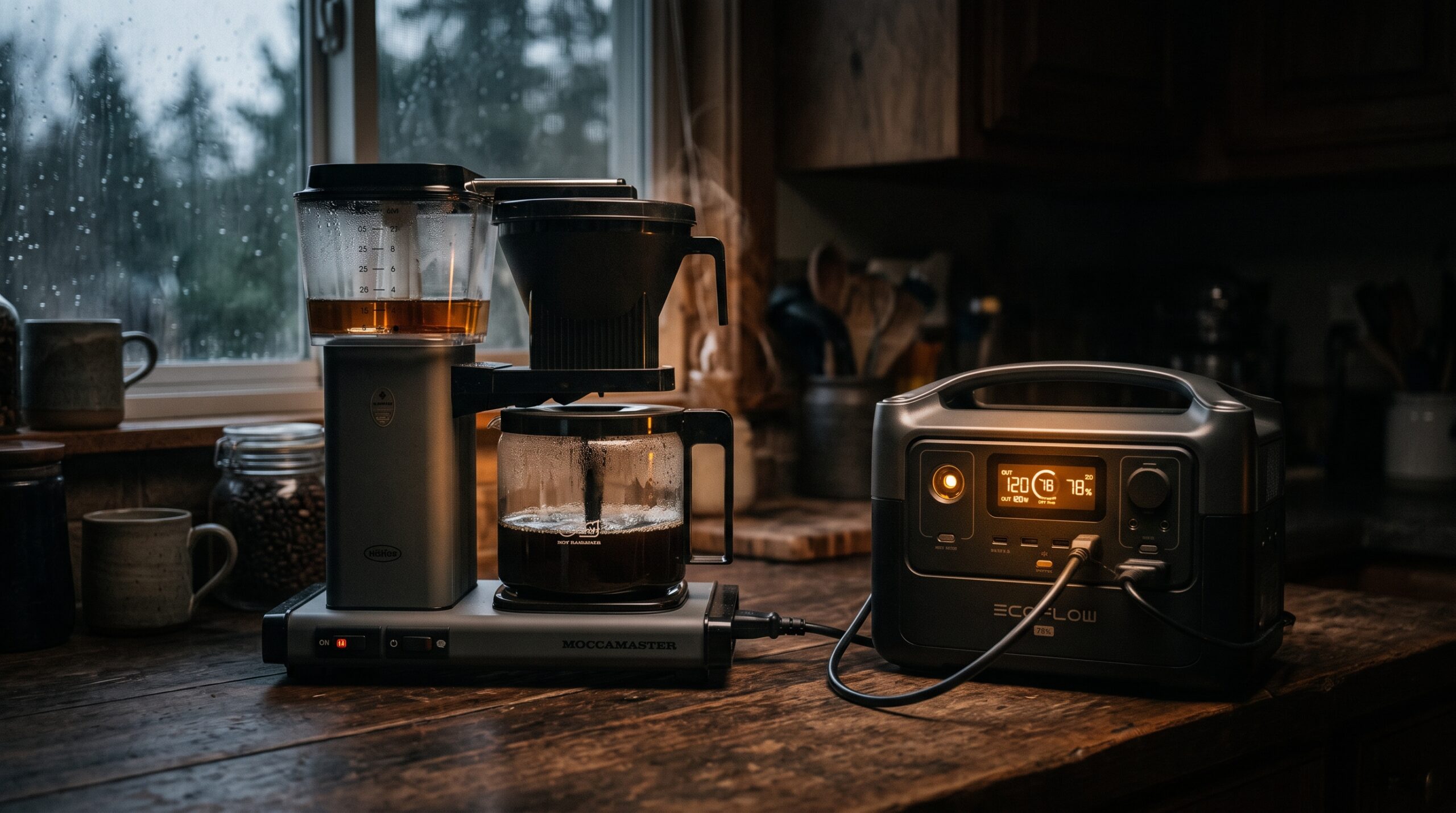
The honest answer is that you should count pots, not hours. A drip coffee maker pulls a lot of power while it heats water, but only for a few minutes, so one pot burns through roughly 100 to 200 watt-hours. That means a 1,000Wh power station can usually brew five or six pots before it needs a recharge, as long as its inverter is big enough to handle the spike in the first place.
The short answer: think in pots, not running hours
People ask how many hours a power station will run a coffee maker, but that framing is misleading. You don’t leave a coffee maker brewing for an hour. The brew cycle lasts five to ten minutes, and then the machine is either off or sitting on a low-power warming plate. So the question that actually matters is how many brews you can get out of a charge.
Energy per brew is small. Heating the water for a full 10- to 12-cup pot takes somewhere around 150 watt-hours. A smaller pot uses less. The warming plate adds a little more if you leave it on, but the brew itself is the main cost, and it’s modest. The catch is the rate at which that energy gets pulled, which is where the inverter comes in.
Why coffee makers spike high but sip energy
A coffee maker is basically a small water heater. To get water to brewing temperature fast, it runs a heating element hard, which is why a drip machine draws roughly 600 to 1,200 watts during the brew. Once the coffee is in the carafe, the warming plate takes over and sips around 50 to 100 watts to keep it hot.
That split is the whole story. A high number on the spec label (watts) tells you what the inverter has to survive for a few minutes. The energy you actually drain from the battery (watt-hours) is what’s left after that short burst, and it’s small because the burst is short. If the terms watts versus watt-hours are fuzzy, our explainer on what a watt-hour is sorts it out.
- Brewing (5–10 min): ~600–1,200W for a drip maker, higher for pod and espresso machines.
- Warming plate (optional): ~50–100W to hold the pot hot.
- Energy per pot: roughly 100–200Wh, depending on pot size and how long the plate stays on.
How many pots your power station can brew
The table below estimates brews per charge for a typical drip maker. It assumes about 150Wh per full pot and a 10 to 15 percent loss running through the inverter, which is normal. Smaller pots and single cups stretch these numbers further.
| Power station capacity | Full pots per charge* | Warming-plate hours per charge** |
|---|---|---|
| 250–300Wh (small) | 1–2 | ~3 |
| 500Wh | 2–3 | ~5–6 |
| 1,000Wh | 5–6 | ~11 |
| 1,500Wh | 8–9 | ~17 |
| 2,000Wh | 11–13 | ~22 |
| 3,000Wh | 16–18 | ~33 |
One thing the table hides: each hour you leave the warming plate on costs about as much as a whole extra brew. If you keep the plate running between cups, your “pots per charge” number drops fast. The fix is further down.
Want numbers for your exact machine and battery? Plug the wattage and capacity into our runtime calculator instead of eyeballing it.
The real test: can your station even start the maker?
This is where small power stations fail. A 250 to 300Wh unit often ships with a 300W inverter. A 1,200W drip maker will trip it the instant the heating element kicks on, and you’ll get an overload error instead of coffee. The battery has plenty of energy for a pot or two; the inverter just can’t deliver the power.
Match the inverter’s continuous rating to the maker’s running watts, with headroom for the startup surge. A heating element doesn’t surge the way a motor does, but it still wants to pull its full draw immediately. Our breakdown of running watts versus starting watts covers why that momentary peak matters more than the average. As a rough rule, you want an inverter rated comfortably above your maker’s brewing wattage:
- Drip maker (~600–1,200W): a 1,000W inverter is borderline for big models; 1,500W is comfortable.
- Keurig / single-serve pod (~900–1,500W): plan for a 1,500W inverter or larger.
- Home espresso machine (~1,000–1,800W): you’ll likely need a 2,000W inverter.
Keurig, espresso, and single-serve machines
Pod machines look efficient because they brew one cup, but they spike hard. Most Keurig models pull 1,100 to 1,500 watts while heating, and some, like the K-Café, climb higher. The upside is the burst is brief: a single cup heats in well under a minute, so the energy per cup is tiny, often under 30Wh. The downside is that high peak draw, which is what overwhelms a small inverter.
Espresso machines are the most demanding of the group. Home units commonly draw 1,000 to 1,800 watts, and they often reheat between shots, so the inverter has to take repeated hits. A pod or espresso setup is fine on a large power station; on a small one, it may not start at all. If a coffee maker is part of your wider outage cooking plan, our guide on how to cook without power puts it in context with other appliances. A coffee maker also makes a useful sanity check before tackling a higher-draw load like a microwave on a power station.
Stretch your runtime: brew into a thermos
The single best trick during an outage is to brew, then pour the pot straight into an insulated thermos or carafe and switch the maker off. The warming plate is the quiet drain here. Skipping it can save 50 to 100 watts for every hour you’d otherwise leave the pot sitting on the burner, and over a morning that adds up to a full extra brew or two.
- Brew the full pot in one go, then turn the machine off at the switch.
- Pour into a pre-warmed thermos so the coffee stays hot on its own.
- For a single cup, a manual pour-over or French press skips the electric heater entirely and only needs hot water.
- Heating water on a camp stove and using a pour-over draws zero battery if you want to save the station for other loads.
Sizes whose inverter handles the spike


As an Amazon Associate we earn from qualifying purchases. Prices are pulled automatically from Amazon and may have changed.
Frequently asked questions
Will a small power station run a coffee maker?
Often no, and the reason is the inverter, not the battery. A 250 to 300Wh station with a 300W inverter can’t supply the 600 to 1,200 watts a drip maker pulls while heating, so it overloads before any coffee brews. You need a unit whose continuous inverter rating clears your maker’s brewing wattage with room to spare.
How many watt-hours does one pot of coffee use?
Roughly 100 to 200 watt-hours for a full 10- to 12-cup pot, most of it spent heating the water during the brew cycle. Smaller pots use less. Leaving the warming plate on afterward adds about 50 to 100 watt-hours per hour.
Does a Keurig use more power than a drip maker?
It pulls a higher peak, usually 1,100 to 1,500 watts, but for a much shorter time. So a single Keurig cup uses less total energy than a full drip pot, while demanding a beefier inverter to handle that brief spike.
Can I run a coffee maker and other appliances at the same time?
Only if the combined draw stays under the inverter’s continuous rating. A coffee maker brewing at 1,000-plus watts can use most of a mid-size station’s output by itself, so it’s safer to brew first, then switch to your fridge, lights, or devices once the cycle finishes.
Does a pure sine wave inverter matter for a coffee maker?
For a basic drip maker, a modified sine wave inverter usually works because the heating element isn’t picky. Machines with electronic controls, displays, or programmable timers run more reliably on a pure sine wave output, which most modern power stations already provide.