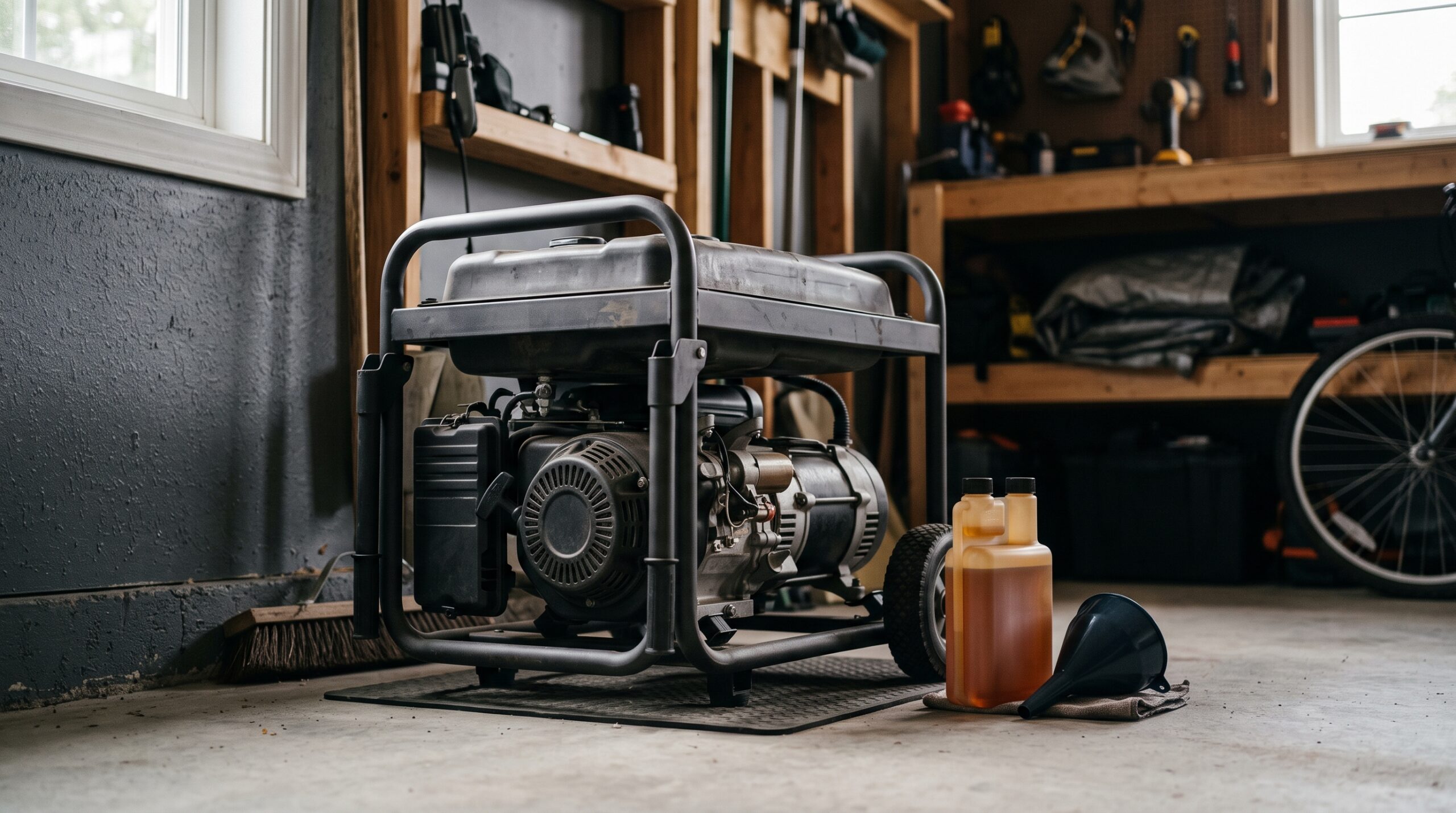
A generator that won’t start when the power goes out almost always has one problem: stale gas. Ethanol-blended pump gasoline starts to break down in about 30 days, and the gummy residue it leaves behind clogs the carburetor. So the single most important storage move is to deal with the fuel before you walk away from the machine: either treat it with a stabilizer and run it through the carburetor, or drain the fuel system completely. Everything else here matters, but the fuel is what separates a generator that fires on the first pull from one that just clicks.
The fuel problem (this is 90% of it)
Most pump gasoline in the US contains up to 10% ethanol (E10). Ethanol pulls moisture out of the air and the gas begins to oxidize, and within roughly a month it can start to varnish and form gum deposits. Those deposits collect in the carburetor’s tiny fuel passages and float bowl. Honda is blunt about this in its fuel guidance: stabilizer extends storage life but “will not reconstitute stale fuel,” so the time to act is before storage, not after. You have two legitimate options, and which one you pick depends on how long the generator will sit.
Option 1: stabilize and run it through
Add a fuel stabilizer to fresh gas, then run the engine for about 10 minutes so the treated fuel reaches the carburetor. This is the convenient route and it works well for shorter gaps between outages. Briggs & Stratton’s storage guidance says to add stabilizer to clean fuel and run the generator a few minutes to circulate it through the fuel system. Honda’s manuals call for stabilized fuel plus draining the carburetor bowl for storage from two months up to a year. Important: stabilizer only protects fuel that’s already fresh. It can’t rescue gas that already smells like varnish.
Option 2: drain the fuel system
For longer storage, or any time the engine runs on ethanol fuel, the foolproof method is to empty the tank and run the carburetor dry. Briggs & Stratton specifically advises that if you don’t use stabilizer, or if the fuel contains alcohol, you should remove all the fuel from the tank and run the engine until it stops from lack of fuel. Many generators also have a carburetor drain screw you can loosen to empty the float bowl. Let the engine cool before you handle fuel, and drain gasoline into an approved container, never down a drain.
If your generator is already hard to start because it sat with old gas in it, that’s a carburetor problem, not a storage decision. Our generator won’t start troubleshooting guide walks through the gummed-carburetor checks step by step.
Oil, spark plug, and the battery
Fuel gets most of the attention, but a few other items keep a stored generator healthy.
- Change the oil while the engine is warm. Used oil holds combustion acids and moisture that can corrode internal parts over a long sit. Briggs & Stratton recommends changing the oil (and filter, if equipped) before storage, while the engine is still warm so it drains cleanly. Check your owner’s manual for the correct viscosity and capacity.
- Check the spark plug. Pull it, look at the electrode, and replace it if it’s fouled or worn. A worn plug is a common reason an otherwise healthy engine cranks but won’t catch. A common rule of thumb is to replace small-engine plugs around every 100 hours of run time.
- Keep the electric-start battery charged. If your generator has electric start, the small 12V battery will self-discharge over months of storage and may be dead when you need it. Honda recommends an automatic charger/maintainer (a “battery tender”) that you can leave connected and that tops the battery up as needed. A discharged starter battery is a frustrating way to lose an electric start during an outage.
- Don’t forget the air filter. A quick look at the air filter before storage (and again before the season) is cheap insurance. A clogged filter makes hard starting worse.
Where to store it: clean, dry, covered
Pick a clean, dry, covered spot out of direct weather: a shed, garage corner, or covered porch works. Let the engine cool fully before covering it. A breathable cover or a tarp that doesn’t trap condensation keeps dust and moisture off without sweating the metal. Store it level so oil and any residual fuel stay where they belong.
One hard rule that has nothing to do with starting and everything to do with safety: never run or refuel a generator indoors. Portable generators produce carbon monoxide, an invisible, odorless gas that can build to lethal levels in minutes. The CPSC warns never to operate a generator inside a home, garage, basement, or shed, even with doors and windows open. Storing it in the garage is fine. Starting it in there to “exercise” it is not. Always run it outdoors, well away from doors, windows, and vents. For the full safe-operation rundown, see how to use a generator safely.
Run it periodically (the monthly exercise)
A generator that sits untouched for a year is far more likely to fail than one that runs occasionally. Honda’s own guidance notes that if you operate the generator less than once a month, you should drain the carburetor for storage, because that’s the threshold where fuel problems start. The practical takeaway: run your generator roughly once a month for 15 to 30 minutes. This circulates fuel and oil, keeps seals from drying out, and charges the electric-start battery. Running it under a light load (a few work lights, a fan) is better than no-load idling, and it doubles as a test that the unit actually works before you stake an outage on it.
If you have a stabilizer in the tank, a monthly run keeps everything fresh. If you drained the system for long-term storage, you don’t need to start it dry every month, just verify the fuel is fresh and re-prep it before the storm season. Generators that burn through fuel quickly may need more frequent fill-ups during an actual outage, which is worth planning for: see how much gas a generator uses.
Short-term vs long-term storage checklist
Use the shorter routine between outages in storm season, and the full routine when the generator is going to sit through the off-season.
| Step | Short-term (under ~1 month) | Long-term (months / off-season) |
|---|---|---|
| Fuel | Keep fresh gas, add stabilizer, run 10 min to circulate | Drain tank + carburetor, OR fully stabilize and drain the float bowl |
| Oil | Check level | Change oil (and filter) while warm |
| Spark plug | Leave it | Inspect, replace if fouled/worn |
| Battery (electric start) | Top up monthly | Connect a battery maintainer |
| Exercise run | Run ~monthly, 15-30 min | Re-prep with fresh fuel before season |
| Location | Clean, dry, covered | Clean, dry, covered; cover the unit |
Before you store / before you restart
Before you store:
- Handle the fuel: stabilize and run through, or drain the tank and carburetor.
- Change the oil while the engine is warm (for long-term storage).
- Check the spark plug and air filter.
- Connect a battery maintainer if it has electric start.
- Let it cool, wipe it down, and cover it in a dry spot.
Before you restart:
- Check the oil level (and that you actually refilled it after an oil change).
- Add fresh fuel if you drained it, or confirm the stored fuel still smells like gas, not varnish.
- Confirm the battery is charged and the spark plug is seated.
- Move it outdoors, well away from the house, before you start it.
- Let it run a few minutes and test it under load before you rely on it.
Storing the fuel itself, safely
If you keep spare gas for the generator, store it the way the CPSC and fire-safety guidance recommends, because gasoline vapor is the real hazard, not the liquid.
- Use approved containers only. Store gasoline only in containers built and listed for it (look for ASTM or UL compliance), never in milk jugs, glass, or random plastic.
- Keep it away from living space and ignition sources. The CPSC says to store fuel containers in a cool, well-ventilated area away from the house, never near a furnace, water heater, stove, pilot light, or any open flame.
- Limit how much you keep on hand. Store only what you’ll reasonably use; many local fire codes cap household gasoline storage (often around 25 gallons in approved containers). Rotate it so it doesn’t go stale, and add stabilizer if you keep it for months.
- Refuel a cool engine, outdoors. Never add gas to a hot or running generator; spilled fuel on a hot muffler can ignite.
If the fuel and storage hassle is part of why you’re rethinking your setup, it’s worth comparing a gas generator against a battery unit that needs none of this seasonal prep, in generator or power station. A dual-fuel generator can also sidestep some of the stale-gas problem by running on propane, which stores for years without degrading.
Frequently asked questions
Can I leave gas in my generator between outages?
Only if it’s treated. Untreated ethanol gas starts degrading in about 30 days. If you want to leave fuel in the tank, add a stabilizer to fresh gas and run the engine for about 10 minutes so the treated fuel reaches the carburetor. For storage beyond a couple of months, most manufacturers recommend also draining the carburetor float bowl or emptying the system entirely.
How long does fuel stabilizer keep gas usable?
Stabilizer products commonly claim to keep fuel fresh for up to one to two years when added to fresh gas. The key word is fresh: stabilizer slows degradation, it can’t reverse it. If the gas already smells sour or like old varnish, no additive will fix it, so drain it and start over with new fuel.
Should I drain the fuel or use stabilizer?
For short gaps (a few weeks), stabilizer plus a run-through is fine. For long-term or off-season storage, or any time you’re using ethanol fuel, draining the tank and running the carburetor dry is the most reliable, as Briggs & Stratton recommends. Draining removes the one thing that gums up carburetors, so there’s nothing left to varnish.
How often should I run a stored generator?
About once a month for 15 to 30 minutes, ideally under a light load. This keeps fuel and oil circulating, prevents seals from drying, and charges the electric-start battery, and it confirms the unit works before an outage. Always run it outdoors, never in a garage or shed, because of carbon monoxide.
Why won’t my generator start after sitting all season?
The usual culprit is stale fuel that has gummed up the carburetor, sometimes combined with a fouled spark plug or a dead electric-start battery. That’s exactly what proper storage prevents. If you’re staring at one that won’t fire right now, work through our generator won’t start troubleshooting guide.
Sources
- Honda Power Equipment — Fuel Recommendations & Storage Tips for Generators
- Briggs & Stratton — Generator Maintenance Tips to Prepare for Winter / Storage
- Generac Support — When Storing My Portable Generator, at What Point Should the Gasoline Be Drained?
- U.S. Consumer Product Safety Commission — Fuel Container and Gasoline Safety
- U.S. Consumer Product Safety Commission — Carbon Monoxide Fact Sheet