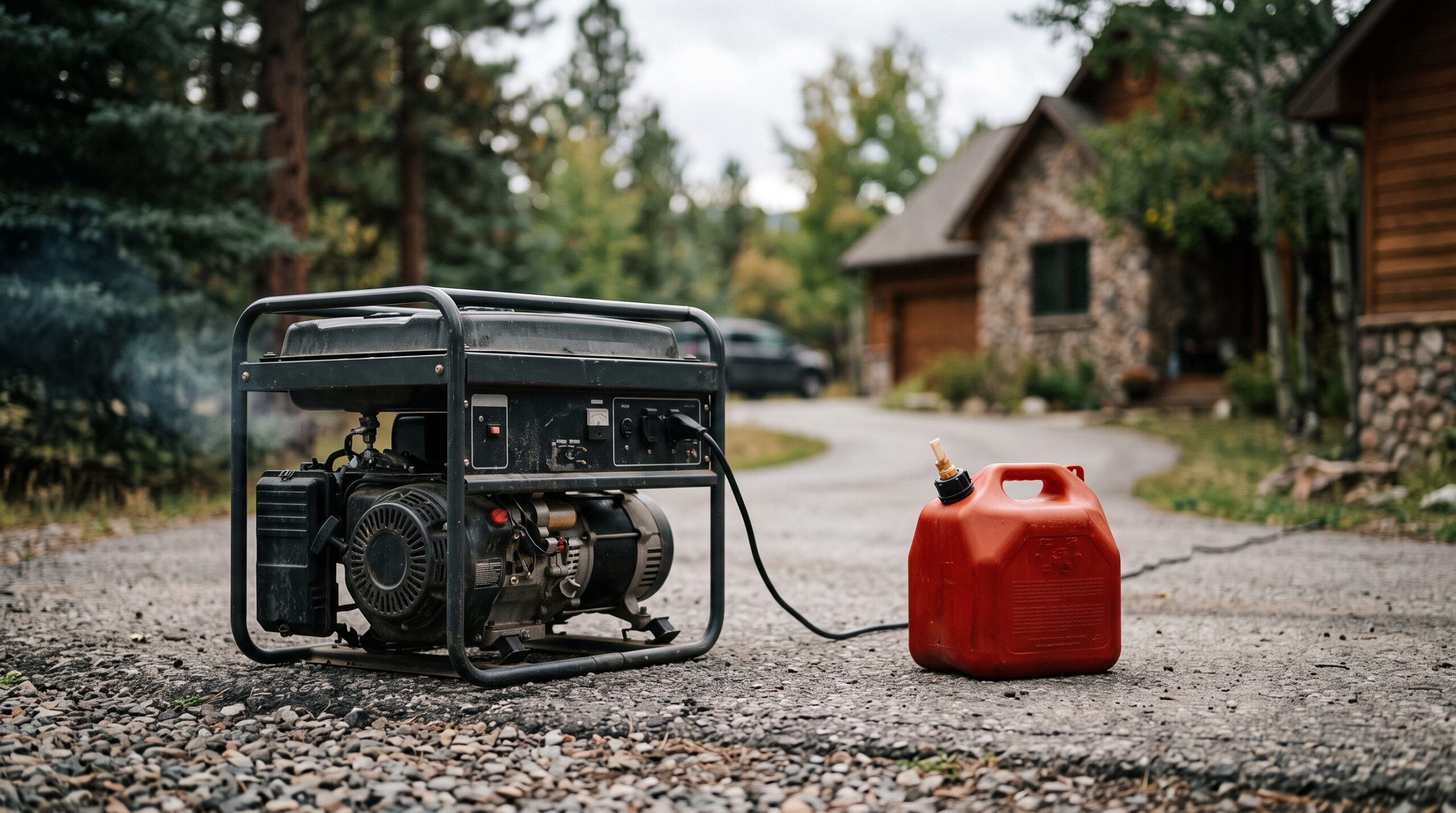
A typical portable generator running at about half load uses roughly 0.5 to 0.75 gallons of gas per hour, which works out to about 8 to 12 hours on a full 5 to 6 gallon tank. Smaller inverter generators sip far less; large units burn more. Fuel use rises with the generator’s size and how hard you load it.
Below is how to estimate your own fuel use, how long a tank really lasts, and how to store fuel safely so you do not run dry mid-outage.
⚠️ Refuel safely, run outdoors only
Run a generator outdoors only, at least 20 feet from windows, doors, and vents, with a CO alarm. Turn the generator off and let it cool before refueling, and store fuel in approved containers away from living spaces and any ignition source.
What affects how much fuel a generator uses
Two things drive fuel use: the generator’s size and how much of its capacity you are actually using. A bigger engine burns more, and a generator working near its limit burns far more than the same unit running a light load. Inverter generators help here, because they adjust engine speed to match the load instead of running flat out, which can cut fuel use a lot at low loads.
Fuel use and runtime by generator size
These are rough planning figures at about half load. Your real numbers depend on your exact model, the load, eco mode, and conditions. Always check your owner’s manual for the rated runtime.
| Generator size | Approx. gas per hour (half load) | Runtime per tank |
|---|---|---|
| Small inverter (1,000–2,000 W) | About 0.1–0.3 gal | Often 8–12+ hours on a small tank, more in eco mode |
| Mid-size portable (3,500–5,000 W) | About 0.4–0.6 gal | About 8–12 hours |
| Large portable (7,000–9,000 W) | About 0.7–1.0 gal | About 8–10 hours |
| Very large (10,000 W+) | About 1.0–1.5+ gal | Varies; bigger tanks offset the higher burn |
How to estimate your own fuel needs
Start with the runtime your manual lists at a given load, then multiply by how many hours of outage you want to cover. A unit that runs 10 hours per tank needs about 2.5 tanks for a full day. For a multi-day outage, that adds up fast, so plan your fuel storage around the longest outage you realistically expect, and run only what you need to stretch each tank.
Not sure how much power you actually need to run, which sets your load and therefore your fuel use? Add it up with the Power-Station Sizing calculator, or see how long backup power lasts for a given device with the Appliance Runtime calculator.
Storing fuel safely
- Keep gasoline in approved, sealed containers, outside your living space and away from heat or ignition sources.
- Gasoline goes stale; use a fuel stabilizer for storage and rotate your supply.
- Store only what local rules allow, and never store fuel near the running generator.
- A dual-fuel generator lets you run on propane, which stores much longer than gasoline.
Propane vs gasoline
Propane burns a little less efficiently per unit of energy, so a generator may run slightly shorter on a tank of propane than on gasoline, but propane stores for years without going bad and burns cleaner. Many people keep a dual-fuel generator on propane for that reason. For sizing the generator itself, see what size generator you need, and always follow safe operation in how to use a generator safely.
Frequently asked questions
How much gas does a generator use per hour?
A mid-size portable at about half load uses roughly 0.4 to 0.6 gallons per hour. Small inverter generators use far less, and large units use more.
How long will a generator run on a full tank?
Most portable generators run about 8 to 12 hours on a full tank at half load. Eco or inverter modes can extend that when the load is light.
How can I make a generator use less fuel?
Run only essential loads, use eco or inverter mode, and avoid running near the generator’s limit. Lower load means lower fuel use.
How much gas should I store for an outage?
Estimate your runtime per tank, then multiply by the hours you want to cover. Store only what local rules allow, in approved containers, with stabilizer, and rotate it.
Does a bigger generator always use more gas?
Generally yes at the same load, but fuel use depends most on how hard you load it. A large generator running a light load can be inefficient compared with a right-sized one.