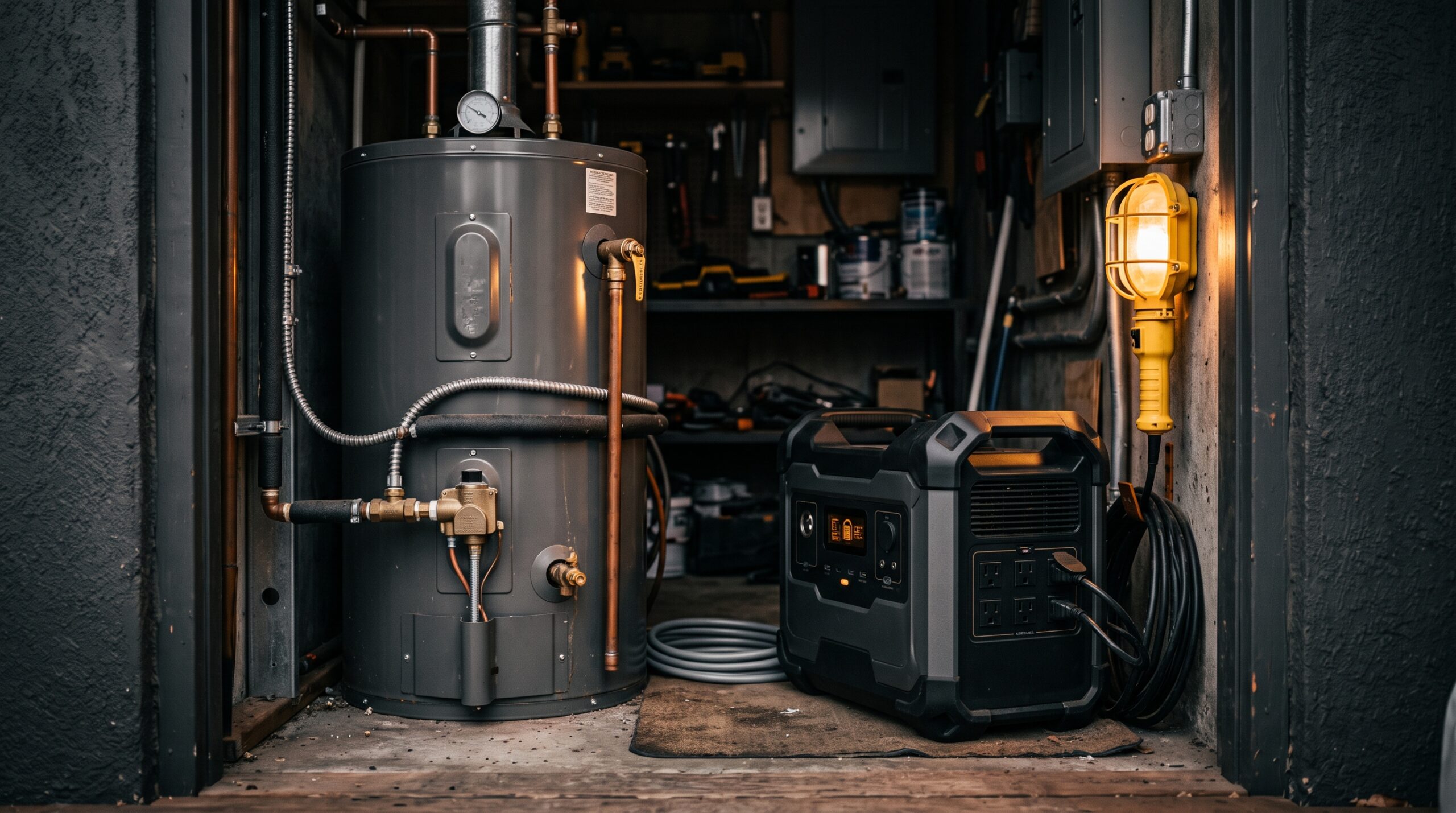
It depends entirely on the type of water heater. A standard electric tank water heater pulls about 4,500 watts on a 240-volt circuit, which is well beyond what a portable power station can deliver, and an electric tankless unit is far worse. A gas water heater is a different story: many models need little or no electricity, and during an outage a basic gas tank often keeps making hot water with no power at all.
The answer hinges on electric vs gas
People ask this question hoping for a yes/no, but there isn’t one number. “Water heater” covers at least four different appliances with wildly different power needs. An electric model does all of its heating with electricity, so it needs thousands of watts. A gas model does the heating with a gas flame, so the only electricity it might use is for ignition or a vent fan, which is a tiny fraction of the load. Before you size anything, find out which kind you have.
Here is how the common types compare.
| Water heater type | Typical electrical need | Can a portable power station run it? |
|---|---|---|
| Electric tank (standard) | ~4,500 W on 240 V | No |
| Electric tankless (whole-home) | ~18,000–36,000 W on 240 V | No |
| Gas tank, standing pilot | 0 W (no electricity) | Not needed — works during an outage on its own |
| Gas tank, electronic ignition | A few watts for the control board | Usually keeps running on its own; trivial draw |
| Gas tank, power-vent | ~100–300 W (120 V blower) | Yes |
| Gas tankless | ~100–150 W startup, 60–100 W running (120 V) | Yes |
Electric tank water heaters: out of reach
A typical residential electric tank heater uses a heating element rated between 3,500 and 5,500 watts, with 4,500 watts on 240 volts being the most common setup. At 4,500 watts and 240 volts that element draws about 18.75 amps, which is why these units sit on a dedicated 30-amp, double-pole breaker.
Two things put this out of reach for almost every portable power station:
- The wattage. Most portable stations top out at 2,000 to 3,600 watts of continuous AC output. A 4,500-watt element exceeds that on its own.
- The voltage. Electric tank heaters run on 240 volts. The vast majority of portable power stations only put out 120 volts from their standard outlets, so they can’t feed a 240-volt appliance at all. A few large units offer a 240-volt output, but you still hit the wattage wall.
This is the same wall you hit with other heavy 240-volt loads. If you want the longer version of that math, see whether a power station can run a dryer.
Electric tankless: even further out
If a tank heater is out of reach, a whole-home electric tankless heater is in another universe. These units heat water instantly instead of storing it, so they draw enormous power while running. Whole-home electric tankless models commonly need somewhere between 18,000 and 36,000 watts on 240 volts. At 36,000 watts that’s 150 amps, which is why many homes need a 200-amp service panel just to support one.
No portable power station comes close. Don’t even size for it. If your home runs on electric tankless and you want hot water during an outage, you’re looking at a large standby generator or a whole-home battery, not a portable unit.
Gas tank water heaters: often need little or no power
This is where the question flips. A gas tank water heater heats with a gas burner, so it doesn’t pull thousands of watts. What it needs from electricity depends on how it lights the burner.
- Standing pilot: a small flame burns continuously and lights the main burner on demand. The thermocouple it generates runs the gas valve, so the unit needs zero household electricity. During a power outage, a standing-pilot gas heater keeps making hot water as long as the gas keeps flowing. You don’t need a power station for it.
- Electronic ignition: a spark or hot-surface igniter lights the burner, controlled by a small electronic board. This uses only a few watts, but it does need power, so the unit may not relight during an outage. Many run off an internal battery or thermopile and keep working; others stop until power returns.
So for a gas tank heater, the realistic outage answer is usually “it keeps working on its own,” and if it does need a few watts, almost any power station can supply that.
Power-vent gas models: a power station can handle the blower
One gas variant does depend on electricity: the power-vent model. Instead of venting exhaust naturally up a flue, it uses an electric blower to push exhaust out through a side wall. No power means no blower, and the heater won’t fire as a safety measure.
The good news is that the blower is a small 120-volt load, generally in the 100 to 300 watt range. That is squarely inside what a portable power station can run. A similar story applies to gas tankless heaters, which use roughly 100 to 150 watts at startup and 60 to 100 watts while running for their controls and fan. Both of these are easy targets for a mid-size station.
One caution: a blower motor can spike when it first starts, drawing more than its running wattage for a moment. Make sure your station’s surge rating covers it, not just its continuous rating. The difference between those two numbers trips up a lot of people, so it’s worth understanding running watts vs starting watts before you buy.
How to figure out what yours needs
Don’t guess. Check the rating plate on the side of the tank, which lists voltage and either wattage (electric) or input. A few quick checks:
- If the label shows 240 V and a wattage in the thousands, it’s electric. Plan around the appliance staying off during an outage.
- If the heater connects to a gas line and only has a thin 120-volt cord (or no cord at all), it’s gas. Figure out whether it’s standing pilot, electronic ignition, or power-vent.
- If there’s a fan or blower on top and a 120-volt plug, it’s a power-vent gas model, and a power station can run that blower.
For the gas loads a power station can run, plug the numbers into our sizing calculator to match a unit to the blower or control load, and read how to choose a power station if you’re starting from scratch. To see what a typical mid-size unit covers beyond hot water, this breakdown of what a 2000W power station can run is a useful reality check.
Anything involving the 240-volt wiring on an electric water heater is not a DIY power-station project. That work needs a licensed electrician.
What electric water heating takes, live prices


As an Amazon Associate we earn from qualifying purchases. Prices are pulled automatically from Amazon and may have changed.
Frequently asked questions
Can any portable power station run an electric water heater?
No. A standard electric tank heater needs about 4,500 watts on a 240-volt circuit, and most portable stations only put out 120 volts at far lower wattage. Even large 240-volt-capable stations run into the wattage limit. Electric tankless units, at 18,000 watts and up, are not remotely feasible.
Will my gas water heater work during a power outage?
A gas tank heater with a standing pilot light keeps working with no electricity, as long as the gas supply is on. A model with electronic ignition may keep running on an internal battery or thermopile, or it may stop until power returns. A power-vent model needs electricity for its blower and won’t fire without it.
How many watts does a power-vent gas water heater use?
Only the blower and controls use power, generally around 100 to 300 watts on 120 volts. That’s an easy load for most portable power stations. Just confirm the unit can handle the brief surge when the blower motor starts.
Why does voltage matter so much here?
Electric water heaters run on 240 volts, while most portable power station outlets are 120 volts. You can’t simply plug a 240-volt appliance into a 120-volt outlet, regardless of wattage. The gas heater loads a power station can run, blowers and control boards, all run on standard 120 volts.
What’s a better way to have hot water during an outage?
If you have a gas tank heater, you likely already have it covered without any backup power. If you rely on an electric heater, hot water during an outage means a large standby generator or a whole-home battery system, not a portable station. In a pinch, heating water on a gas or propane stove is the simplest fallback.
Sources
- Jackery — How Many Amps Does a Water Heater & Tankless Water Heater Use
- LearnMetrics — How Many Amps Does a Tankless Water Heater Use
- A. O. Smith — Does a Gas Tankless Water Heater Need Electricity?
- Logan Services — Does a Gas Water Heater Need Electricity?
- Corro-Protec — Does a Gas Water Heater Need Electricity?