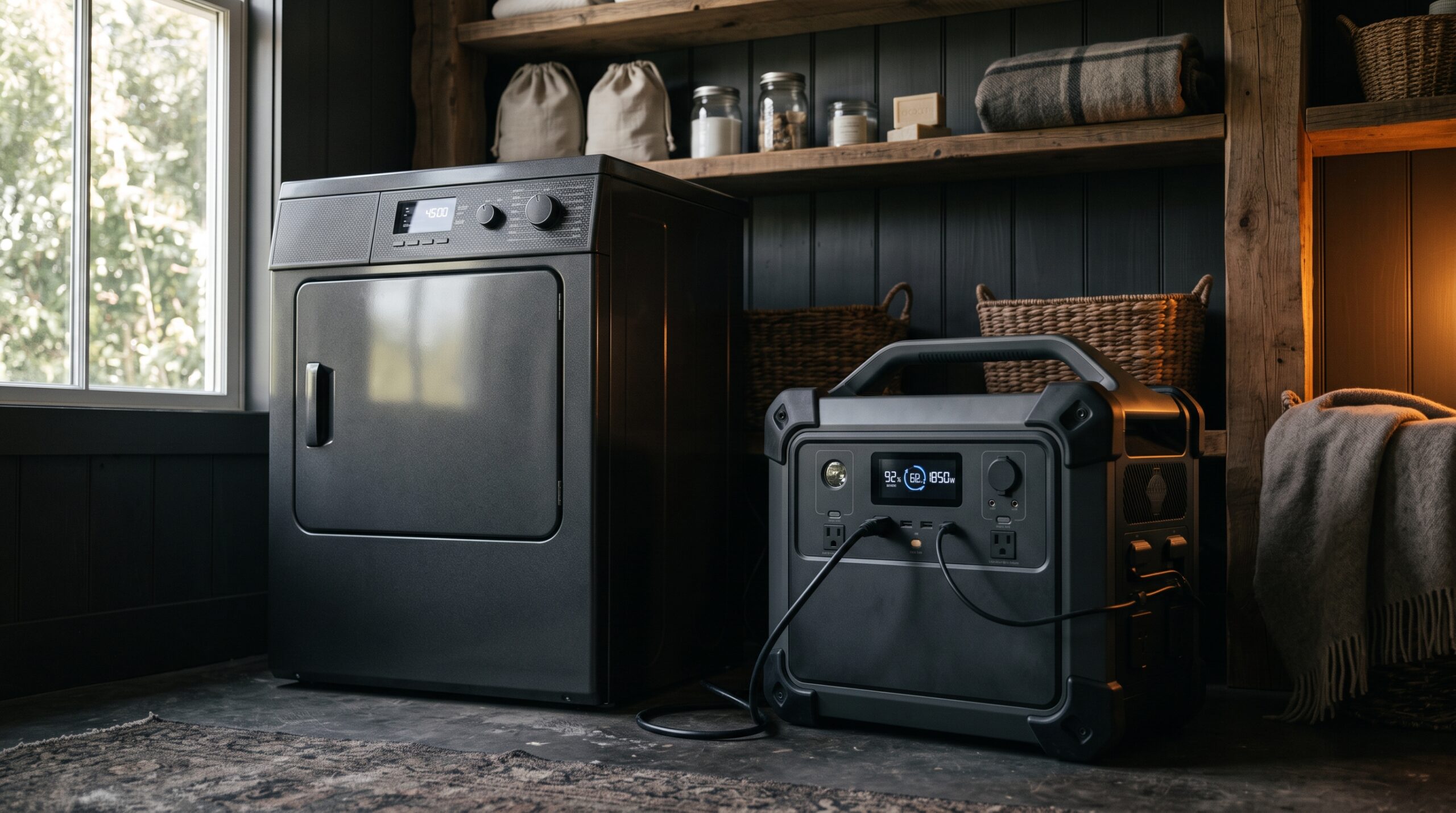
Can a power station run a dryer? It depends entirely on the type of dryer. An electric dryer heats with a 240-volt element and pulls roughly 3,000 to 5,400 watts on a dedicated 30-amp circuit, which is more than almost any portable power station can deliver, so the honest answer there is usually no. A gas dryer is a different story: the gas burner does the heating, and only the drum motor, controls, and igniter run on about 300 to 700 watts at 120 volts, which a mid-size or large power station can often handle.
The short answer: electric vs gas
Before you plan anything, find out which kind of dryer you own. Look at the plug and the outlet behind it. A large three- or four-prong plug going into a 240-volt outlet means an electric dryer. A standard household plug in a normal 120-volt outlet, plus a gas line running to the back, means a gas dryer.
- Electric dryer: Generally no. It needs 240 volts and 30 amps. Only the largest power stations paired with a 240-volt accessory kit can do it, and even then runtime is short.
- Gas dryer: Often yes. It only needs 120 volts and a few hundred watts for the motor and electronics, which many 1,000W-and-up stations can supply.
- Compact 120V electric dryer: Maybe. These plug into a normal outlet but still draw around 850 to 1,500 watts of heat, so you need one of the bigger stations.
Why an electric dryer is too much for most power stations
A standard full-size electric dryer makes heat with an electric element, and that element is hungry. Most pull between 21 and 25 amps on a 240-volt circuit, which works out to roughly 5,000 to 6,000 watts while heating. That is why the dryer gets its own 30-amp breaker and a special 240-volt outlet instead of sharing a normal wall socket.
Most portable power stations output 120 volts, the same as a regular wall outlet, and top out somewhere between 1,800 and 3,600 watts of continuous AC. Even a 3,600W unit cannot reach the 240 volts an electric dryer demands, so the dryer simply will not run. Trying to force it through an adapter does not help, because the heating element is built for double the voltage. If you are still mapping out which loads are realistic, our guide on what a 2,000W power station can run shows where the ceiling sits for everyday appliances.
How much power a gas dryer actually uses
A gas dryer burns natural gas or propane to make heat, so electricity is only doing the light work: turning the drum, running the blower fan, sparking the igniter, and powering the control board. Add it up and most gas dryers draw about 300 to 700 watts at 120 volts while running, with the drum motor being the single biggest piece.
There is one catch worth planning for: the motor needs a brief surge of power to start spinning. That startup spike can hit roughly 600 to 700 watts for a moment before settling back down. This is the difference between running watts and starting watts, and it is the number that trips up undersized gear. It is worth understanding the gap between running watts and starting watts before you commit to a station, because the spec sheet rating has to clear the surge, not just the steady draw.
Dryer power needs at a glance
Here is how the three common dryer types compare, and whether a typical portable power station can keep up.
| Dryer type | Typical running watts | Voltage / circuit | Can a portable power station run it? |
|---|---|---|---|
| Full-size electric dryer | ~3,000–5,400W | 240V / 30A | No for 120V units. Only a dual-unit 240V kit (e.g. two EcoFlow Delta Pro + a voltage hub) |
| Gas dryer | ~300–700W | 120V / standard outlet | Often yes. Many 1,000W-and-up stations handle it, surge included |
| Compact 120V electric dryer | ~850–1,500W | 120V / standard outlet | Maybe. Needs a larger 1,800–3,600W station |
Wattage varies by model, so always check the label on the back of your own dryer or the spec sheet before you buy a power station around it. You can plug your real numbers into our power station sizing calculator to see what capacity actually covers the load plus runtime.
Which power stations can run a dryer
For a gas dryer, a power station rated around 1,000 watts or more of continuous AC, with a surge rating that clears 700 watts, is a sensible starting point. A pure sine wave output is best, since the motor and electronics prefer clean power. Battery capacity then decides runtime: a load of a few hundred watts drains a 1,000Wh station fairly slowly, so a single full cycle is usually realistic.
For a full-size electric dryer, a normal portable unit will not work, full stop. The only consumer option is a heavy-duty 240-volt setup, such as two EcoFlow Delta Pro units joined by a Double Voltage Hub, which together deliver 240 volts and up to 7,200 watts. That is enough to start the dryer, but with limited battery capacity you get a short window rather than a laundry day. The same 240-volt wall applies to other big heaters like an electric water heater. To weigh continuous wattage, surge, capacity, and 240-volt support together, walk through how to choose a power station before spending money.
Air-drying and smarter alternatives during an outage
During a power outage, running a dryer off a battery is rarely the best use of stored energy. A dryer is a heavy, time-consuming load, and the same battery would keep a fridge, lights, phones, and a CPAP going for far longer. A few practical options:
- Air-dry instead. A drying rack or clothesline costs nothing in power and clears a backlog within a day, especially in warm or breezy weather.
- Spin first, then hang. If your washer can run on the power station, an extra spin cycle wrings out most of the water so clothes dry far faster on a rack.
- Wait for grid power. Laundry is rarely an emergency. Saving the dryer for when the lights come back keeps your battery for the loads that matter.
- Size for essentials first. Plan your power station around the fridge, medical gear, and communications, and treat the dryer as a bonus only a large unit can offer.
Sizes for a gas dryer motor, live prices


As an Amazon Associate we earn from qualifying purchases. Prices are pulled automatically from Amazon and may have changed.
Frequently asked questions
Can a 2,000W power station run an electric dryer?
No. A full-size electric dryer needs 240 volts, and a 2,000W power station outputs 120 volts. The voltage mismatch means the dryer will not run at all, regardless of the wattage rating. A 2,000W unit can comfortably run a gas dryer, though.
What size power station do I need for a gas dryer?
Look for at least 1,000 watts of continuous output, a surge rating above 700 watts, and pure sine wave AC. Most gas dryers draw 300 to 700 watts while running, so a station in this class handles the load with room for the brief startup spike.
Can the EcoFlow Delta Pro run a 240V electric dryer?
A single Delta Pro outputs 120 volts and cannot. Two Delta Pro units linked with EcoFlow’s Double Voltage Hub deliver 240 volts and up to 7,200 watts, which can start a typical electric dryer. Battery capacity still limits how long it runs, so expect a partial cycle rather than unlimited laundry.
Do I need an electrician to run a 240V dryer from a power station?
If you want to power a hardwired or outlet-based 240-volt dryer through any kind of transfer or hub setup, yes. The 240-volt wiring, outlets, and any panel connection should be handled by a licensed electrician. Plugging a load directly into a 240-volt kit’s own outlet follows the manufacturer’s instructions, but anything touching house wiring is electrician territory.
Is it worth running a dryer off a battery at all?
For most people, no. A dryer is one of the heaviest household loads, and the same stored energy keeps essentials like a refrigerator and medical devices running far longer. Air-drying during an outage is usually the smarter call, and saves your battery for what truly needs it.