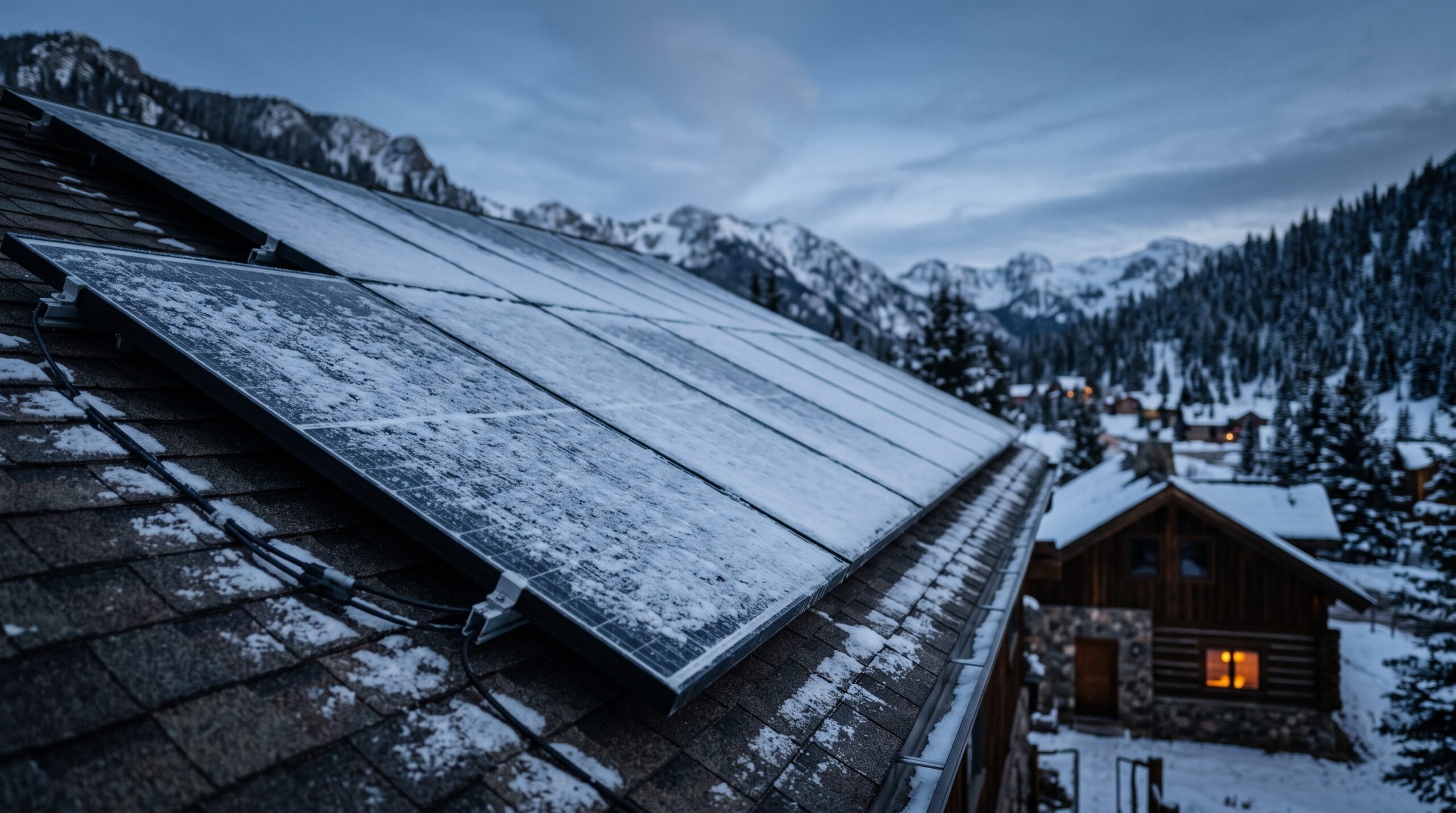
Yes, solar panels work in winter, and on a clear cold day each panel can actually produce a little more power per hour of sun than it does in summer heat, because panels run more efficiently when they are cold. The catch is that winter days are short and the sun sits low, so you collect fewer hours of strong light overall, which means less total energy per day. And anytime snow covers the glass, production stops until the snow slides off or you clear it.
Yes, and cold weather actually helps each panel
This surprises people, but solar panels are tested and rated at 77°F (25°C), and they get slightly more efficient as the cell temperature drops below that. Heat is what hurts them. Every crystalline silicon panel has a temperature coefficient of roughly -0.3% to -0.5% per °C, meaning it loses about a third to half a percent of its output for every degree the cell runs above 77°F, and gains it back as the cell cools. On a bright, freezing day, a panel can briefly run a few percent above its rated wattage.
So the panel itself is not the weak link in winter. A clear January afternoon can be one of the most efficient operating windows of the year for the glass and silicon. The reason your daily total still drops has nothing to do with the cold and everything to do with how much sun reaches the panel in the first place.
Peak sun hours: why winter still gives you less
The number that actually decides daily output is peak sun hours — the equivalent number of hours per day that the sun shines at full strength (1,000 watts per square meter, the same intensity panels are rated against). Five peak sun hours does not mean five hours of daylight; it means the day’s total sunlight added up to five hours at full noon intensity.
Winter cuts that number two ways: the days are shorter, and the sun stays low in the sky, so its light passes through more atmosphere and hits the panel at a shallow angle. NREL’s PVWatts modeling shows that across much of the United States, a system collects only about 50% to 70% as much energy in December as it does in June. The further north you are, the bigger the swing.
| June | December | |
|---|---|---|
| Daylight and sun angle | Long days, high sun | Short days, low sun |
| Typical peak sun hours/day (northern U.S.) | ~5–6 | ~2–3 |
| Panel temperature | Warm (slight loss) | Cold (slight gain) |
| Daily energy collected | Year’s peak | Often ~50–70% of summer |
Numbers vary a lot by location. A sunny southern state still sees solid winter production; a cloudy northern one drops further. If you want figures for your own setup, our solar calculator estimates output and charge times based on panel size and sun hours.
Snow: the one thing that really stops production
Cold is fine. A thick layer of snow on the glass is not. If snow fully covers a panel, almost no light reaches the cells and output drops to roughly zero until the snow clears. The good news is that panels usually shed snow on their own: the glass is smooth and dark, it absorbs a little warmth and melts the bottom layer, and a tilted panel lets the rest slide off. The steeper the tilt, the faster it sheds.
Over a full year, snow is a smaller loss than most people expect. Field studies in northern states put annual snow losses at only a few percent of total production for well-tilted arrays, though heavy-snow regions and flat-mounted panels lose more. There is even a small upside: fresh snow on the ground reflects extra light onto the panels, which can nudge output up once the glass is clear.
If you do clear snow yourself, use a soft snow rake or brush made for panels and work from the ground. Never climb onto a snowy, sloped roof, and never use anything metal or abrasive that can scratch the glass. For portable panels, you can simply wipe them off and re-aim them.
Cloudy days still produce, just less
Winter brings more overcast skies, and clouds matter too. Panels run on daylight, not direct beams, so they keep working under clouds, but output falls. Light haze or thin cloud might trim output modestly, while a heavy, dark overcast can cut it to a small fraction of a clear day. You will see this as slow, uneven charging rather than a full stop. Plan for it by not counting on a single short, gray day to fully top off a battery.
Charging a power station with solar in winter
For outage planning, this is the part that matters: in winter, expect a solar generator or power station to charge slower than the spec sheet suggests — not because the panel is weaker, but because there are fewer good sun hours to work with. A panel rated to refill a battery in, say, 6 hours of strong summer sun might need a full short winter day, or even two, to do the same job.
A few practical moves to plan around that:
- Size for the worst month. Base your plan on December sun hours, not summer ones, so the system still covers you when days are shortest. See how many solar panels it takes to recharge a power station.
- Start early and keep it in the sun all day. With so few peak hours, every bit of midday light counts. Our guide on how long it takes to charge a power station with solar walks through the math.
- Use a portable panel you can re-aim. Portable panels are easy to tilt toward the low winter sun and move out of shade. See our picks for the best portable solar panels.
- Know how your system works. If solar charging during an outage is new to you, how a solar generator works covers the panel, battery, and inverter together.
How to get the most from winter solar
- Aim at the low sun. A steeper winter tilt (roughly your latitude plus 15 degrees, or just propping a portable panel up more vertically) catches the low sun better and also helps snow slide off.
- Clear snow promptly. A covered panel makes nothing, so brush it off from the ground when you safely can.
- Keep the glass clean. Winter brings road grime and dust; a clean panel makes the most of the short day.
- Avoid shade. Long winter shadows from trees and buildings reach further than in summer. Reposition portable panels through the day if you can.
- Set realistic expectations. Treat winter as your low season, charge whenever the sun is out, and don’t wait for a single day to refill a big battery.
Frequently asked questions
Do solar panels work better in cold weather?
Per hour of sunlight, yes. Panels are more efficient when cold and lose efficiency as they heat up, so a clear, freezing day can briefly push a panel slightly above its rated output. The reason winter totals are still lower is fewer sun hours, not the temperature.
How much less power do panels make in winter?
It depends on location, but across much of the U.S. a system produces roughly 50% to 70% as much energy in December as in June. Northern and cloudier areas see a larger drop; sunny southern states stay closer to their summer numbers.
Do I need to clear snow off my panels?
Often not. Tilted panels usually shed snow on their own as the dark glass warms and the snow slides off. If a heavy layer lingers, clear it from the ground with a soft snow rake — never climb onto a snowy roof, and never scrape the glass with anything hard.
Will solar still charge my power station on a cloudy winter day?
Yes, but slowly. Panels still work under clouds, just at reduced output, so expect partial, uneven charging. On a short, dark, overcast day, plan on a top-up rather than a full recharge, and finish the job when the sun returns.
Is it worth having solar for winter outages?
It can be, as long as you size it for winter sun and treat it as a recharge source rather than instant power. Pairing panels with a power station gives you a way to keep refilling a battery during a multi-day outage, which beats relying on a single charge.