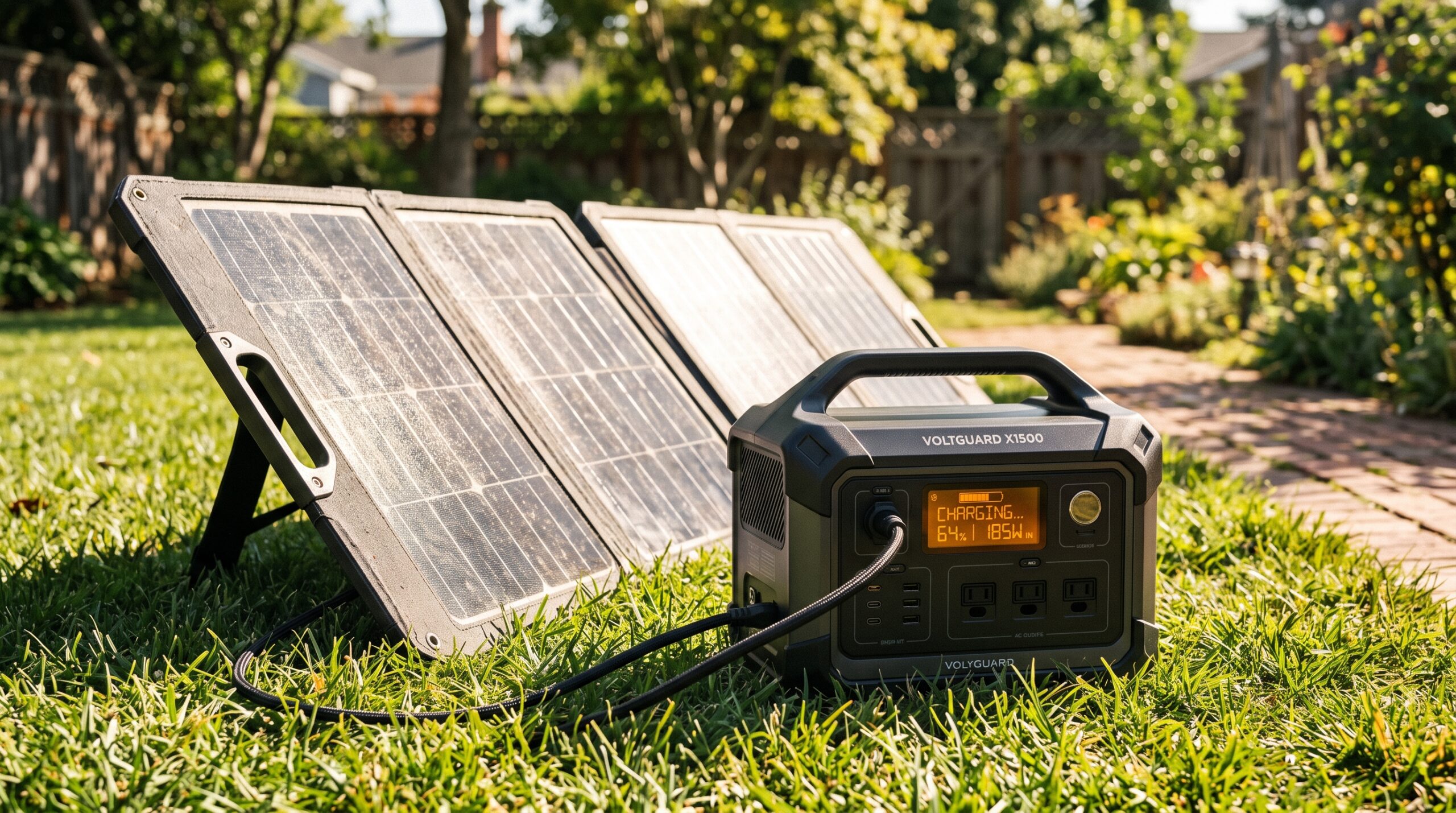
The math for solar charging is short: charge time in hours roughly equals your battery capacity in watt-hours divided by the panel’s rated watts, multiplied by a reality factor of about 0.7. A 1,000Wh station with a 200W panel needs around 1,000 ÷ (200 × 0.7) = roughly 7 hours of strong sun. Since most places only deliver 3 to 6 hours of strong sun per day, that single number often means more than one day, not one afternoon.
The formula for solar charge time
Start with two numbers you already know: the battery’s capacity (printed on the unit, like 1024Wh) and the rated wattage of the panels you plan to use (like 200W). The clean version of the formula is:
Charge time (hours) ≈ battery capacity (Wh) ÷ (rated panel watts × derate)
The derate is the part beginners skip. Spec sheets test panels in a lab at 1000 W/m² and 25°C with the panel aimed straight at the light. Your driveway is not a lab. Use a derate of about 0.7 for a portable panel propped on the ground, and maybe 0.8 if it is cool out and you keep the panel angled at the sun.
That gives you a number in “panel-hours” of full sun. The second step, which most people forget, is converting panel-hours into real days using peak sun hours. More on that below.
Why rated panel watts overpromise
A “200W” panel rarely sends 200 watts into your power station. Field testing and panel manuals both land in the same place: a panel typically delivers 60 to 80 percent of its rating once it is sitting outside in the real world. A 100W panel that puts out 60 to 80 watts is normal, not defective.
Several losses stack up at once:
- Sun angle. A panel flat on the ground at 10 a.m. catches sunlight at a shallow angle and loses output. Aiming it square at the sun is the single biggest free upgrade.
- Heat. Panels are rated at 25°C (77°F). On a hot day a panel face can hit 50 to 60°C, and output drops about 0.3 to 0.4 percent for every degree above 25. Ironically, the brightest summer afternoons cost you efficiency.
- Clouds, haze, and shade. A thin cloud passing over can cut output in half for a minute. A shadow across even one corner of the panel drags the whole string down.
- Charge controller and wiring losses. The MPPT controller inside the unit and the cable between panel and station each shave off a few percent.
- Panel mismatch. Two panels chained together only perform as well as the weaker one.
This is why the 0.7 factor exists. It is not pessimism. It is the gap between a lab and your back yard, baked into one number. If you want the deeper version of this, see how a solar generator actually works.
Peak sun hours decide whether you finish in a day
One peak sun hour equals one hour of sunlight at 1000 watts per square meter, the lab condition. A day might have 12 hours of daylight but only deliver 4 or 5 peak sun hours, because early morning and late evening sun is weak and angled.
Using NREL’s solar data, the continental US averages roughly 4 to 5 peak sun hours per day, but the spread is large and seasonal:
- Desert Southwest (Arizona, Nevada, New Mexico): about 6 to 6.5 peak sun hours, fairly steady year-round.
- Most of the country: about 4 to 5 in summer, dropping noticeably in winter.
- Pacific Northwest and northern tier in winter: as low as 2 to 3 peak sun hours on a clear short day, less when overcast.
This is the part that catches people. Your formula might say a station needs 7 panel-hours. In Phoenix in June that fits inside one day with hours to spare. In Seattle in December, 7 panel-hours against 2.5 peak sun hours per day is closer to three days of charging. The panel is fine. The sky is the limit.
Charge time table: capacity vs panel watts
The table below uses the 0.7 derate to get effective watts, divides capacity by that to get panel-hours, then shows how those hours land on a good sunny day (5 peak sun hours) versus a weak winter day (3 peak sun hours). Numbers are rounded and assume charging from near-empty to full.
| Station capacity | Panel array (rated) | Effective watts (×0.7) | Panel-hours needed | Good day (5 PSH) | Winter day (3 PSH) |
|---|---|---|---|---|---|
| 300 Wh | 100 W | ~70 W | ~4.3 hrs | About 1 day | ~1.5 days |
| 500 Wh | 200 W | ~140 W | ~3.6 hrs | Under 1 day | ~1.2 days |
| 1,000 Wh | 200 W | ~140 W | ~7.1 hrs | ~1.5 days | ~2.4 days |
| 1,000 Wh | 400 W | ~280 W | ~3.6 hrs | Under 1 day | ~1.2 days |
| 2,000 Wh | 400 W | ~280 W | ~7.1 hrs | ~1.5 days | ~2.4 days |
| 2,000 Wh | 800 W | ~560 W | ~3.6 hrs | Under 1 day | ~1.2 days |
| 3,600 Wh | 1,000 W | ~700 W | ~5.1 hrs | ~1 day | ~1.7 days |
The pattern is clear: doubling panel wattage roughly halves the panel-hours, and a single mid-size panel on a big battery almost never finishes in one day. To pin down the exact array for your unit and location, run your own numbers through the solar charging calculator, and cross-check the panel count against the guide on how many solar panels you need to recharge a power station.
What slows solar charging down
Beyond the basic derate, a few specific things quietly cap your charge speed:
- The unit’s max solar input. Every station has a ceiling. A Jackery Explorer 1000 v2 accepts up to 800W of solar; an EcoFlow DELTA 2 Max tops out near 1,000W; a Bluetti AC200MAX caps around 900W. Connect 1,200W of panels to an 800W unit and the controller simply ignores the extra. Buying more panel than the input can swallow wastes money.
- MPPT vs PWM. Power stations use MPPT charge controllers, which constantly hunt for the panel’s best voltage and harvest more in marginal light. Cheap standalone PWM controllers can lose 20 to 30 percent by comparison. If you are pairing a generic panel with a station, MPPT is already built in, which is good news.
- Heat throttling. Hot panels lose voltage, and a hot power station can dial back its own charge rate to protect the battery. Shade the station (not the panel) on scorching days.
- Voltage window. Most units need the panel string to hit a minimum voltage before charging even starts. One small panel in dim light may produce nothing until the sun climbs.
If your readings still look low after checking all this, the general guide to charging a power station walks through wall, car, and solar inputs and where each tends to bottleneck.
How to charge faster on solar
You cannot change the sun, but you can stop leaving watts on the table:
- Match panel wattage to the unit’s max input. Get close to the ceiling without going far over. A 1,000Wh station that accepts 500W input charges much faster on 400 to 500W of panel than on a single 100W folding panel.
- Tilt toward the sun, not flat. Prop the panel at roughly your latitude angle and face it south. This alone can recover 20 to 30 percent versus laying it flat.
- Reposition at midday. The sun moves. Nudging the panel two or three times across the day keeps it near square-on and meaningfully raises the daily total.
- Keep the whole panel in sun. Watch for a fence post, antenna, or tree branch shadow creeping across a corner. Shade on one cell can crater the whole panel.
- Wipe off dust and pollen. A dirty face quietly costs a few percent every day.
- Charge while the unit runs, if it allows it. Many stations pass solar straight through to your loads, so you can top up and power a fridge at the same time.
Picking the panel itself matters too. A higher-efficiency, well-built panel holds a bigger share of its rating in real conditions; the roundup of the best portable solar panels compares real-world output, not just sticker watts.
Panels by class, live prices


As an Amazon Associate we earn from qualifying purchases. Prices are pulled automatically from Amazon and may have changed.
Frequently asked questions
How long does it take to charge a 1,000Wh power station with solar?
With a 200W panel and a 0.7 derate, you get about 140 effective watts, so roughly 7 panel-hours of strong sun. On a good 5-peak-sun-hour day that is about a day and a half. With a 400W panel it drops to under one good day. Cloudy or winter conditions push it longer.
Why is my power station charging slower than the spec sheet says?
The advertised time assumes lab-perfect sun aimed straight at the panel. In practice the panel delivers 60 to 80 percent of its rating, and you only get a handful of peak sun hours per day. Sun angle, heat, haze, dust, and a low winter sun all eat into the rate. A slower real-world number is expected, not a fault.
Can I just add more panels to charge faster?
Only up to the unit’s maximum solar input. If your station caps at 800W, plugging in 1,200W of panels gives you 800W at best, and the controller discards the rest. More panel helps mainly in weak light, where extra surface area partly makes up for low intensity. Check your model’s rated max input before buying.
Does cold weather hurt solar charging?
Cold air actually helps panel efficiency a little. The real winter problem is fewer and weaker peak sun hours, plus a low sun angle and short days. Northern regions can drop to 2 to 3 peak sun hours in December, which is what stretches charge time across multiple days, not the temperature.
Is solar charging fast enough for a power outage?
It can be, if the panel array is sized for daily use rather than a one-time top-up. Solar shines for multi-day outages where you recharge each day to cover that day’s loads. For a fast single recharge, wall power is far quicker. Many people keep both: wall charging when the grid is up, solar to extend runtime when it is not.
Sources
- Jackery — Peak Sun Hours: How Many Peak Sun Hours Needed to Go Solar
- NREL — Solar Resource Maps and Data (NSRDB / PVWatts)
- EcoFlow — How Volts, Amps & Watts Affect Power Station Charging
- Jackery — Solar Panels Complete Guide (charging times and max input)
- BLUETTI — AC200MAX specifications (900W max solar input)