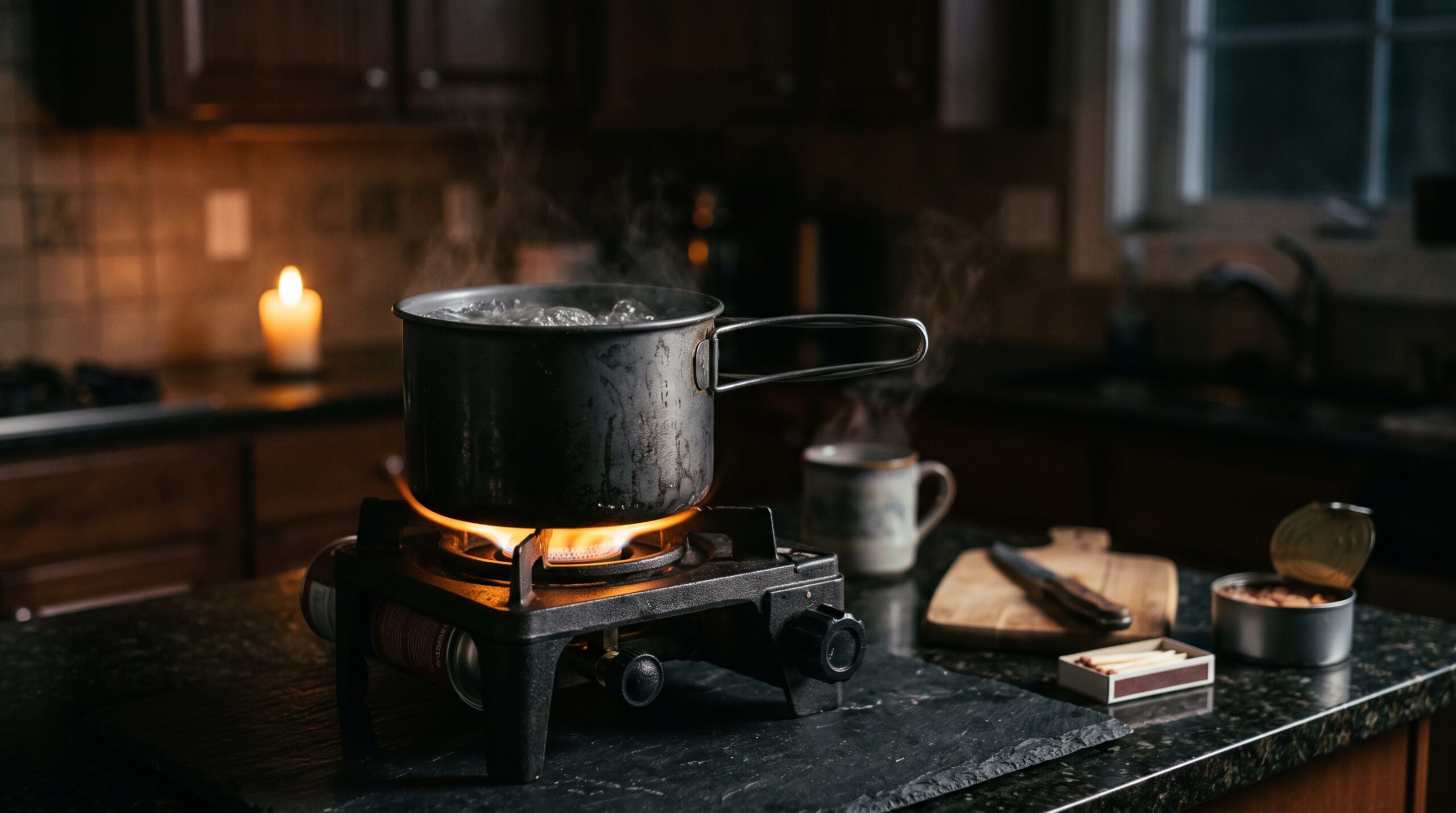
When the power goes out, your electric stove, microwave, and plug-in kettle all go dark with it. The good news is that boiling water rarely depends on the grid, because most reliable methods burn fuel or run off a battery instead. Below are the practical ways to get a pot boiling during an outage, along with the one safety rule that matters more than the method you choose.
Gas stovetops usually keep working
A gas range burns natural gas or propane, so the burners themselves do not need household electricity. The part that fails is the electronic igniter, which clicks but will not spark without power. If the burner does not light on its own, turn the knob to a low setting and hold a long match or a lighter near the burner edge until the flame catches, then adjust the flame. Do not let gas flow for more than a few seconds without a flame, and stop right away if you smell gas.
A gas stovetop is the one combustion appliance built to be used indoors. It vents into your kitchen the same way it does on a normal day, so boiling a pot of water on it during an outage is fine. For full meals beyond boiling water, see our guide on how to cook without power.
Outdoor-only methods: camp stoves, grills, and charcoal
Propane camp stoves, gas grills, and charcoal grills all boil water quickly, and every one of them belongs outside. These devices give off carbon monoxide, a gas you cannot see or smell that builds up fast in a home, garage, or any partly enclosed space. Ready.gov and the American Red Cross both say to run them outdoors only and keep them well away from windows, doors, and vents. A common guideline is at least 20 feet from the house.
- Propane camp stove: Lights fast and boils a pot in a few minutes. Set it on a flat, stable surface outdoors.
- Gas grill: Use the side burner if it has one, or set a metal pot directly on the grate with the lid up.
- Charcoal grill: Let the coals burn down to a white-ash stage, then set a pot over them. Charcoal puts out especially high levels of carbon monoxide, so never bring it inside.
- Rocket or twig stove: Burns small sticks efficiently and works well outdoors when fuel canisters run low.
Portable butane burners need real ventilation
Single-burner butane stoves, the kind used at buffets and for tabletop cooking, are popular as an outage backup because they are cheap and compact. They still burn fuel and still produce carbon monoxide, so treat them like any other camp stove. The safest choice is to use one outdoors. If that is not possible, run it only in a space with strong cross-ventilation, such as near a wide-open window or door, and never in a small closed room. Keep a spare fuel canister on hand, since each one boils only a limited number of pots.
Wood stoves, fireplaces, and solar cookers
If you heat with a wood stove or an insert that has a flat top, it doubles as a cooktop. Because it vents through its own chimney flue, you can safely boil water on it indoors while it is running. An open fireplace can also bring water to a boil if you suspend a pot over the flames, though it heats slowly and unevenly and coats the pot in soot.
On a clear day, a solar cooker or solar oven boils water using only sunlight, with no fuel and no fumes. It is slow and depends on the weather, but it is a genuinely safe option when you have time and sun. A rocket stove covers the same need on cloudy days as long as you use it outside.
Run an electric kettle from a power station
A portable power station can run a normal electric kettle or a plug-in induction burner, which means you can boil water indoors with no flame and no fumes. The catch is wattage. A US electric kettle typically draws around 1,500 watts, and an induction cooktop pulls roughly 1,200 to 1,800 watts, so the power station’s inverter has to be rated for that continuous output. Smaller units that top out at a few hundred watts will simply shut off.
Battery capacity is usually the easier part. Boiling a small pot only takes a couple of minutes, so it draws a modest slice of the battery even at high wattage. The wattage rating is the real limit, not the stored energy. The same logic applies to other quick, high-draw appliances, which is why we walk through the numbers in how long a power station will run a microwave. Keeping a charged unit in your power outage emergency kit gives you a fume-free way to heat water indoors.
Never run combustion gear indoors
This is the rule that decides whether these methods are safe. The American Red Cross says never to use a generator, grill, camp stove, or any gasoline, propane, natural gas, or charcoal-burning device inside a home, garage, basement, crawlspace, or partially enclosed area. Opening a door or window or running a fan does not clear carbon monoxide fast enough to protect you. The gas can build to dangerous levels before you notice anything wrong.
The two exceptions are appliances designed and vented for indoor use: your gas kitchen stove and a wood stove connected to a flue. Everything else stays outside. Install carbon monoxide alarms on each level of your home, and if one sounds, get to fresh air outdoors and call for help from there. For the full picture, read our guide on carbon monoxide safety during a power outage.
Make the boiled water safe to drink
If your area is under a boil water advisory, or you are drawing from an unknown source, boiling does double duty by killing germs as well as heating the water. The CDC says to bring clear water to a rolling boil for one minute, and for three minutes if you are above about 6,500 feet in elevation, where water boils at a lower temperature. The EPA gives the same one-minute guidance. A rolling boil means a steady, churning bubble, not just the first small bubbles forming.
If the water is cloudy, let it settle and filter it through a clean cloth or coffee filter before boiling. After boiling, let the water cool and store it in a clean container with a lid. One important limit: boiling kills bacteria, viruses, and parasites, but it does not remove chemicals, lead, or other heavy metals. If those are the concern, use bottled water instead. For other approaches when boiling is not enough, see how to purify water during an emergency.
Frequently asked questions
Can I boil water on a gas grill during a power outage?
Yes. A gas grill will boil a pot of water just fine, but only outdoors. Set the pot on the grate or a side burner with the lid up, and keep the grill well away from windows and doors so carbon monoxide cannot drift inside.
How long do I need to boil water to make it safe to drink?
The CDC recommends a rolling boil for one minute at most elevations, and three minutes if you are above roughly 6,500 feet. That inactivates the great majority of disease-causing germs. Boiling does not remove chemical contaminants, so use bottled water if chemicals or metals are the concern.
Is it safe to use a portable camping stove indoors?
No. Camp stoves, including small butane burners, produce carbon monoxide and are meant for outdoor use. If you have no outdoor option, use one only with strong cross-ventilation near a wide-open window, never in a closed room, and stop if you feel dizzy or develop a headache.
Will a portable power station boil water?
Yes, as long as its inverter can handle the load. An electric kettle draws around 1,500 watts, so the power station needs a continuous output rating above that. Boiling is quick, so battery capacity is rarely the limit; the wattage rating is what matters.
Does boiling remove chemicals or lead from water?
No. Boiling kills bacteria, viruses, and parasites, but it does not remove chemicals, lead, or other heavy metals, and it can even concentrate some of them as water evaporates. For those contaminants, use commercially bottled water or an appropriate filter instead.